
[论文解读] The NANOGrav 15-year Data Set: Search for Anisotropy in the Gravitational-Wave Background
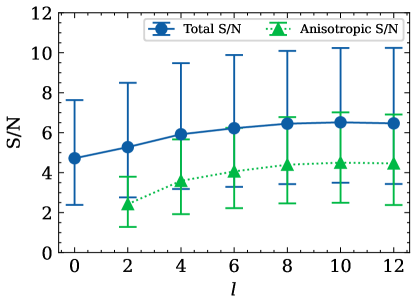
本论文报道使用 NANOGrav 15 年数据集搜索 nanohertz GWB 的各向异性;未发现显著各向异性,95% 的贝叶斯上限为 (C_l>0 / C_l=0) < 20%,模拟表明数据对预测的较大一部分各向异性是敏感的。
The North American Nanohertz Observatory for Gravitational Waves (NANOGrav) has reported evidence for the presence of an isotropic nanohertz gravitational wave background (GWB) in its 15 yr dataset. However, if the GWB is produced by a population of inspiraling supermassive black hole binary (SMBHB) systems, then the background is predicted to be anisotropic, depending on the distribution of these systems in the local Universe and the statistical properties of the SMBHB population. In this work, we search for anisotropy in the GWB using multiple methods and bases to describe the distribution of the GWB power on the sky. We do not find significant evidence of anisotropy, and place a Bayesian $95\%$ upper limit on the level of broadband anisotropy such that $(C_{l>0} / C_{l=0}) < 20\%$. We also derive conservative estimates on the anisotropy expected from a random distribution of SMBHB systems using astrophysical simulations conditioned on the isotropic GWB inferred in the 15-yr dataset, and show that this dataset has sufficient sensitivity to probe a large fraction of the predicted level of anisotropy. We end by highlighting the opportunities and challenges in searching for anisotropy in pulsar timing array data.
研究动机与目标
- 由于宿主星系分布和源属性,SMBHB 主导的 GWB 可能具有各向异性这一预期的动机和量化。
- 描述使用多种天空基表示和贝叶斯/频率分析管道的全面 GWB 各向异性搜索。
- 对带宽的各向异性给出上限,并评估数据对现实水平的各向异性的敏感性。
- 将结果与以各向同性 GWB 为条件的天体物理模拟进行情境化解释,以解读对 SMBHB 群体的含义。
提出的方法
- 使用 radiometer 像素和球谐基来建模 GWB 的各向异性,以描述天空功率分布。
- 使用平方根球谐基来强制 GWB 功率的正定性并计算角功率谱 C_l。
- 实现贝叶斯和频率分析管道来评估各向异性,包括通过先验与后验之间的Hellinger距离进行比较。
- 用包含地球项与脉冲星项贡献的重叠削减函数(ORF)表示并据此计算天空积分的 ORF。
- 用 C_l 来量化各向异性,并在幂律 GWB 谱和自由谱方法下评估带宽各向异性。
实验结果
研究问题
- RQ1NANOGrav 15 年数据中是否检测到在纳赫兹频率范围内的显著各向异性?
- RQ2在当前 PTA 敏感度下, monopole 之外的角功率谱(C_l)的约束是多少?
- RQ3在 GWB 幂律模型下以及模型无关谱下,数据如何约束带宽各向异性?
- RQ4NANOGrav 15 年观测是否足以探测到来自 SMBHB 群体的理论预测的各向异性水平?
- RQ5不同基选择(辐射计像素 vs 球谐函数)在捕捉潜在各向异性方面的比较如何?
主要发现
- 在 NANOGrav 15 年数据中未检测到 GWB 各向异性的显著证据。
- 建立带宽各向异性的贝叶斯 95% 上限为 (C_l>0 / C_l=0) < 20%。
- 以各向同性 GWB 为条件的天体物理模拟表明数据集具有足够的敏感性去探测预测的巨大一部分各向异性。
- 分析使用多种基底(辐射计像素和球谐函数,包括平方根形式)以及贝叶斯和频率分析管道。
- 本工作强调在脉冲星定时阵列中继续搜索各向异性所面临的机会与挑战。

更好的研究,从现在开始
从论文设计到论文写作,大幅缩短您的研究时间。
无需绑定信用卡
本解读由 AI 生成,并经人工编辑审核。