
[论文解读] The Next Generation Deep Extragalactic Exploratory Public (NGDEEP) Survey
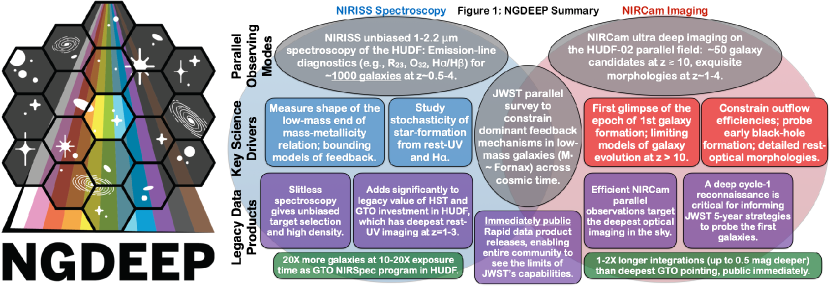
NGDEEP 是 JWST 第1周期的宝库计划,结合 HUDF 的深度 NIRISS slitless 光谱学与 HUDF-Par2 的并行 NIRCam 成像,以研究 across 0.5 < z < 4 的低质量星系的反馈,并推动 rest-UV LF 到 z > 12。
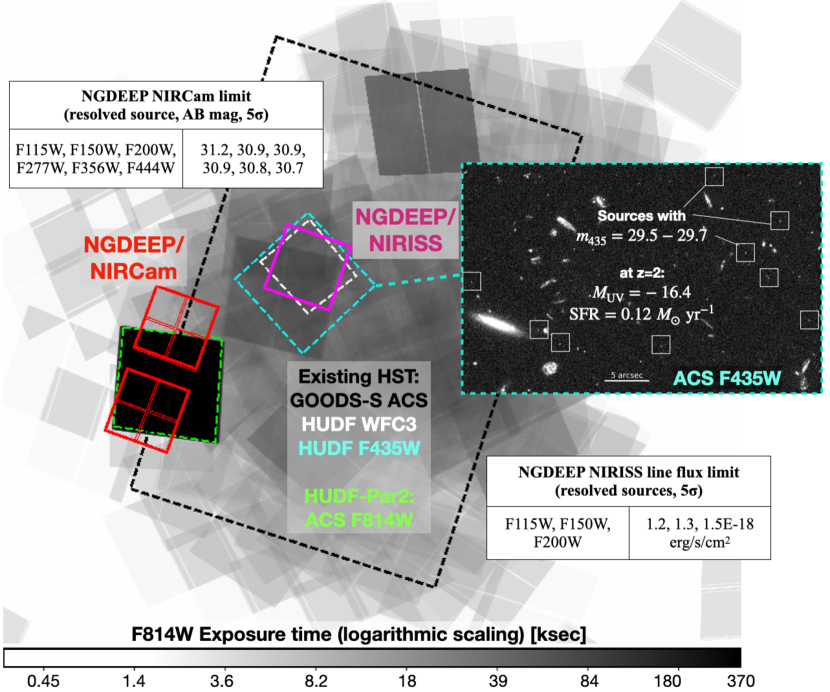
We present the Next Generation Deep Extragalactic Exploratory Public (NGDEEP) Survey, a deep slitless spectroscopic and imaging Cycle 1 JWST treasury survey designed to constrain feedback mechanisms in low-mass galaxies across cosmic time. NGDEEP targets the Hubble Ultra Deep Field (HUDF) with NIRISS slitless spectroscopy (f~1.2e-18 erg/s/cm^2, 5sigma) to measure metallicities and star-formation rates (SFRs) for low-mass galaxies through the peak of the cosmic SFR density (0.512, constraining the slope of the faint-end of the rest-ultraviolet luminosity function. NGDEEP overlaps with the deepest HST ACS optical imaging in the sky: F435W in the HUDF (m=29.6), and F814W in HUDF-Par2 (m=30), making this a premier HST+JWST Deep Field. As a treasury survey, NGDEEP data is public immediately, and we will rapidly release data products and catalogs in the spirit of previous deep field initiatives. In this paper we present the NGDEEP survey design, summarize the science goals, and detail plans for the public release of NGDEEP reduced data products.
研究动机与目标
- 通过测量来自深度 slitless 光谱的金属丰度与星形成率来约束随宇宙时间演化的低质量星系的反馈机制。
- 表征质量-金属关系(MZR)的低质量端及其随 redshift 的演化(z ~ 0.5–4)。
- 通过并行场的深度 NIRCam 成像探测 z > 9–15 的 rest-UV 光度函数的暗端。
- 利用公开的 treasure-data 发布,推动社区范围内的深场 JWST 科学研究。
提出的方法
- 在 HUDF 的 NIRISS WFSS(NGDEEP-NIS)以检测≥1000 颗星系、深度达到 ~1.2–1.5 × 10^-18 erg s^-1 cm^-2(5σ)在 1–2.2 μm 的多线性分布(emission lines)。
- 在 HUDF-Par2 的 NIRCam 并行成像(NGDEEP-NRC)达到 6 过滤器、在 ~1–5 μm 范围内,5σ 深度 30.6–30.9 AB 星等。
- 两种 NIRISS 梯形光栅取向与两种相位角,间隔约 3 度,以改进污染建模与线-ID。
- 端到端的模拟与 JWST ETC 基于的深度预测,以预测发射线计数与连续光限。
- 公开数据发布计划,按照深场先例进行快速产物与目录发布。
- 与 JADES/MDS/binning 进行比较,以评估高-z 星系选择中的深度与场覆盖。
实验结果
研究问题
- RQ10.5 < z < 4 的质量-金属关系(MZR)低质量端斜率及其随红移的演化如何?
- RQ2在低质量星系中基于 Hα 的 SFR 与基于 UV 的 SFR 有何差异,且在 z ~ 1–2 的 M* ≲ 10^9 M⊙ 下,星形成主序的固有散布是多少?
- RQ3在 z > 9–15 的 rest-UV 光度函数暗端的斜率是多少,它如何约束早期星系形成与反馈模型?
- RQ4观测到的金属丰度、SFR 与形态如何约束理论模型与星系演化模拟中的反馈设定?
- RQ5NGDEEP-NRC 场中预期的 z > 10–15 星系产出率是多少,这对高 redshift 星系形成情景有何启示?
主要发现
| Line or Index | Number (3σ) | Number (5σ) | Redshift Range |
|---|---|---|---|
| Any line | 2266 | 1601 | |
| Ly α λ1216 | 6 | 1 | 7.22–17.09 |
| Mg II λλ2796,2804 | 40 | 19 | 2.57–6.87 |
| [O II] λλ3727,3730 | 464 | 307 | 1.68–4.90 |
| [Ne III] λ3870 | 40 | 8 | 1.58–4.68 |
| Hβ λ4863 | 289 | 162 | 1.06–3.52 |
| [O III] λ5008 | 837 | 618 | 1.00–3.39 |
| Hα λ6565 | 965 | 676 | 0.52–2.35 |
| [S II] λλ6718,6732 | 156 | 96 | 0.49–2.27 |
- NGDEEP-NIS 将在 z ~ 0.5–4 的 >350 颗星系中测量多线性金属丰度,覆盖 log(M*/M⊙) ≈ 7 的下限,检验低质量 MZR 的预测。
- 在 0.7 ≲ z ≲ 2.3 的 ~1000 颗低质量星系中,基于 Hα 的 SFR 约为 ≈0.1 M⊙ yr^-1,将量化 SFR 的随机性与 SFMS 的散布。
- NGDEEP-NIS 将检测 >1000 颗在 z ≲ 5 的 3σ–5σ 发射线星系,使 R23 与 Ne3O2 等金属丰度诊断在更高 redshift 下可用。
- NGDEEP-NRC 将发现 ~30–100 颗在 z > 11 的星系,并将 rest-UV 光度函数暗端的约束扩展到 z ~ 14–15。
- NGDEEP 提供的深度比 JADES 在关键滤波上深约 0.3–0.5 等级, enabling robust z > 9 的 dropout 选择与 Lyα-break 研究。
- 总体而言,NGDEEP 将使金属丰度的上限在 ~0.2 dex 的范围内扩展 MZR 与 SFMS 的约束,并揭示跨越宇宙时间的低质量星系演化。
更好的研究,从现在开始
从论文设计到论文写作,大幅缩短您的研究时间。
无需绑定信用卡
本解读由 AI 生成,并经人工编辑审核。