
[论文解读] The opacity limit
本文重新評估了恆星形成中的光學厚度極限,推導出在不同輻射場與塵埃消光定律下,塵埃冷卻的塌縮氣體團塊熱演化的一致表達式。結果顯示,在弱輻射或低塵環境中,最小 Jeans 質量 $M_{\rm J}^{\rm min}$ 的尺度為 $A_{\rm d}^{-1/11}$ 至 $A_{\rm d}^{-1/15}$;而在強輻射與高塵條件下,則為 $A_{\rm d}^{1/3}$ —— 這表明在星系中心或高紅移星團等致密、多塵區域,初始質量函數可能不那麼底重。
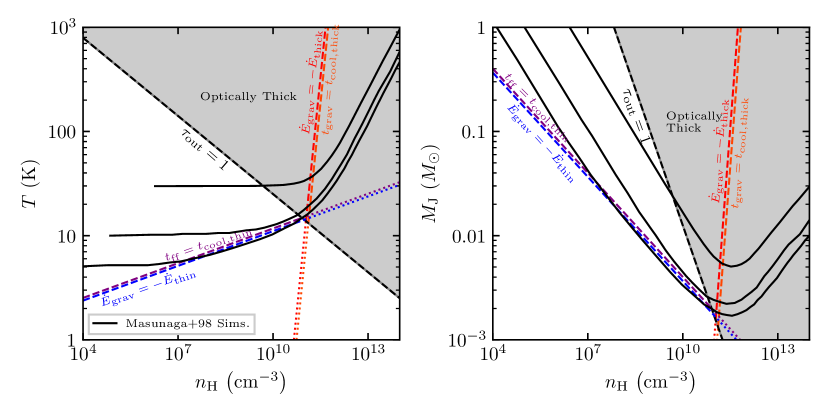
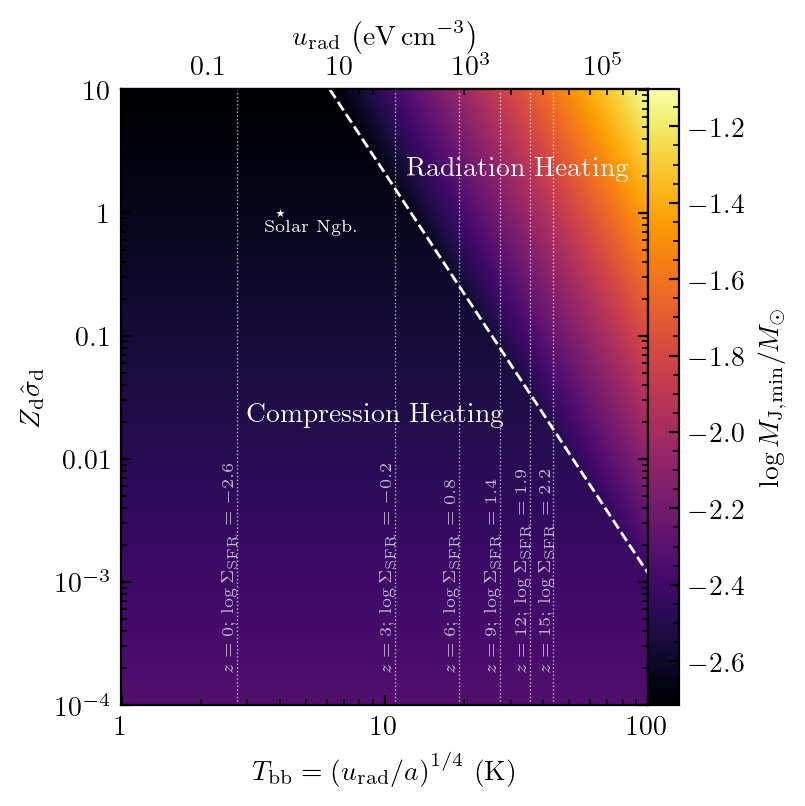
The opacity limit is an important concept in star formation: isothermal collapse cannot proceed without limit, because eventually cooling radiation is trapped and the temperature rises quasi-adiabatically, setting a minimum Jeans mass $M_{ m J}^{ m min}$. Various works have considered this scenario and derived expressions for $M_{ m J}^{ m min}$, generally $\sim 10^{-3}-10^{-2}M_\odot$ in normal star-forming conditions, but with conflicting results about the scaling with ambient conditions and material properties. We derive expressions for the thermal evolution of dust-cooled collapsing gas clumps in various limiting cases, given a general ambient radiation field ($u_{ m rad}$, $T_{ m rad}$) and a general power-law dust opacity law $σ_{ m d} = A_{ m d} T^β$. By accounting for temperature evolution self-consistently we rule out a previously-proposed regime in which the adiabatic transition occurs while the core is still optically-thin. If the radiation field is weak or dust opacity is small, $M_{ m J}^{ m min}$ is insensitive to dust properties/abundance ($\sim A_{ m d}^{-\frac{1}{11}}-A_{ m d}^{-\frac{1}{15}}$), but if the radiation field is strong and dust is abundant it scales $\propto A_{ m d}^{1/3}$. This could make the IMF less bottom-heavy in dust-rich and/or radiation-dense environments, e.g. galactic centers, starburst galaxies, massive high-$z$ galaxies, and proto-star clusters that are already luminous.
研究动机与目标
- 解決文獻中關於最小 Jeans 質量 ($M_{\rm J}^{\rm min}$) 與塵埃性質及周圍條件在恆星形成中關係的衝突結果。
- 透過一致建模塌縮過程中的溫度演化,修正先前研究中錯誤的假設——特別是「當光學厚度 $\tau \gtrsim 1$ 時發生絕熱過渡」的觀點。
- 推導出在各種漸近區域中,光學厚度限制的 Jeans 質量與過渡密度 ($n_{\rm ad}$) 的一般表達式,同時考慮壓縮加熱與輻射場效應。
- 評估環境變化對 $M_{\rm J}^{\rm min}$ 的影響,及其對初始質量函數 (IMF) 的含義,特別是在星系中心或高紅移星團等極端環境中。
- 提供一個統一且物理一致的光學厚度極限框架,使用經過輻射流體力學模擬驗證的校準近似。
提出的方法
- 推導在一般幂律塵埃消光定律 $\sigma_{\rm d} = A_{\rm d} T^{\beta}$ 與周圍輻射場 ($u_{\rm rad}, T_{\rm rad}$) 下,塵埃冷卻、自引力氣體團塊的熱演化。
- 識別出兩個關鍵區域:壓縮加熱極限(類似於 Low & Lynden-Bell 1976)與輻射加熱極限(推廣自 Masunaga & Inutsuka 1999),其中較大者決定 $M_{\rm J}^{\rm min}$。
- 在高密度、高光學厚度極限下,使用漸近近似來處理溫度演化,避免假設僅當 $\tau \gtrsim 1$ 時即觸發絕熱行為。
- 應用量綱分析與尺度論證,推導出 $M_{\rm J}^{\rm min}$ 與 $n_{\rm ad}$ 的解析表達式,並經由一維輻射流體力學模擬驗證。
- 評估 $M_{\rm J}^{\rm min}$ 對塵埃豐度 $A_{\rm d}$、輻射場強度與金屬豐度的依賴關係,區分弱輻射場與強輻射場區域。
- 將結果整合至 IMF 形成的更廣泛脈絡中,與湍流破碎及原恆星反饋等其他機制對碎片質量的調節作用進行比較。
实验结果
研究问题
- RQ1塌縮中塵埃冷卻的氣體團塊中, quasi-adiabatic 漸近演化的正確物理條件是什麼?為何 $\tau \gtrsim 1$ 條件不充分?
- RQ2在不同天體物理環境中,最小 Jeans 質量 $M_{\rm J}^{\rm min}$ 如何隨塵埃豐度 $A_{\rm d}$ 與周圍輻射場強度變化?
- RQ3在何種區域中,光學厚度極限會主導其他碎片機制(如湍流破碎或原恆星反饋)對 IMF 的調節作用?
- RQ4為何先前研究對 $M_{\rm J}^{\rm min}$ 與塵埃消光的依賴關係得出衝突結論?哪些假設導致了 $M_{\rm J}^{\rm min} \propto A_{\rm d}^{-1}$ 之類的非物理結果?
- RQ5金屬豐度與輻射場強度等環境因素如何影響光學厚度限制的 Jeans 質量?對極端恆星形成區域中 IMF 的含義為何?
主要发现
- 絕熱過渡並非發生於 $\tau \gtrsim 1$;其真正取決於壓縮加熱與輻射能量傳導之間的平衡,因此先前認為在光學薄核心中即開始絕熱演化的區域是錯誤的。
- 在弱輻射場或低塵環境中,$M_{\rm J}^{\rm min} \propto A_{\rm d}^{-1/11}$ 至 $A_{\rm d}^{-1/15}$,顯示對塵埃豐度的敏感度極弱。
- 在強輻射場且塵埃豐富的環境中,$M_{\rm J}^{\rm min} \propto A_{\rm d}^{1/3}$,表示 $M_{\rm J}^{\rm min}$ 隨塵埃豐度增加而增加,可能使此類環境中的 IMF 不那麼底重。
- 最小 Jeans 質量由兩種極限中的較大者決定:壓縮加熱極限(Low & Lynden-Bell 1976)與輻射加熱極限(推廣自 Masunaga & Inutsuka 1999),後者在高輻射、高塵條件下主導。
- 推導出的 $M_{\rm J}^{\rm min}$ 對 $A_{\rm d}$ 與輻射場強度的依賴關係表明,光學厚度極限可能在星系中心或高紅移星團等致密多塵區域中,對 IMF 的調節作用更為顯著。
- 本研究透過顯示 Masunaga & Inutsuka (1999) 所得的 $A_{\rm d}^{-1}$ 比例為非物理結果,並歸因於對絕熱過渡條件的錯誤假設,從而調和了文獻中的衝突結論。
更好的研究,从现在开始
从阅读论文到最终审阅,大幅缩短您的研究时间。
无需绑定信用卡
本解读由 AI 生成,并经人工编辑审核。