
[论文解读] The Physics of (good) LDPC Codes I. Gauging and dualities
本文通过规范理论和非欧几里得几何上的对偶性,建立了一个统一的基于物理的框架,用于理解良好的经典和量子 LDPC 码,以链复形作为数学基础。它表明所有已知的良好量子 LDPC 码均源于对局部可测试经典码的规范化,通过广义对偶变换构造自旋玻璃哈密顿量,揭示了其与对称保护拓扑相及链复形上的 $Χ_2$ 规范理论的联系。
Low-depth parity check (LDPC) codes are a paradigm of error correction that allow for spatially non-local interactions between (qu)bits, while still enforcing that each (qu)bit interacts only with finitely many others. On expander graphs, they can give rise to ``good codes'' that combine a finite encoding rate with an optimal scaling of the code distance, which governs the code's robustness against noise. Such codes have garnered much recent attention due to two breakthrough developments: the construction of good quantum LDPC codes and good locally testable classical LDPC codes, using similar methods. Here we explore these developments from a physics lens, establishing connections between LDPC codes and ordered phases of matter defined for systems with non-local interactions and on non-Euclidean geometries. We generalize the physical notions of Kramers-Wannier (KW) dualities and gauge theories to this context, using the notion of chain complexes as an organizing principle. We discuss gauge theories based on generic classical LDPC codes and make a distinction between two classes, based on whether their excitations are point-like or extended. For the former, we describe KW dualities, analogous to the 1D Ising model and describe the role played by ``boundary conditions''. For the latter we generalize Wegner's duality to obtain generic quantum LDPC codes within the deconfined phase of a Z_2 gauge theory. We show that all known examples of good quantum LDPC codes are obtained by gauging locally testable classical codes. We also construct cluster Hamiltonians from arbitrary classical codes, related to the Higgs phase of the gauge theory, and formulate generalizations of the Kennedy-Tasaki duality transformation. We use the chain complex language to discuss edge modes and non-local order parameters for these models, initiating the study of SPT phases in non-Euclidean geometries.
研究动机与目标
- 通过凝聚态物理和规范理论的视角,统一理解良好经典和量子 LDPC 码。
- 使用链复形将 Kramers-Wannier 和 Wegner 对偶性推广至非局域、非欧几里得设置。
- 通过证明良好量子 LDPC 码源于对局部可测试经典码的规范化,阐明其物理起源。
- 通过广义 Kennedy-Tasaki 对偶性,从任意经典码构造自旋玻璃哈密顿量。
- 使用链复形形式化,启动对非欧几里得几何中对称保护拓扑相的研究。
提出的方法
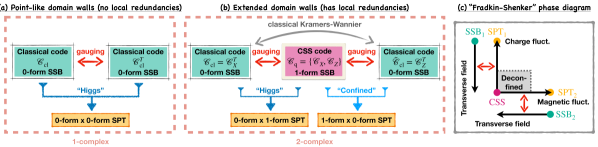
- 使用链复形作为统一的数学语言,描述经典和量子 LDPC 码,其中映射 $\delta_1$、$\tilde{\delta}_1$、$\delta_2$、$\tilde{\delta}_2$ 编码校验和稳定算符结构。
- 对横向磁场中的经典码应用规范化程序,生成具有 $\mathbb{Z}_2$ 规范结构的量子哈密顿量。
- 引入一个耦合规范理论框架,其哈密顿量为 $H_{\text{CSS}} = -J_x \sum_i \prod_{a \in \delta_1^T(i)} \tau_a^x - J_z \sum_p \prod_{a \in \tilde{\delta}_2(p)} \tau_a^z - K_z \sum_q \prod_{a \in \delta_2(q)} \tau_a^z - K_x \sum_j \prod_{a \in \tilde{\delta}_1^T(j)} \tau_a^x$。
- 在强耦合极限 $\lambda \to \infty$ 下投影到子空间,使得 $\tilde{\tau}_a^x = \tau_a^z$ 且 $\tilde{\tau}_a^z = \tau_a^x$,从而恢复 CSS 哈密顿量。
- 应用广义 Kennedy-Tasaki 对偶性,将经典码与自旋玻璃哈密顿量联系起来,实现具有拓扑序的模型的构造。
实验结果
研究问题
- RQ1良好的量子 LDPC 码的构造能否被理解为经典码的物理规范化过程?
- RQ2Kramers-Wannier 对偶性在具有非局域相互作用和非欧几里得几何的系统中扮演什么角色?
- RQ3LDPC 码中的激发态——点状与扩展态——如何决定对偶性和相结构的性质?
- RQ4能否通过广义对偶性系统地从任意经典 LDPC 码构造自旋玻璃哈密顿量?
- RQ5在由链复形描述的非欧几里得几何中,对称保护拓扑序的物理意义是什么?
主要发现
- 所有已知的良好量子 LDPC 码均通过规范化局部可测试的经典 LDPC 码获得,确立了其存在的物理起源。
- 本文通过广义 Kennedy-Tasaki 对偶性,从任意经典码构造自旋玻璃哈密顿量,将经典码与具有拓扑序的量子模型联系起来。
- LDPC 码中的激发态分为两类:点状(类似于一维伊辛模型)和扩展态(类似于 $\mathbb{Z}_2$ 规范理论中的禁闭相),其对偶结构截然不同。
- Kramers-Wannier 对偶性被推广至非局域设置,边界条件在区分点状与扩展激发态中起关键作用。
- Wegner 对偶性被扩展至链复形,为 $\mathbb{Z}_2$ 规范理论中禁闭相的通用量子 LDPC 码提供了一个框架。
- 耦合规范理论模型的相图允许在经典码与量子码之间连续调节,强耦合极限 $\lambda \to \infty$ 下恢复了 CSS 哈密顿量。
更好的研究,从现在开始
从阅读论文到最终审阅,大幅缩短您的研究时间。
无需绑定信用卡
本解读由 AI 生成,并经人工编辑审核。