
[论文解读] The $γ$-ray emitting region in low synchrotron peak blazars. Testing self-synchrotron Compton and external Compton scenarios
本研究通过使用104个射电选源的完整样本,测试了自同步辐射康普顿(SSC)和外部康普顿(EC)模型,以探究GeV γ射线发射在低同步辐射峰值(LSP)耀变体中的起源。研究发现,仅靠SSC无法解释观测到的谱能分布(SED),而更倾向于由红外外部光子场主导的EC机制,表明γ射线发射区域距离黑洞较远,距离大于0.1 pc,与支持快速变亮的喷流结构足够狭窄的结论一致。
From the early days in gamma-ray astronomy, locating the origin of GeV emission within the core of an active galactic nucleus (AGN) persisted as an open question; the problem is to discern between near- and far-site scenarios with respect to the distance from the super massive central engine. We investigate this question under the light of a complete sample of low synchrotron peak (LSP) blazars which is fully characterized along many decades in the electromagnetic spectrum, from radio up to tens of GeV. We consider the high-energy emission from bright radio blazars and test for synchrotron self-Compton (SSC) and external Compton (EC) scenarios in the framework of localizing the $γ$-ray emission sites. Given that the inverse Compton (IC) process under the EC regime is driven by the abundance of external seed photons, these photons could be mainly ultraviolet (UV) to X-rays coming from the accretion disk region and the broad-line region (BLR), therefore close to the jet launch base; or infrared (IR) seed photons from the dust torus and molecular cloud spine-sheath, therefore far from jet launch base. We use enhanced SED information from recent works (including new $γ$-ray detections) to refine the study of Syn to IC peak correlations, which points to a particular $γ$-ray emission site. We show that SSC alone is not enough to account for the observed SEDs. Our analysis favors an EC scenario under the Thomson scattering regime, with a dominant IR external photon field. Therefore, the far-site (i.e., far from the jet launch) is probably the most reasonable scenario to account for the population properties of bright LSP blazars in cases modeled with a pure leptonic component. We calculate the photon energy density associated with the external field at the jet comoving frame to be $ m U'_{ext}=1.69 imes 10^{-2}$ erg/cm$^3$, finding good agreement to other correlated works.
研究动机与目标
- 确定低同步辐射峰值(LSP)耀变体中γ射线发射区域的位置,区分近场(SSC)与远场(EC)情形。
- 评估同步辐射自康普顿(SSC)或外部康普顿(EC)机制是否能解释LSP耀变体在射电至GeV波段的全波段SED。
- 识别驱动EC过程的主导外部光子场(来自宽线区的UV或来自尘埃环的IR)。
- 通过多波段SED建模,约束喷流的物理参数,包括洛伦兹因子、多普勒增强因子和外部光子能量密度。
- 探索谱参数(如峰值频率、谱指数)与光度之间的相关性,以推断喷流的内在物理机制。
提出的方法
- 分析了104个LSP耀变体的完整样本,其37 GHz通量密度大于1 Jy,使用从射电至GeV γ射线波段的SED。
- 在单区轻子喷流模型下,构建并拟合了包含SSC和EC模型的全波段SED。
- 测试了两种EC情景:一种使用来自宽线区(BLR)的UV种子光子,另一种使用来自尘埃环和分子云的IR种子光子。
- 计算了共动参考系中的外部光子能量密度 $ U^{ ext{'} }_{\text{ext}} $,以评估外部场的主导性。
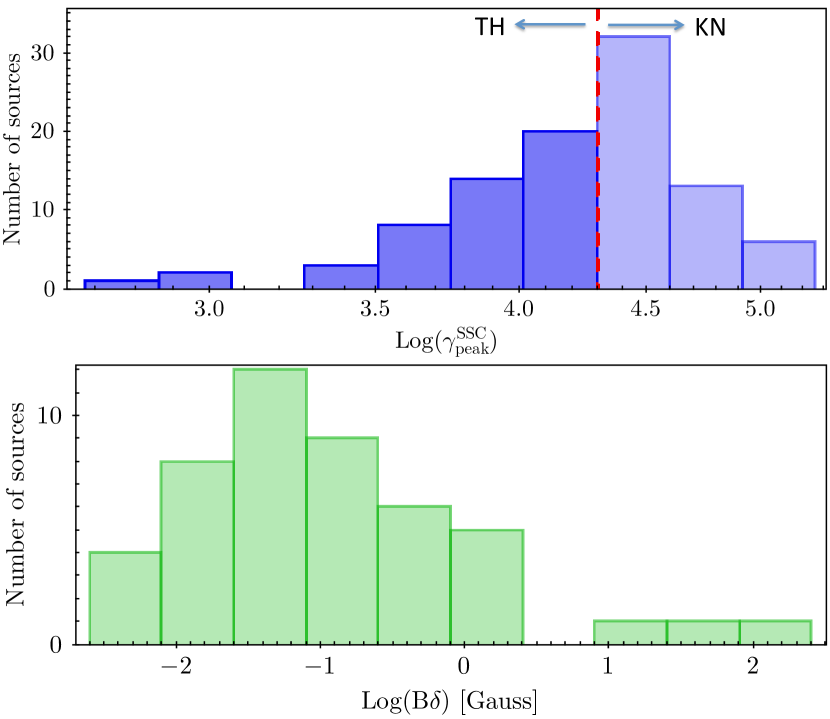
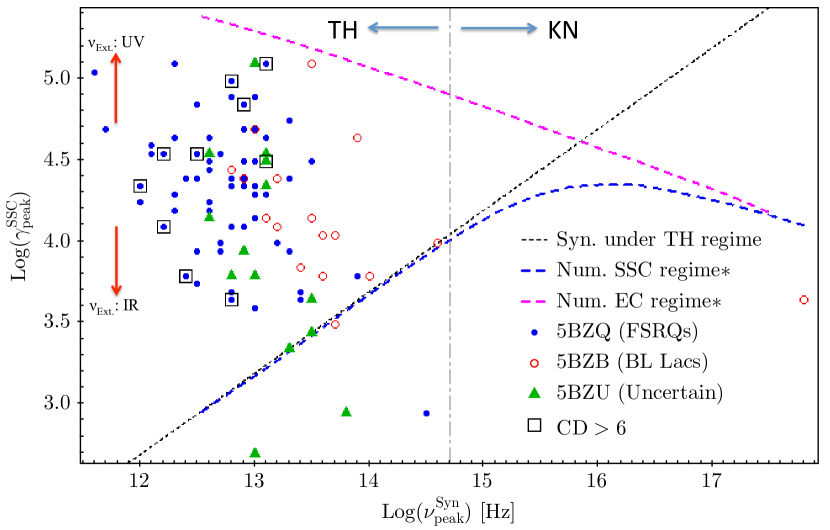
- 绘制了 $ \log(\gamma^{\text{EC}}_{\text{peak}}) $ 与 $ \log(\nu^{\text{Syn}}_{\text{peak}}) $ 的平面图,以识别支持EC而非SSC的区域。
- 绘制了光度平面 $ \log(L_{\text{IC}}) $ 与 $ \log(L_{\text{Syn}}) $,研究在七数量级范围内IC与同步辐射光度之间的相关性。
实验结果
研究问题
- RQ1同步辐射自康普顿(SSC)模型是否足以解释LSP耀变体观测到的SED?
- RQ2在LSP耀变体中,哪种外部光子场——来自BLR的UV还是来自尘埃环的IR——更符合观测到的γ射线发射?
- RQ3基于EC模型和观测SED,γ射线发射区域距中心黑洞的推断距离是多少?
- RQ4谱参数(如 $ \nu^{\text{Syn}}_{\text{peak}} $、$ \nu^{\text{IC}}_{\text{peak}} $、$ \Gamma $)与光度和峰值频率之间有何相关性?
- RQ5为产生观测到的IC发射,所需的共动参考系外部光子能量密度是多少?
主要发现
- 仅靠SSC无法解释LSP耀变体观测到的SED,因为大多数源位于与主导SSC机制不一致的参数空间区域。
- 采用红外(IR)外部光子场的外部康普顿(EC)模型能更好地拟合SED,表明γ射线发射区域远离喷流基底,距离黑洞大于0.1 pc。
- 共动参考系中的外部光子能量密度计算为 $ U^{ ext{'} }_{\text{ext}} = 1.69 \times 10^{-2} $ erg/cm³,与独立研究结果高度一致。
- 平均值 $ \langle \log(B\delta) \rangle \approx 0.99 $ 和 $ \langle \log(\gamma^{\text{EC}}_{\text{peak}}) \rangle \approx 2.80 $ 与先前研究的预期一致,支持具有高集体洛伦兹因子和强多普勒增强的喷流结构。
- 在光度平面 $ \log(L_{\text{IC}}) $ 与 $ \log(L_{\text{Syn}}) $ 中发现一条紧密相关性,斜率略大于1,表明喷流中粒子加速与能量损失之间存在平衡。
- γ射线谱指数 $ \Gamma $ 随 $ \nu^{\text{Syn}}_{\text{peak}} $ 和 $ \nu^{\text{IC}}_{\text{peak}} $ 增大而变硬,且LSP耀变体在0.1–500 GeV波段表现出陡谱,使其难以被Fermi-LAT探测到。
更好的研究,从现在开始
从阅读论文到最终审阅,大幅缩短您的研究时间。
无需绑定信用卡
本解读由 AI 生成,并经人工编辑审核。