
[论文解读] The Rise of Faint, Red AGN at $z>4$: A Sample of Little Red Dots in the JWST Extragalactic Legacy Fields
本文提出了基于 JWST 的 341 个微弱、红色的 AGN 候选体(Little Red Dots,LRDs)样本,覆盖 z ~ 2–11,详细描述了它们的连续光谱斜率、紧凑形态,以及遮挡的 AGN 特性。它分析了红移分布、星数密度、X 射线和 NIRSpec 确认,并与先前的 LRD 样本进行比较。
We present a sample of 341 "little red dots" (LRDs) spanning the redshift range $z\sim2-11$ using data from the CEERS, PRIMER, JADES, UNCOVER and NGDEEP surveys. Unlike past use of color indices to identify LRDs, we employ continuum slope fitting using shifting bandpasses to sample the same rest-frame emission blueward and redward of the Balmer break. This enables the detection of LRDs over a wider redshift range and with less contamination from galaxies with strong breaks that otherwise lack a rising red continuum. The redshift distribution of our sample increases at $z<8$ and then undergoes a rapid decline at $z\sim4.5$, which may tie the emergence of these sources to the inside-out growth that galaxies experience during this epoch. We find that LRDs are $\sim1$ dex more numerous than X-ray and UV selected AGN at z~5-7. Within our sample, we have identified the first two X-ray detected LRDs. An X-ray spectral analysis confirms that these AGN are moderately obscured with $\log\,(N_{ m H}/{ m cm}^{2}$) of $23.3^{+0.4}_{-1.3}$ and $22.72^{+0.13}_{-0.16}$. Our analysis reveals that reddened AGN emission dominates their rest-optical light, while the rest-UV originates from their host galaxies. We also present NIRSpec observations from the RUBIES survey of 17 LRDs that show broad emission lines consistent with AGN activity. The confirmed AGN fraction of our sample is 71\% for sources with F444W<26.5. In addition, we find three LRDs with blue-shifted Balmer absorption features in their spectra, suggesting an outflow of high-density, low-ionization gas from near the central engine of these faint, red AGN.
研究动机与目标
- 识别一组广泛、基于光度的选择的紧凑红色光学/蓝紫外源人群,作为高红移下潜在的强烈红化 AGN。
- 量化红移分布、空间密度,并与 JWST 深场中明亮类星体及其他 AGN 选择进行比较。
- 通过 X 射线探测和 NIRSpec 光谱特征化经过确认的 AGN 本质,以理解遮挡与宿主星系贡献。
- 评估 LRD 的发生率与早期宇宙时期的星系增长和 AGN 供给之间的关系。
提出的方法
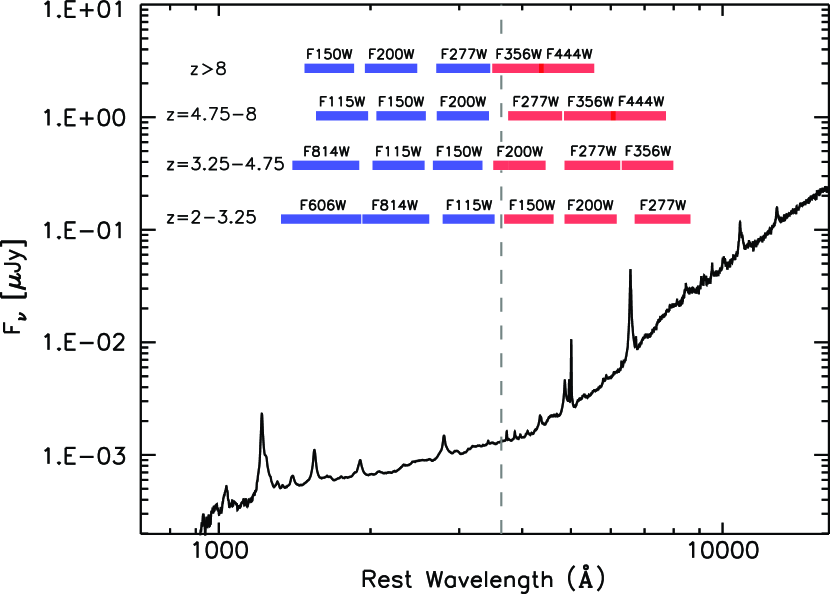
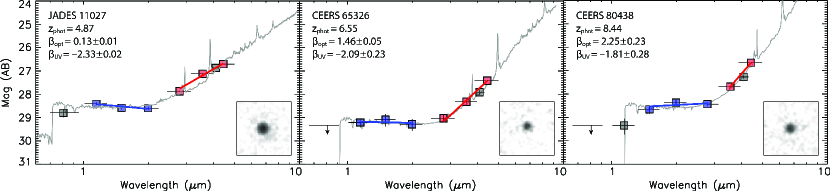
- 通过在 Balmer 劈断蓝侧和红侧的带通随移而对光度测量拟合,计算原初帧内 UV 与光学连续谱斜率(β_UV 与 β_opt)(参见方程 m_i 关系)。
- 在 F444W 的信噪比>12、β_opt 为正、β_UV 介于 -2.8 与 -0.37 之间时,选取红色光学/蓝色紫外的紧凑源。
- 施加紧凑形态裁剪,设半光半径 r_h < 1.5 × r_{h,stars},以去除扩展的污染源。
- 排除 β_UV < -2.8 的潜在褐矮星,并利用 β_F277W-F356W 与 β_F277W-F410M 截断来移除 β_opt 可能被强线发射增强的源。
- 使用 χ^2 最小化的星系+AGN 分量拟合 SED,并使用混合模型(星系 + 风致 reddened AGN)进行可视化(在样本选择中不使用)。
- 用 EAZY 光度红移和对部分样本(GO-4233)的 NIRSpec RUBIES 光谱进行有效性验证,以识别宽线发射线和遮挡性 AGN 的特征。
实验结果
研究问题
- RQ1JWST 深场中微弱、红色 AGN(LRDs)在高达 z~11 的发病率和红移分布如何?
- RQ2LRDs 的数密度与高红移时的明亮类星体以及 X 射线/紫外选取的 AGN 相比如何?
- RQ3LRDs 是否主要是遮挡性 AGN,它们对原始光学/紫外光及宿主星系发射的贡献如何?
- RQ4哪些光谱特征(宽线、吸收性外流)揭示 LRDs 的 AGN 活性与反馈?
- RQ5LRD 人口统计学如何为早期黑洞生长与星系协同演化的模型提供信息?
主要发现
- 在 PRIMER-UDS、PRIMER-COSMOS、CEERS、JADES、UNCOVER 与 NGDEEP 范围内识别出 341 个 LRD 样本,红移 z~2–11。
- LRDs 在 z~5–7 时比明亮类星体多出 2–3 个数量级,但在这些红移时的数密度仅比 X 射线和紫外选取的 AGN 高出 0.6–1 个数量级。
- 在 z=3.1 和 z=4.66 发现了 LRD 的首次 X 射线探测,遮挡程度中等:log(N_H/cm^2) = 23.3^{+0.4}_{-1.3} 和 22.72^{+0.13}_{-0.16}。
- X 射线光谱分析表明,红化的 AGN 发射主导了原始光学光,而原始紫外主要来自宿主星系发射。
- 对 17 个 LRD 的 NIRSpec RUBIES 观测显示出与 AGN 活性一致的宽线发射线。
- 对于 F444W < 26.5 mag 的源,确认的 AGN 比例为 71%;有三 个 LRD 显示窄的蓝移 Balmer 吸收,指示出流。
更好的研究,从现在开始
从论文设计到论文写作,大幅缩短您的研究时间。
无需绑定信用卡
本解读由 AI 生成,并经人工编辑审核。