
[论文解读] The role of interior dynamics and differentiation on the surface and atmosphere of lava planets
本研究通过二维和三维数值模拟,探究了内部动力学与固液分异如何主导岩浆行星的长期演化,揭示出两种截然不同的演化模式:一种是内部完全熔融、夜侧地壳重力不稳定的高温状态;另一种是内部较冷、大部分固态、日侧存在浅层岩浆海洋且大气中缺乏Na、K和FeO的冷却状态——这两种状态可通过詹姆斯·韦布空间望远镜(JWST)观测加以区分。
Lava planets are rocky exoplanets that orbit so close to their host star that their day-side is hot enough to melt silicate rock. Their short orbital periods ensure that lava planets are tidally locked into synchronous rotation, with permanent day and night hemispheres. Such asymmetric magma oceans have no analogs in the Solar System and will exhibit novel fluid dynamics. Here we report numerical simulations of lava planet interiors showing that solid-liquid fractionation in the planetary interior has a major impact on the compositional structure and evolution of the planet. We explored two styles of dynamics that depend primarily on the interior thermal state : 1) a hot fully molten interior, and 2) a mostly solid interior with a shallow day-side magma ocean. In the hot interior scenario, the atmosphere reflects the planet's bulk silicate composition and the night-side crust is gravitationally unstable and constantly replenished. In the cool interior scenario, the distilled atmosphere will lack Na, K and FeO, and the night-side mantle is entirely solid, with a cold surface. These two end-member cases can be distinguished with observations from the James Webb Space Telescope, offering an avenue to probe the diversity of terrestrial exoplanet evolutions.
研究动机与目标
- 理解硅酸盐地幔内部动力学与相变如何主导具有半球形岩浆海洋的岩浆行星的演化。
- 研究热状态、对流与相变在塑造行星结构与大气成分中的作用。
- 确定岩浆行星的长期演化是否导致可观测差异的端元状态。
- 评估自转、湍流与球形几何对潮汐锁定系外行星岩浆海洋动力学的影响。
- 为利用未来詹姆斯·韦布空间望远镜观测区分行星演化路径提供可检验的预测。
提出的方法
- 使用MagIC代码进行数值模拟,基于Boussinesq近似,模拟旋转球壳中的湍流热对流。
- 基于恒星辐照度设定非均匀表面温度边界条件,以昼侧点为最低温度,夜侧点为最高温度。
- 采用无量纲参数(瑞利数、Ekman数、普朗特数、罗斯比数)对物理条件进行无量纲化,确保浮力与旋转力之间的力平衡。
- 采用两种互补模型:无相变的三维球形几何湍流流动模型,以及含相变与熔融曲线缓冲的二维笛卡尔模型。
- 应用无滑移边界条件,空间离散化采用切比雪夫多项式与球谐函数的伪谱方法。
- 时间积分采用混合Crank-Nicolson与二阶Adams-Bashforth格式,长时间积分以确保收敛。
实验结果
研究问题
- RQ1固液相变的存在如何影响岩浆行星岩浆海洋中的温度分布与对流模式?
- RQ2完全熔融内部与主要固态内部伴随后续日侧岩浆海洋的行星在结构与大气成分上存在哪些关键差异?
- RQ3自转与湍流在潮汐锁定岩浆行星半球形岩浆海洋动力学中影响程度如何?
- RQ4两种端元演化状态——全球高温岩浆海洋与冷却固态地幔——能否通过大气成分加以区分?
- RQ5无量纲参数(如罗斯比数)如何反映自转与对流在塑造内部动力学中的相对重要性?
主要发现
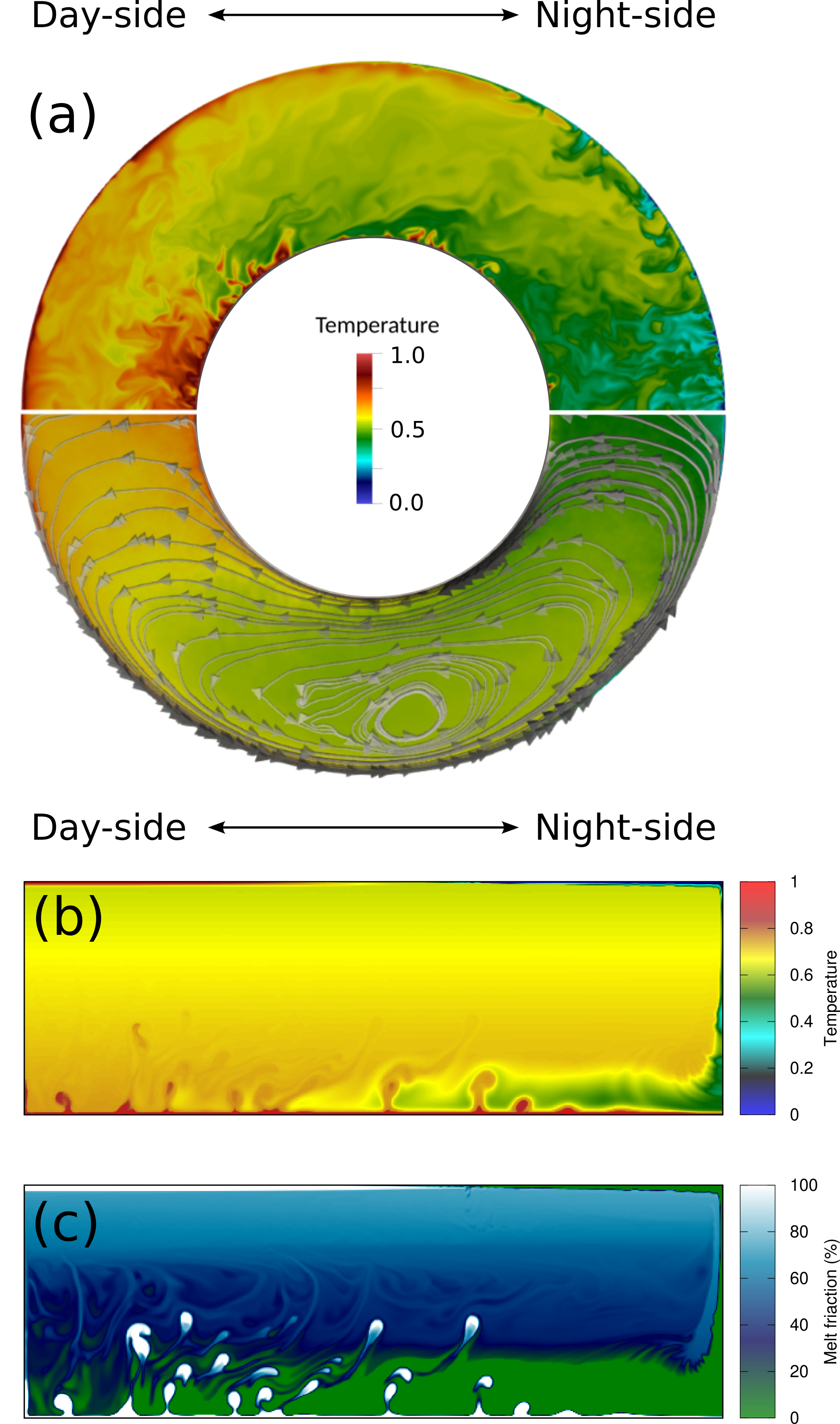
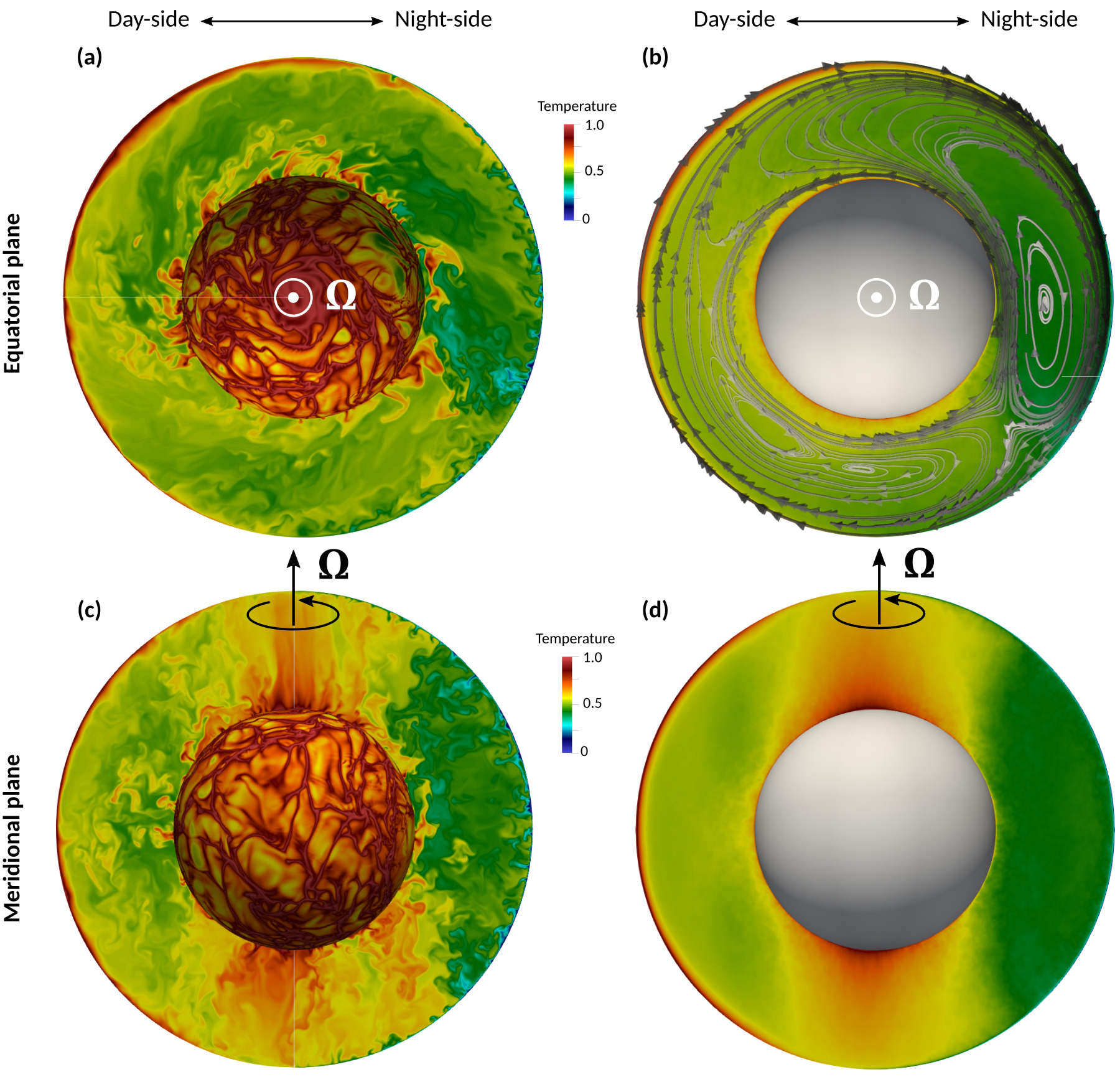
- 在高温完全熔融内部模式中,湍流对流使温度趋于均一,但日侧与夜侧之间仍存在明显的温度对比。
- 引入相变后,硅酸盐熔融曲线对温度起到缓冲作用,实现更有效的热均一化,并显著降低超绝热温差。
- 在高温内部情景中,夜侧地壳处于重力不稳定性状态,因成分翻转而持续被补充。
- 在冷却内部情景中,夜侧地幔完全保持固态,且大气中挥发性元素(如Na、K和FeO)显著贫化。
- 罗斯比数(Ro_c ≈ 1.6)表明旋转效应与浮力力强度相当,支持在模拟中包含旋转效应的合理性。
- 两种端元模式产生截然不同的大气成分,为通过詹姆斯·韦布空间望远镜观测实现区分提供了可行路径。
更好的研究,从现在开始
从阅读论文到最终审阅,大幅缩短您的研究时间。
无需绑定信用卡
本解读由 AI 生成,并经人工编辑审核。