
[论文解读] The role of turbulence and winding in the development of large-scale, strong magnetic fields in long-lived remnants of binary neutron star mergers
本研究采用高分辨率大涡模拟(LES)结合梯度亚格子尺度模型,探究长寿命双中子星并合残余物中的磁场演化。结果表明,约30 ms后,由于磁质螺缠绕作用,环形磁场呈线性增长;而极向磁场仅在约90 ms后才在小尺度上开始增长,表明在模拟时标内不会形成大尺度极向磁场或喷流,且初始强偶极场与真实的并合后磁场拓扑结构不一致。
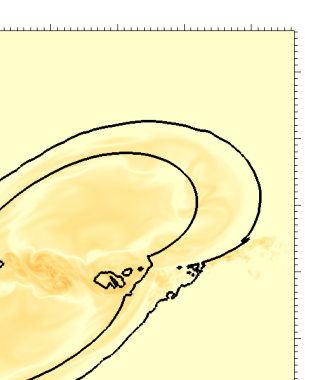
We perform a long and accurate Large-Eddy Simulation of a binary neutron star merger, following the newly formed remnant up to 110 milliseconds. The combination of high-order schemes, high-resolution and the gradient subgrid-scale model allow us to have among the highest effective resolutions ever achieved. Our results show that, although the magnetic fields are strongly amplified by the Kelvin-Helmholtz instability, they are coherent only over very short spatial scales until t \gtrsim 30 ms. Around that time, magnetic winding becomes more efficient leading to a linear growth of the toroidal component and slowly ordering the field to more axisymmetric, large scales. The poloidal component only starts to grow at small scales at much later times t \gtrsim 90 ms, in a way compatible with the magneto-rotational instability. No strong large-scale poloidal field or jet is produced in the timescales spanned by our simulation, although there is an helicoidal structure gradually developing at late times. We highlight that soon after the merger the topology is always strongly dominated by toroidal structures, with a complex distribution in the meridional plane and highly turbulent perturbations. Thus, starting with strong purely dipolar fields before the merger is largely inconsistent with the outcomes of a realistic evolution. Finally, we confirm the universality of the evolved topology, even when starting with very different magnetic fields confined to the outermost layers of each neutron star.
研究动机与目标
- 研究双中子星并合长寿命残余物中大尺度强磁场的发展过程。
- 评估湍流与磁质螺缠绕在并合后塑造磁场拓扑结构中的作用。
- 评估初始强大尺度极向磁场是否与真实的并合动力学物理上相容。
- 检验不同初始磁场构型与数值分辨率下磁场演化的鲁棒性。
- 确定高分辨率LES结合梯度SGS建模是否能捕捉关键磁流体动力学不稳定性与磁场演化,尽管存在未解析的小尺度湍流。
提出的方法
- 对双中子星并合进行长达110 ms的长期、高精度大涡模拟(LES)。
- 采用高阶数值格式与梯度亚格子尺度(SGS)模型,提升有效分辨率并捕捉未解析的磁流体动力学行为。
- 使用真实状态方程模拟并合过程,并将初始磁场配置在星体外层或在整个星体中分布。
- 追踪极向与环形磁场分量的演化,重点关注相干性、增长率与拓扑结构。
- 分析开尔文-赫尔姆霍兹不稳定性(KHI)、磁质螺缠绕与磁旋转不稳定性(MRI)之间的相互作用。
- 通过不同初始磁场构型与数值分辨率的对比,评估收敛性与鲁棒性。
实验结果
研究问题
- RQ1湍流与磁质螺缠绕在长寿命双中子星并合残余物中如何影响大尺度磁场的增长与相干性?
- RQ2初始磁场构型(如偶极场与表面束缚场)在多大程度上影响最终磁场拓扑与演化?
- RQ3LES中的梯度SGS模型能否准确捕捉未解析磁流体动力学不稳定性(如KHI与MRI)的本质动力学?
- RQ4为何初始强极向磁场的模拟无法再现真实并合残余物中环形磁场占主导的现象?
- RQ5大尺度极向磁场从何时开始增长?该时间尺度是否与喷流形成机制相容?
主要发现
- 磁场由开尔文-赫尔姆霍兹不稳定性强烈放大,但相干性仅在约30 ms后才在几公里尺度上显现。
- 约30 ms后磁质螺缠绕成为主导机制,驱动环形磁场分量随时间线性增长,并促进轴对称、大尺度有序结构的形成。
- 极向磁场分量的强度在t ≳ 90 ms前基本保持不变,此后才在小尺度上开始增长,与磁旋转不稳定性(MRI)一致。
- 在110 ms的模拟时标内,未形成强大尺度极向磁场或相对论性喷流,尽管逐渐发展出螺旋状结构。
- 初始纯偶极磁场与并合后拓扑结构不一致,无论初始构型如何,最终磁场均以湍流主导的环形结构为主。
- 磁场放大与演化在不同初始磁场分布下均具鲁棒性——无论磁场局限于外层或在整个星体中分布——表明磁场拓扑演化具有普适性。
![Figure 2: 2D plots in the meridional plane . The rows show, from top to bottom, the rest-mass density in [g cm -3 ], magnetic field intensity in [G], angular velocity of the fluid $\Omega$ in [rad s -1 ], and inverse of $\beta$ factor, at $t=\{10,50,100\}$ ms after the merger (first, second and thir](https://ar5iv.labs.arxiv.org/html/2307.04837/assets/x10.png)
更好的研究,从现在开始
从阅读论文到最终审阅,大幅缩短您的研究时间。
无需绑定信用卡
本解读由 AI 生成,并经人工编辑审核。