
[论文解读] The second data release from the European Pulsar Timing Array: IV. Implications for massive black holes, dark matter and the early Universe
本文分析 European Pulsar Timing Array 的第二数据释放 DR2,以探讨对大质量黑洞、暗物质和早期宇宙的含义。它讨论 DR2 如何约束相关物理。
The European Pulsar Timing Array (EPTA) and Indian Pulsar Timing Array (InPTA) collaborations have measured a low-frequency common signal in the combination of their second and first data releases respectively, with the correlation properties of a gravitational wave background (GWB). Such signal may have its origin in a number of physical processes including a cosmic population of inspiralling supermassive black hole binaries (SMBHBs); inflation, phase transitions, cosmic strings and tensor mode generation by non-linear evolution of scalar perturbations in the early Universe; oscillations of the Galactic potential in the presence of ultra-light dark matter (ULDM). At the current stage of emerging evidence, it is impossible to discriminate among the different origins. Therefore, in this paper, we consider each process separately, and investigate the implications of the signal under the hypothesis that it is generated by that specific process. We find that the signal is consistent with a cosmic population of inspiralling SMBHBs, and its relatively high amplitude can be used to place constraints on binary merger timescales and the SMBH-host galaxy scaling relations. If this origin is confirmed, this is the first direct evidence that SMBHBs merge in nature, adding an important observational piece to the puzzle of structure formation and galaxy evolution. As for early Universe processes, the measurement would place tight constraints on the cosmic string tension and on the level of turbulence developed by first-order phase transitions. Other processes would require non-standard scenarios, such as a blue-tilted inflationary spectrum or an excess in the primordial spectrum of scalar perturbations at large wavenumbers. Finally, a ULDM origin of the detected signal is disfavoured, which leads to direct constraints on the abundance of ULDM in our Galaxy.
研究动机与目标
- 激发并量化 European Pulsar Timing Array 的第二数据释放如何为大质量黑洞的理论提供信息。
- 评估可通过脉冲星定时数据获取的潜在暗物质信号。
- 研究 PTA 观测得到的早期宇宙物理极限。
提出的方法
- 使用 European Pulsar Timing Array DR2 数据集来研究定时残差。
- 应用跨脉冲星相关分析以探测随机背景和信号模型。
- 将大质量黑洞、暗物质效应和早期宇宙情景的理论模型纳入对 PTA 数据的解释。
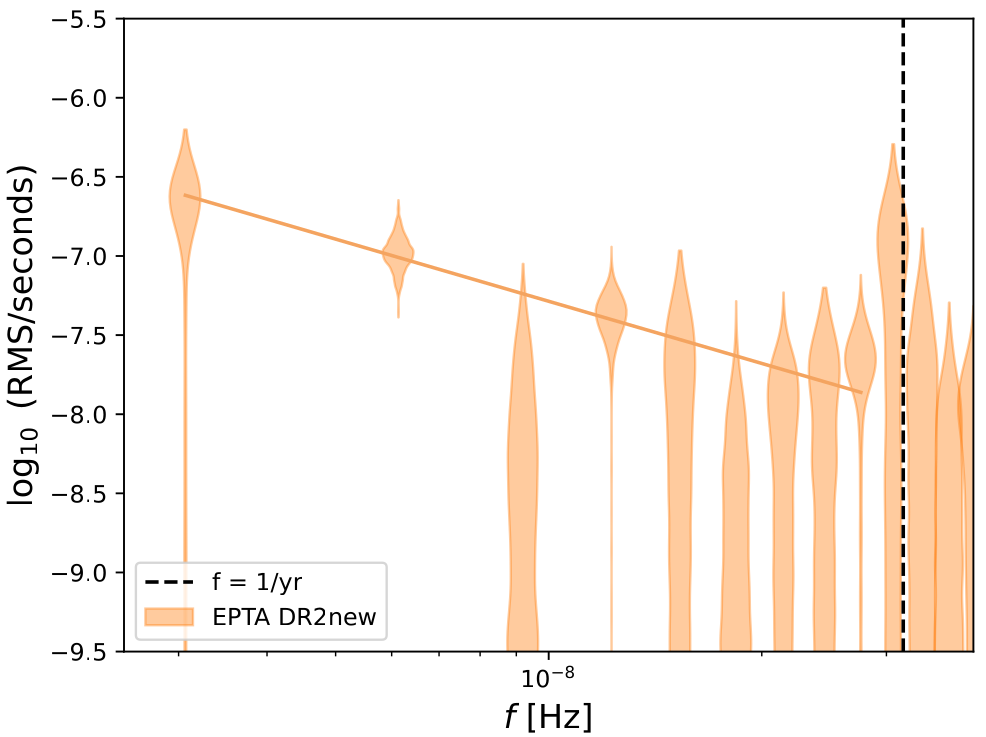
实验结果
研究问题
- RQ1DR2 数据集对脉冲星定时阵列可检测的大质量黑洞的种群及性质有哪些约束?
- RQ2DR2 对与脉冲星定时相关的暗物质相互作用或分布有哪些限制或信号?
- RQ3DR2 如何通过 PTA 观测为早期宇宙模型提供信息?
主要发现
- DR2 为 PTA 频段中大质量黑洞的作用提供了新的见解。
- 这些数据为脉冲星定时测量中的暗物质相关效应提供了更新的视角。
- 在 PTA 定时残差和随机背景的背景下讨论了对早期宇宙物理学的含义。
更好的研究,从现在开始
从论文设计到论文写作,大幅缩短您的研究时间。
无需绑定信用卡
本解读由 AI 生成,并经人工编辑审核。