
[论文解读] The SN 2023ixf Progenitor in M101: I. Infrared Variability
本研究利用19年期的斯皮策望远镜和地面近红外数据,分析了M101星系中SN 2023ixf(一种II型超新星)前身星的红外变异性。研究在光变曲线中识别出1091±71天的周期性,归因于脉动不稳定性,并推导出前身星的绝对星等为M_K = -11.58±0.31等,暗示其初始质量为20±4 M☉——这是迄今为止观测到的最高质量的激波坍缩超新星前身星之一。
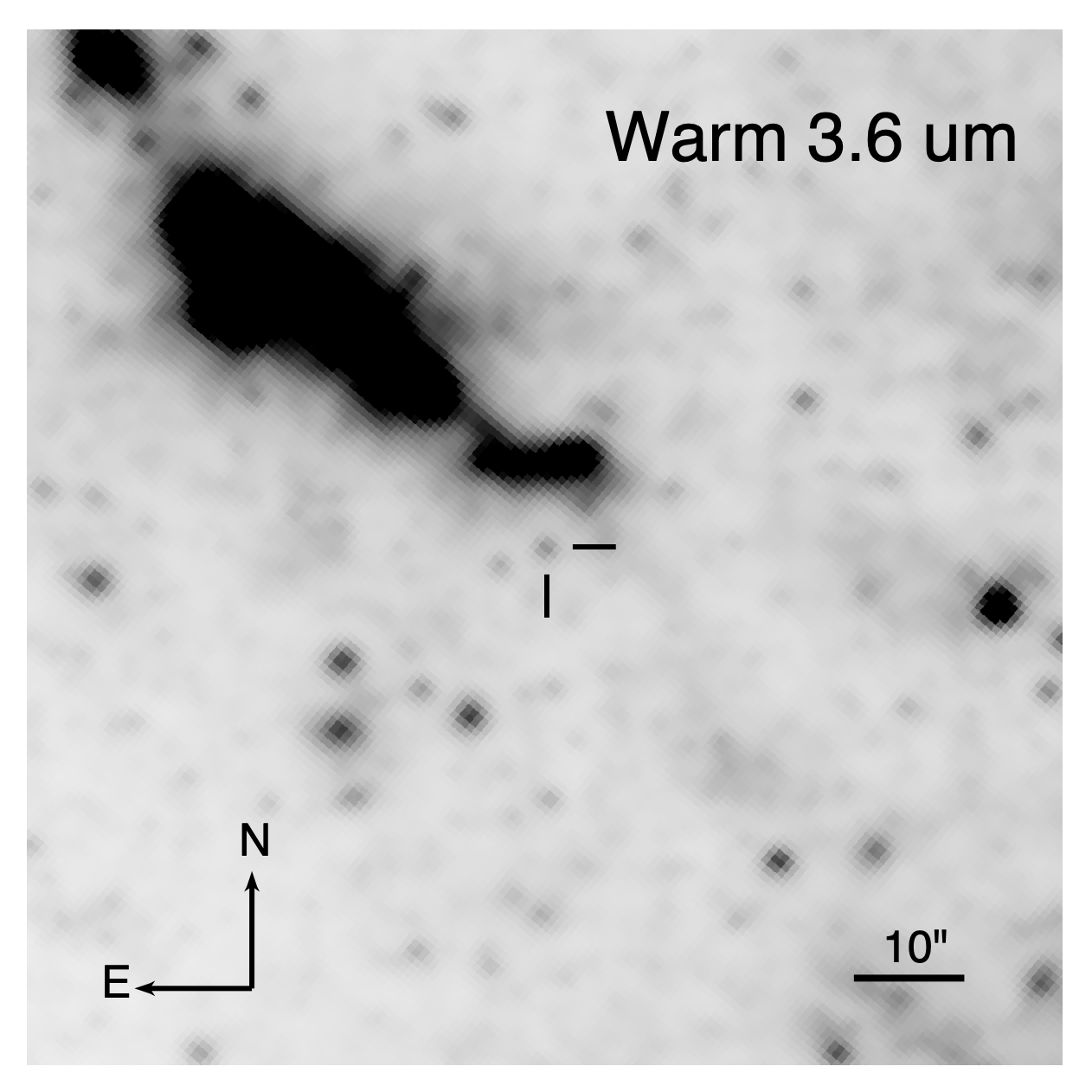
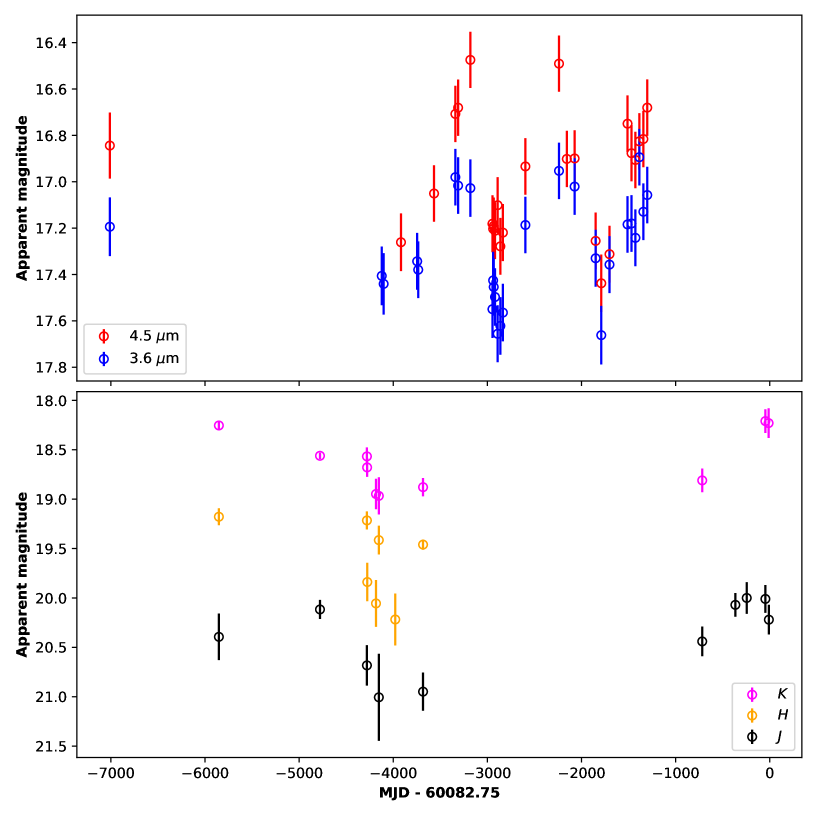
Observational evidence points to a red supergiant (RSG) progenitor for SN 2023ixf. The progenitor candidate has been detected in archival images at wavelengths (>0.6 micron) where RSGs typically emit profusely. This object is distinctly variable in the infrared (IR). We characterize the variability using pre-explosion mid-IR (3.6 and 4.5 micron) Spitzer and ground-based near-IR (JHKs) archival data jointly covering 19 yr. The IR light curves exhibit significant variability with RMS amplitudes in the range of 0.2-0.4 mag, increasing with decreasing wavelength. From a robust period analysis of the more densely sampled Spitzer data, we measure a period of 1091+/-71 days. We demonstrate using Gaussian Process modeling that this periodicity is also present in the near-IR light curves, thus indicating a common physical origin, which is likely pulsational instability. We use a period-luminosity relation for RSGs to derive a value of M_K=-11.58+/-0.31 mag. Assuming a late M spectral type, this corresponds to log(L/L_sun)=5.27+/-0.12 at T_eff=3200 K and to log(L/L_sun)=5.37+/-0.12 at T_eff=3500 K. This gives an independent estimate of the progenitor's luminosity, unaffected by uncertainties in extinction and distance. Assuming the progenitor candidate underwent enhanced dust-driven mass-loss during the time of these archival observations, and using an empirical period-luminosity-based mass-loss prescription, we obtain a mass-loss rate of around (2-4)x10^-4 M_sun/yr. Comparing the above luminosity with stellar evolution models, we infer an initial mass for the progenitor candidate of 20+/-4 M_sun, making this one of the most massive progenitors for a Type II SN detected to-date.
研究动机与目标
- 利用档案中的斯皮策望远镜和地面近红外数据,表征SN 2023ixf前身星的红外变异性。
- 确定观测到的变异性物理起源,特别是其是否由脉动不稳定性驱动。
- 利用周期-光度关系,独立于消光和距离估计,推导出前身星的光度和初始质量。
- 基于经验的周期-光度关系,估算爆发前阶段的质量损失率。
- 提供对前身星初始质量的独立约束,以增进对大质量恒星演化及超新星前身星群体特征的理解。
提出的方法
- 将19年期的中红外(3.6和4.5 μm)斯皮策望远镜数据与来自UKIRT、Gemini North和WFCAM的地面近红外(JHKs)数据相结合。
- 对密集采样的斯皮策光变曲线进行稳健的周期分析,识别出1091±71天的主导周期性。
- 对近红外光变曲线应用高斯过程建模,以检验其与中红外周期性的一致性,证实存在共同的物理起源。
- 利用红超巨星的周期-光度关系,推导出M_K = -11.58±0.31等,该结果独立于消光和距离。
- 估算前身星在T_eff = 3200–3500 K时的光度,得出log(L/L☉) = 5.27±0.12至5.37±0.12。
- 应用基于周期和光度的经验质量损失方案,估算爆发前阶段的质量损失率为(2–4)×10⁻⁴ M☉ yr⁻¹。
实验结果
研究问题
- RQ1SN 2023ixf前身星中观测到的红外变异性性质及其起源是什么?
- RQ2中红外光变曲线中的观测周期性是否在近红外波段也存在,表明其具有共同的物理机制?
- RQ3前身星的本征光度是多少,且独立于消光和距离估计?
- RQ4基于其脉动周期和光度,前身星的初始质量是多少?
- RQ5爆发前阶段的质量损失率是多少,其与恒星脉动特性有何关联?
主要发现
- SN 2023ixf前身星表现出显著的红外变异性,其RMS振幅为0.2–0.4等,且随波长减小而增大。
- 在斯皮策望远镜的中红外光变曲线中检测到1091±71天的主导周期性,表明存在脉动不稳定性。
- 高斯过程建模证实该周期性也存在于近红外光变曲线中,支持其具有共同的物理起源。
- 利用红超巨星的周期-光度关系,推导出前身星的绝对K波段星等为M_K = -11.58±0.31等。
- 前身星的光度对应于log(L/L☉) = 5.27±0.12(T_eff = 3200 K)和5.37±0.12(T_eff = 3500 K),且独立于消光和距离。
- 恒星演化模型表明其初始质量为20±4 M☉,使其成为迄今观测到的最高质量的II型超新星前身星之一。
更好的研究,从现在开始
从阅读论文到最终审阅,大幅缩短您的研究时间。
无需绑定信用卡
本解读由 AI 生成,并经人工编辑审核。