
[论文解读] The split majoron model confronts the NANOGrav signal and cosmological tensions
本文重新评估 split majoron 模型作为 NANOGrav 引力波背景的来源,显示低尺度的一次相变加上 SMBHBs 可以拟合数据,同时解决额外辐射和氘约束,并可能缓解宇宙学矛盾。
In the light of the evidence of a gravitational wave background from the NANOGrav 15yr data set, we reconsider the split majoron model as a new physics extension of the standard model able to generate a needed contribution to solve the current tension between the data and the standard interpretation in terms of inspiraling supermassive black hole massive binaries. In the split majoron model the seesaw right-handed neutrinos acquire Majorana masses from spontaneous symmetry breaking of global $U(1)_{B-L}$ in a strong first order phase transition of a complex scalar field occurring above the electroweak scale. The final vacuum expectation value couples to a second complex scalar field undergoing a low scale phase transition occurring after neutrino decoupling. Such a coupling enhances the strength of this second low scale first order phase transition and can generate a sizeable primordial gravitational wave background contributing to the NANOGrav 15yr signal. Some amount of extra-radiation is generated after neutron-to-proton ration freeze-out but prior to nucleosynthesis. This can be either made compatible with current upper bound from primordial deuterium measurements or even be used to solve a potential deuterium problem. Moreover, the free streaming length of light neutrinos can be suppressed by their interactions with the resulting majoron background and this mildly ameliorates existing cosmological tensions. Thus cosmological observations nicely provide independent motivations for the model.
研究动机与目标
- 重新评估 split majoron 模型作为 NANOGrav GW 信号在 15 年数据集下的来源。
- 分析来自额外辐射(Delta Neff)和 BBN/CMB 观测的宇宙学约束。
- 展示高尺度和低尺度相变如何影响 GW 光谱。
- 探索中微子–majoron 相互作用是否可以缓解如哈勃紧张等宇宙学矛盾。
提出的方法
- 构建一个具有自发 U(1) 对称性破缺的两标量(phi, phi')和右手中微子框架。
- 计算相对论性自由度 g_rho 和 g_s 的演化,以及暗域温度比 r_D 与 Delta Neff。
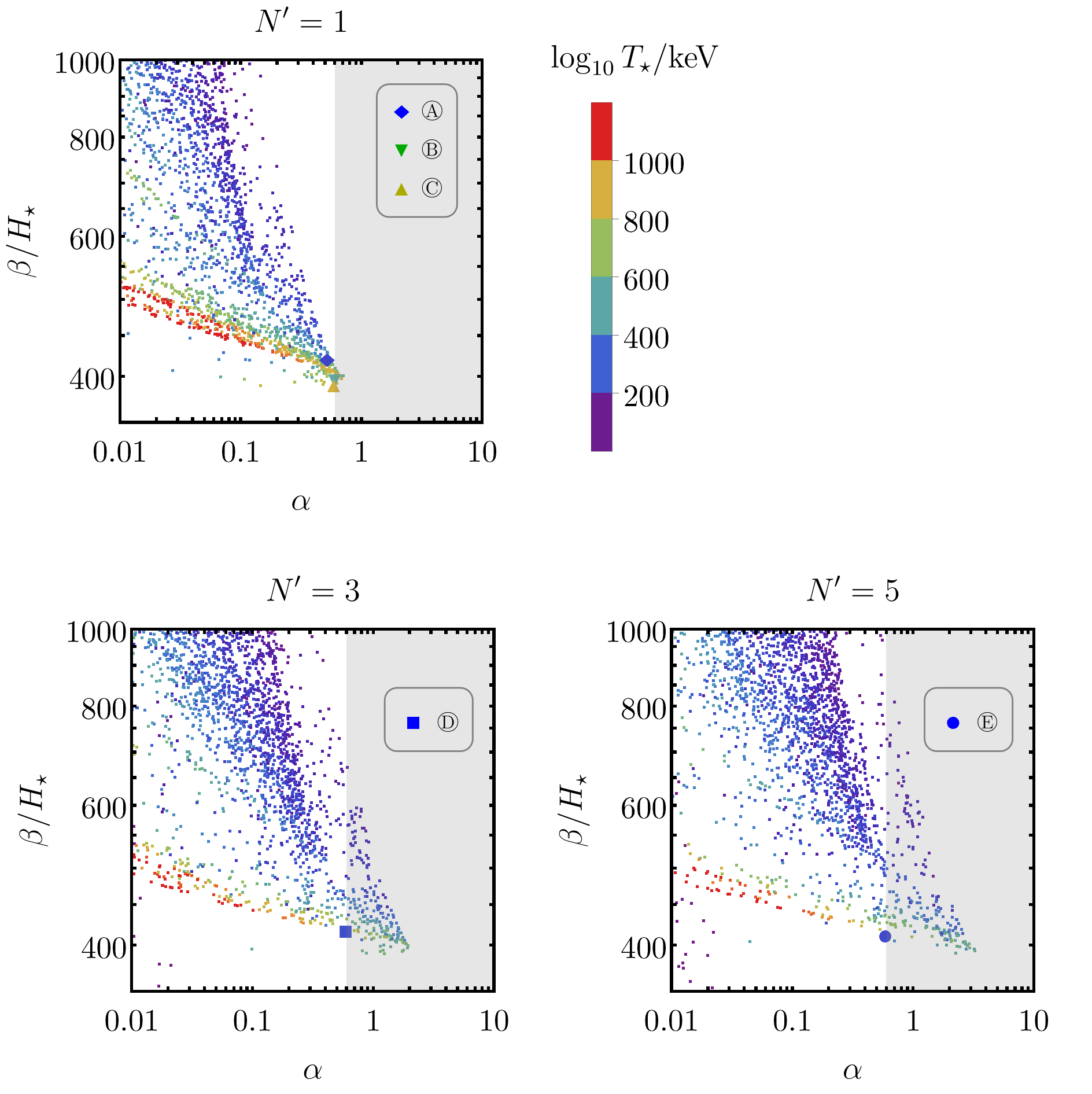
- 用有限温度有效势对低尺度相变建模,并导出 GW 产额的 alpha 和 beta/H_* 参数。
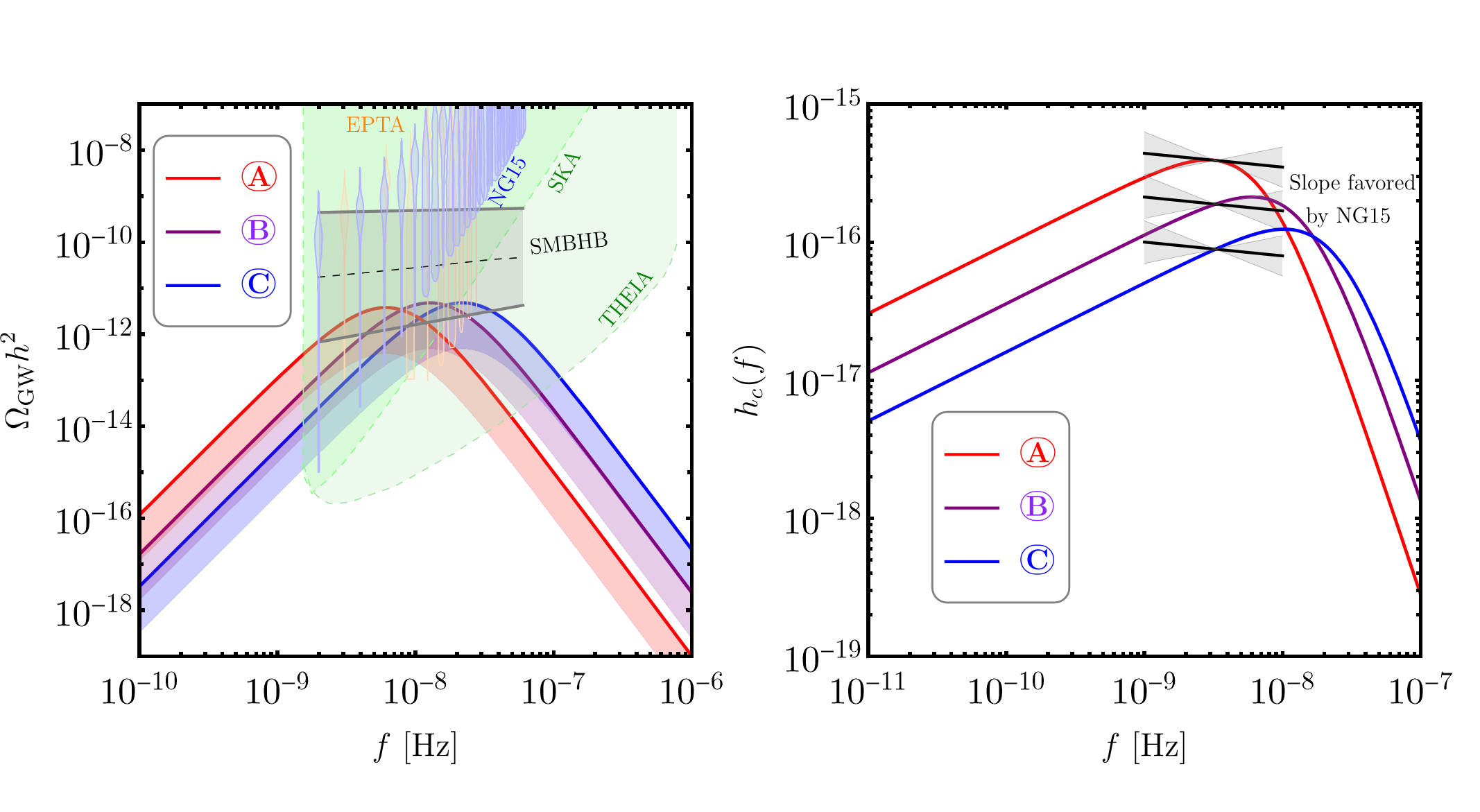
- 使用以声波为主的 GW 光谱、Jo(u)guet 确爆和抑制因子来预测 GW 信号,并与 NANOGrav 15 年结果进行比较。
- 结合 BBN 氘测量和中微子去耦合的宇宙学约束以划定可行参数空间。
实验结果
研究问题
- RQ1分裂 majoron 模型是否能够产生足以解释 NANOGrav 15 年信号的 GW 背景而不违反 BBN/CMB 约束?
- RQ2有哪些相变参数(alpha, beta/H_*, v_w)以及暗域贡献的允许范围能够拟合 NANOGrav 数据?
- RQ3额外暗辐射(Delta Neff)及其温度演化对原初元素丰度和 CMB 测量的兼容性有何影响?
- RQ4中微子–majoron 相互作用是否可以改变中微子自由传播,从而缓解如哈勃紧张等宇宙学矛盾?
- RQ5增加暗域自由度是否有助于使氘约束与 GW 信号之间的关系趋于一致?
主要发现
- 低尺度的一次相变连同 SMBHB 基线可以改善对 NANOGrav 15 年信号的拟合。
- 该模型预测额外辐射 Delta Neff 的量级约为 0.3–0.5,具体取决于暗域内容,这可以与 BBN 和 CMB 约束相容,甚至对其有轻微有利影响。
- 增加暗域自由度可以降低有效 Delta Neff,有望使氘约束与模型兼容。
- 中微子–majoron 相互作用可以抑制中微子自由流动,轻度缓解现有宇宙学矛盾如哈勃紧张。
- GW 光谱通过低尺度相变的有限温度有效势来计算,并对 alpha_nuD 与 beta/H_* 表现出量化依赖性,且包含对有限声波寿命的抑制因子。
更好的研究,从现在开始
从论文设计到论文写作,大幅缩短您的研究时间。
无需绑定信用卡
本解读由 AI 生成,并经人工编辑审核。