
[论文解读] The Taurus Boundary of Stellar/Substellar (TBOSS) Survey I: far-IR disk emission measured with Herschel
本研究利用赫歇尔PACS仪器对塔比奥星形成区中的远红外盘发射进行了完整普查,分析了153个光谱型M4–L0的恒星/亚恒星天体。研究发现,在恒星/亚恒星边界处,盘的过量发射与中心天体通量之间无显著变化,70 μm的中位通量随光谱型平滑下降,并通过陡峭的24–70 μm谱指数识别出5个新的候选过渡盘。
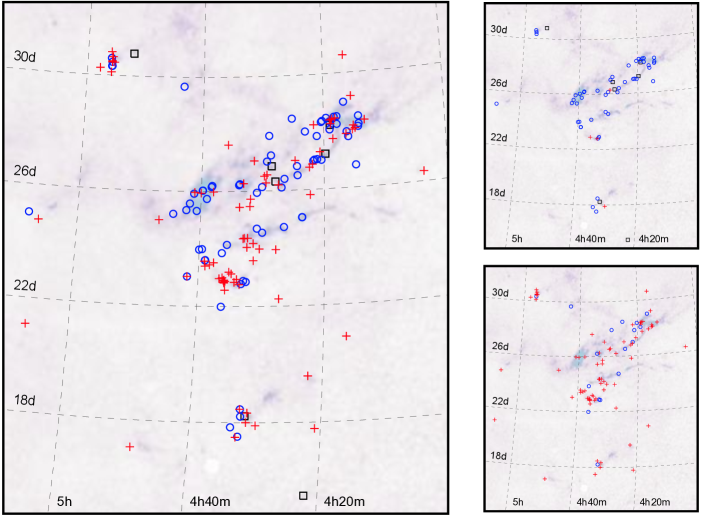
With Herschel/PACS 134 low mass members of the Taurus star-forming region spanning the M4-L0 spectral type range and covering the transition from low mass stars to brown dwarfs were observed. Combining the new Herschel results with other programs, a total of 150 of the 154 M4-L0 Taurus members members have observations with Herschel. Among the 150 targets, 70um flux densities were measured for 7 of the 7 ClassI objects, 48 of the 67 ClassII members, and 3 of the 76 ClassIII targets. For the detected ClassII objects, the median 70um flux density level declines with spectral type, however, the distribution of excess relative to central object flux density does not change across the stellar/substellar boundary in the M4-L0 range. Connecting the 70um TBOSS values with the results from K0-M3 ClassII members results in the first comprehensive census of far-IR emission across the full mass spectrum of the stellar and substellar population of a star-forming region, and the median flux density declines with spectral type in a trend analogous to the flux density decline expected for the central objects. SEDs were constructed for all TBOSS targets covering the optical to far-IR range and extending to the submm/mm for a subset of sources. Based on an initial exploration of the impact of different physical parameters; inclination, scale height and flaring have the largest influence on the PACS flux densities. From the 24um to 70um spectral index of the SEDs, 5 new candidate transition disks were identified. The steep 24um to 70um slope for a subset of 8 TBOSS targets may be an indication of truncated disks in these systems.Two examples of mixed pair systems that include secondaries with disks were measured. Finally, comparing the TBOSS results with a Herschel study of Ophiuchus brown dwarfs reveals a lower fraction of disks around the Taurus substellar population.
研究动机与目标
- 调查塔比奥星形成区中恒星/亚恒星边界处盘的频率与性质。
- 确定低质量恒星与棕矮星(光谱型M4–L0)之间盘的特性是否存在差异。
- 为年轻M4–L0天体构建从光学到亚毫米波段的完整谱存在能量分布(SED)样本。
- 基于远红外SED形态识别并表征过渡盘。
- 将塔比奥星形成区的盘性质与欧克菲乌斯星形成区的盘性质进行比较,以评估环境或质量依赖性趋势。
提出的方法
- 利用赫歇尔PACS仪器对134个低质量塔比奥成员(光谱型M4–L0)进行了深度远红外测光,波长为70 μm。
- 将赫歇尔数据与现有调查数据结合,形成包含153个天体的99%完整样本(150个有赫歇尔数据,3个来自斯皮兹勒)。
- 从光学到亚毫米波段构建SED,必要时整合更长波段的数据。
- 通过分析24 μm至70 μm波段的SED斜率,识别具有陡峭谱指数的候选过渡盘。
- 利用SED建模评估倾角、标高和盘面翘曲对PACS波段通量密度的影响。
- 将赫歇尔探测结果与高分辨率伴星调查交叉比对,识别具有双星/多星系统中盘的系统。
实验结果
研究问题
- RQ1在恒星/亚恒星边界(光谱型M4–L0)处,原恒星盘的频率或形态是否发生显著变化?
- RQ2在M4–L0范围内,塔比奥星形成区中Class II盘的远红外(70 μm)通量密度如何随光谱型变化?
- RQ3与标准Class II盘相比,亚恒星区域中的过渡盘是否具有独特的远红外SED特征?
- RQ4塔比奥星形成区中的盘性质与欧克菲乌斯星形成区中的盘性质相比如何,尤其是在相似年龄和质量条件下?
- RQ5哪些物理参数(如倾角、盘面翘曲、标高)对观测到的70 μm通量密度影响最大?
主要发现
- 在150个观测的TBOSS目标中,70 μm通量密度测量到7个Class I、48个Class II和3个Class III天体。
- 70 μm的中位通量密度随光谱型下降,其趋势与中心天体通量预期的下降趋势类似,表明存在质量依赖的盘发光度趋势。
- 在M4–L0范围内,恒星/亚恒星边界处,盘过量与中心天体通量之比无显著变化。
- 基于陡峭的24–70 μm谱指数,识别出5个新的候选过渡盘,其外盘SED与标准Class II盘无法区分。
- 8个TBOSS目标的24–70 μm斜率较陡,提示可能存在截断盘,但外半径在缺乏额外数据的情况下仍无法确定。
- 在赫歇尔数据中检测到两个包含具有盘的次星的混合对系统,证实了双星系统中盘的存活。
- 当比较相似质量下的通量密度时,塔比奥星形成区中亚恒星天体周围的盘比例低于欧克菲乌斯星形成区。
更好的研究,从现在开始
从阅读论文到最终审阅,大幅缩短您的研究时间。
无需绑定信用卡
本解读由 AI 生成,并经人工编辑审核。