
[论文解读] The $z \gtrsim 9$ galaxy UV luminosity function from the JWST Advanced Deep Extragalactic Survey: insights into early galaxy evolution and reionization
论文利用 JWST/JADES 在 z>9 时段推导原框架 rest-frame UV 光度函数,达到 Muv ~ -17,并发现明亮端超额与微弱端斜率陡峭,对早期星系演化与再电离具有意义。
The high-redshift UV luminosity function provides important insights into the evolution of early galaxies. JWST has revealed an unexpectedly large population of bright ($M_\mathrm{UV} \lesssim -20$) galaxies at $z\gtrsim10$, implying fundamental changes in the star forming properties of galaxies at increasingly early times. However, constraining the fainter population ($M_\mathrm{UV} \gtrsim -18$) has been more challenging. In this work, we present the $z\gtrsim9$ UV luminosity function from the JWST Advanced Deep Extragalactic Survey. We calculate the UV luminosity function from several hundred $z\gtrsim9$ galaxy candidates that reach UV luminosities of $M_\mathrm{UV}\sim-17$ in redshift bins of $z\sim9-12$ (309 candidates) and $z\sim12-16$ (63 candidates). We search for candidates at $z\sim16-22.5$ and find none. We also estimate the $z\sim14-16$ luminosity function from the $z\geq14$ subset of the $z\sim12-16$ sample. Consistent with other measurements, we find an excess of bright galaxies that is in tension with many theoretical models, especially at $z\gtrsim12$. However, we also find high number densities at $-18\lesssim M_\mathrm{UV} \lesssim-17$, suggesting that there is a larger population of faint galaxies than expected, as well as bright ones. From our parametric fits for the luminosity function, we find steep faint end slopes of $-2.5\lesssimα\lesssim-2.3$, suggesting a large population of faint ($M_\mathrm{UV} \gtrsim -17$) galaxies. Combined, the high normalization and steep faint end slope of the luminosity function could imply that the reionization process is appreciably underway as early as $z=10$.
研究动机与目标
- 使用 JWST/NIRCam 成像(来自 JADES)约束 z>9 的 rest-frame UV 光度函数。
- 探测微弱端区间至 Muv ~ -17,以理解完整的星系族群。
- 评估 UV 光密度随红移的演化及其对宇宙再电离的影响。
- 将观测结果与理论星系形成模型比较,找出矛盾与可能解释。
- 基于 LF 测量,描述再电离过程正在展开的红shift 区间。
提出的方法
- 在 F115W、F150W 和 F200W 的光度失效(dropout)选择,以识别 z~9-17 的星系候选体。
- BEAGLE 光谱能量分布拟合,以推导光度学红移与概率性红移后验。
- 使用八个 JWST/NIRCam 滤镜(F090W–F444W)构建 rest-frame UV 光度测量并计算 LF。
- 在 z~9-12 和 z~12-16 的红移区间计算 UV 光度函数,并在 z>16 处给出上限。
- 估计随红移变化的 rest-UV 光密度演化。
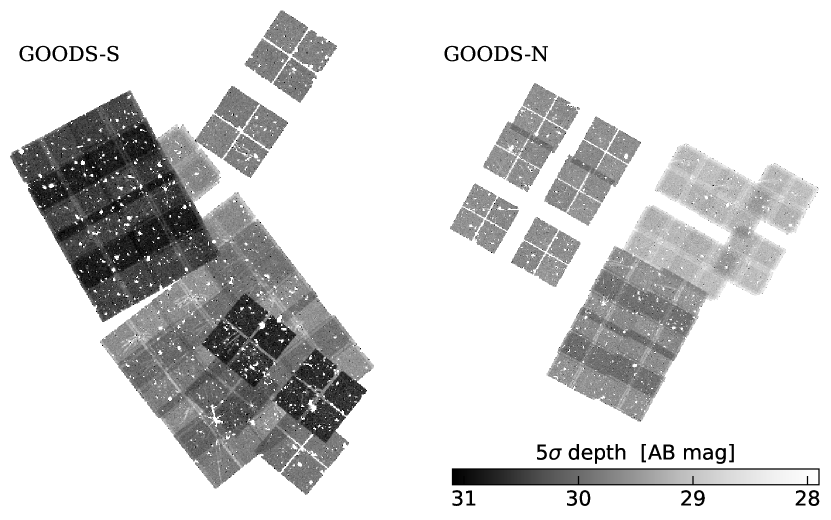
- 结合深度与调查面积的变化来约束 LF 的微弱端。
实验结果
研究问题
- RQ1z~9-12 与 z~12-16 的 rest-frame UV 光度函数形状与归一化是多少?
- RQ2是否存在与理论模型相比的 z>12 明亮星系超额,这对早期恒星形成意味着什么?
- RQ3z>9 的 UV LF 的微弱端斜率(alpha)是多少,微弱星系是否主导 UV 光密度?
- RQ4UV 光密度向更高红shift 的演化如何,对宇宙再电离时间线有何含义?
主要发现
- 在 z>12 的明亮星系存在超额,与许多理论模型相矛盾。
- -18 ≲ Muv ≲ -17 的高数密度,表明存在相当数量的微弱星系群体。
- 参数拟合得到陡峭的微弱端斜率:-2.5 ≲ α ≲ -2.3,表明许多微弱星系(Muv ≳ -17)。
- 结合高归一化与陡峭的微弱端斜率,暗示再电离可能在 z ≈ 10 时就已在进行。
- 在 z~16-22.5 未发现候选体,给出这些红移区间 UV LF 的上限。
- z>9 的结果与明亮星系在 z~13 之前呈现缓慢演化的一致性,并指示对 UV 光密度贡献的星系光度范围较广。
更好的研究,从现在开始
从论文设计到论文写作,大幅缩短您的研究时间。
无需绑定信用卡
本解读由 AI 生成,并经人工编辑审核。