
[论文解读] Time Series Alignment with Global Invariances
本文提出DTW-GI,一种新颖的相似性度量方法,通过动态时间规整(DTW)联合优化时间对齐与特征空间变换,以处理多变量时间序列中的时间与特征层级不变性。该方法引入可微分损失函数与新几何下的重心计算,实现了在歌曲封面识别与人体动作预测任务上的最先进性能,通过在时间规整与特征空间刚性变换上进行联合优化。
Multivariate time series are ubiquitous objects in signal processing. Measuring a distance or similarity between two such objects is of prime interest in a variety of applications, including machine learning, but can be very difficult as soon as the temporal dynamics and the representation of the time series, {\em i.e.} the nature of the observed quantities, differ from one another. In this work, we propose a novel distance accounting both feature space and temporal variabilities by learning a latent global transformation of the feature space together with a temporal alignment, cast as a joint optimization problem. The versatility of our framework allows for several variants depending on the invariance class at stake. Among other contributions, we define a differentiable loss for time series and present two algorithms for the computation of time series barycenters under this new geometry. We illustrate the interest of our approach on both simulated and real world data and show the robustness of our approach compared to state-of-the-art methods.
研究动机与目标
- 为解决因全局不变性(如时间规整与传感器排列)导致的时间序列在时间动态与特征空间表示上差异的问题。
- 开发一种统一的相似性度量方法,联合优化时间对齐与特征空间变换,提升时间序列数据在分布偏移下的鲁棒性。
- 在新几何框架下支持异质时间序列的重心计算,支持聚类与预测等下游应用。
- 通过约束优化整合关于变换类别的先验知识(如音乐中的音高转调),展示方法的通用性。
提出的方法
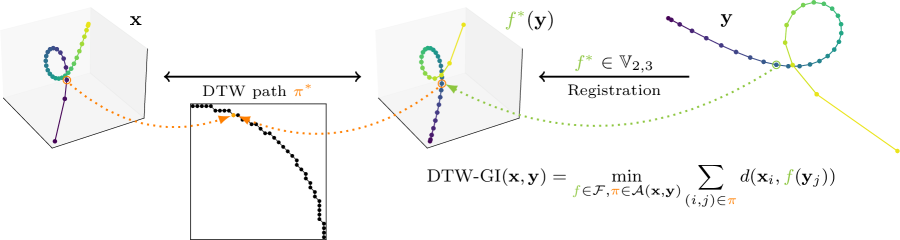
- 该方法将时间序列对齐建模为时间对齐(通过DTW或softDTW)与特征空间中全局变换(如Stiefel流形上的旋转)的联合优化问题。
- 提出一种可微分损失函数,支持使用基于梯度的方法端到端优化对齐与变换参数。
- 该框架支持多种不变性类别,包括正交变换(如旋转、排列),并可通过关于变换族的先验知识实现约束优化。
- 提出两种基于DTW-GI几何的算法,用于计算异质时间序列的重心,支持聚类与表征学习。
- 该方法足够灵活,可通过穷举评估所有候选变换(如音乐中的12个半音转调)来处理离散变换集合,并选择最优解。
- 通过显式学习变换映射,扩展了CTW与GromovDTW等现有方法,支持在下游任务中复用,并更好地与深度学习流水线集成。
实验结果
研究问题
- RQ1能否通过统一框架联合优化时间对齐与特征空间变换,以在全局不变性下提升时间序列相似性度量?
- RQ2所提出的时序规整与特征变换联合优化方法,在处理具有异质表示的真实世界时间序列时,相较于最先进方法表现如何?
- RQ3关于变换类别(如音乐中的音高转调)的先验知识在多大程度上可被整合进对齐过程以提升性能?
- RQ4所提出的几何框架能否支持对异质时间序列计算有意义的重心,以实现聚类与表征学习?
- RQ5DTW-GI的可微分公式化如何支持其在深度学习模型中的集成,以应用于表征学习或模仿学习等任务?
主要发现
- 在使用Stiefel流形上特征空间优化时,DTW-GI在歌曲封面识别任务中达到MR1为29.0 ± 1.0,优于未联合优化对齐与变换的基线方法。
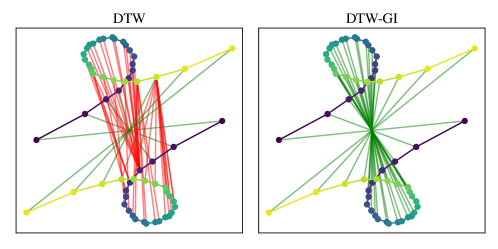
- 通过整合12种可能音高转调的先验知识,DTW-GI在性能上显著优于在平均特征上计算转调的基线方法,证明了联合优化的优势。
- 该方法在模拟数据与真实世界数据集上均优于CTW及其他最先进方法,表现出对特征空间中旋转与时间偏移的鲁棒性。
- 据作者所知,所提出的DTW-GI几何下的重心计算是首个针对异质时间序列的公式化方法,支持聚类与表征学习等新应用。
- SoftDTW-GI实现了可微分对齐与变换,表明其作为损失函数或特征提取器在深度学习模型中的潜力,如未来工作中展示的与三元组损失训练的兼容性。
更好的研究,从现在开始
从阅读论文到最终审阅,大幅缩短您的研究时间。
无需绑定信用卡
本解读由 AI 生成,并经人工编辑审核。