
[论文解读] Time-Varying Graph Mode Decomposition
本文提出了一种数据驱动的变分优化方法,用于将时变图信号分解为多个图模式,以捕捉时间、频率和拓扑结构中的振荡分量。通过使用ADMM和原始-对偶优化整合时间域、频谱域和图基约束,该方法实现了多尺度功能连接性与信号动态的联合分析,已在EEG、能耗和工业过程数据上得到验证。
Time-varying graph signals are alternative representation of multivariate (or multichannel) signals in which a single time-series is associated with each of the nodes or vertex of a graph. Aided by the graph-theoretic tools, time-varying graph models have the ability to capture the underlying structure of the data associated with multiple nodes of a graph -- a feat that is hard to accomplish using standard signal processing approaches. The aim of this contribution is to propose a method for the decomposition of time-varying graph signals into a set of graph modes. The graph modes can be interpreted in terms of their temporal, spectral and topological characteristics. From the temporal (spectral) viewpoint, the graph modes represent the finite number of oscillatory signal components (output of multiple band-pass filters whose center frequencies and bandwidths are learned in a fully data-driven manner), similar in properties to those obtained from the empirical mode decomposition and related approaches. From the topological perspective, the graph modes quantify the functional connectivity of the graph vertices at multiple scales based on their signal content. In order to estimate the graph modes, a variational optimization formulation is designed that includes necessary temporal, spectral and topological requirements relevant to the graph modes. An efficient method to solve that problem is developed which is based on the alternating direction method of multipliers (ADMM) and the primal-dual optimization approach. Finally, the ability of the method to enable a joint analysis of the temporal and topological characteristics of time-varying graph signals, at multiple frequency bands/scales, is demonstrated on a series of synthetic and real time-varying graph data sets.
研究动机与目标
- 解决现有多变量信号分解方法在捕捉动态数据中复杂通道间连接模式方面的局限性。
- 统一图信号处理与数据驱动的谐波分析,以处理时变图信号。
- 开发一种完全数据驱动的方法,无需在时间域或图域预设基函数即可提取图模式。
- 实现在多个频率尺度下对时间动态与拓扑结构的联合分析。
- 提供一个框架,用于识别不规则网络化数据中的振荡分量及其功能连接性。
提出的方法
- 构建一个变分优化问题,整合时间带宽、频谱局部化和拓扑平滑性约束,以描述图模式。
- 采用原始-对偶前向-后向-前向算法,高效求解非凸优化问题。
- 应用交替方向乘子法(ADMM)将问题分解为可处理的子问题。
- 通过图拉普拉斯矩阵和邻接矩阵,强制模式沿图测地线保持平滑。
- 以数据驱动方式施加完全信号重构和带限振荡分量的约束。
- 在优化过程中,采用邻近算子和梯度步长迭代更新原始变量和对偶变量。
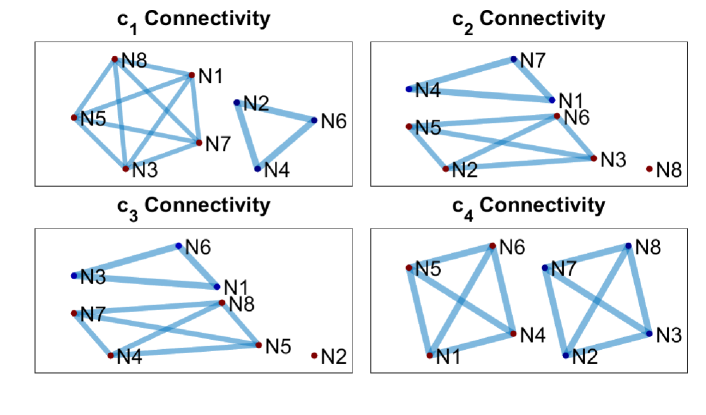
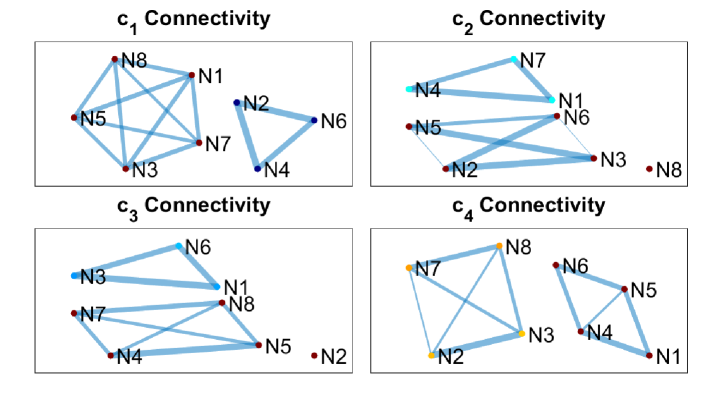
实验结果
研究问题
- RQ1数据驱动的分解方法能否在保持拓扑结构的同时,从时变图信号中提取振荡分量?
- RQ2如何在统一框架中联合建模图信号的时间、频谱和拓扑特性?
- RQ3所提出方法在真实世界数据中,对不同频带的功能连接模式的局域化程度如何?
- RQ4该方法能否成功利用基于图的连接性,从静息态EEG中分离出如α波等脑节律?
- RQ5该方法在识别非平稳系统(如能耗或工业过程)中的动态连接模式方面表现如何?
主要发现
- 该方法成功从静息态EEG数据中分离出α节律,并正确将它们的源定位在枕叶和顶叶脑区。
- 在电力消耗数据中揭示了显著的多尺度连接模式,支持在不同时间尺度下分析用户级能耗行为。
- 该算法为浮选厂数据集生成了有意义的连接图,支持通过单元分组进行故障诊断。
- 该分解实现了完全的信号重构,同时在不预先假设基函数的前提下,将带限振荡分量有效分离。
- 基于原始-对偶ADMM的求解器收敛稳定,表现出在合成与真实世界数据集上的鲁棒性与可扩展性。
- 该方法在同时捕捉时间动态与拓扑交互方面优于标准多变量分解技术。
更好的研究,从现在开始
从阅读论文到最终审阅,大幅缩短您的研究时间。
无需绑定信用卡
本解读由 AI 生成,并经人工编辑审核。