
[论文解读] TimeMixer: Decomposable Multiscale Mixing for Time Series Forecasting
TimeMixer 利用多尺度过去信息,通过 Past-Decomposable-Mixing 和 Future-Multipredictor-Mixing,在高效的基于 MLP 的设计中实现最先进的长短期时间序列预测。
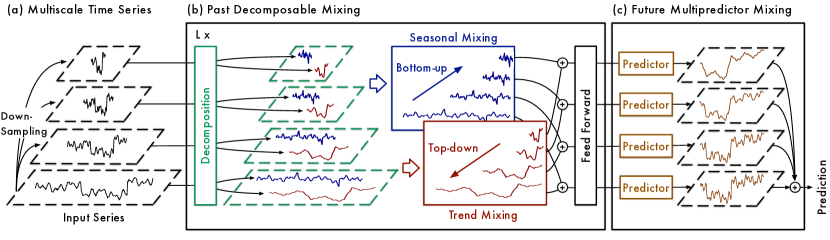
Time series forecasting is widely used in extensive applications, such as traffic planning and weather forecasting. However, real-world time series usually present intricate temporal variations, making forecasting extremely challenging. Going beyond the mainstream paradigms of plain decomposition and multiperiodicity analysis, we analyze temporal variations in a novel view of multiscale-mixing, which is based on an intuitive but important observation that time series present distinct patterns in different sampling scales. The microscopic and the macroscopic information are reflected in fine and coarse scales respectively, and thereby complex variations can be inherently disentangled. Based on this observation, we propose TimeMixer as a fully MLP-based architecture with Past-Decomposable-Mixing (PDM) and Future-Multipredictor-Mixing (FMM) blocks to take full advantage of disentangled multiscale series in both past extraction and future prediction phases. Concretely, PDM applies the decomposition to multiscale series and further mixes the decomposed seasonal and trend components in fine-to-coarse and coarse-to-fine directions separately, which successively aggregates the microscopic seasonal and macroscopic trend information. FMM further ensembles multiple predictors to utilize complementary forecasting capabilities in multiscale observations. Consequently, TimeMixer is able to achieve consistent state-of-the-art performances in both long-term and short-term forecasting tasks with favorable run-time efficiency.
研究动机与目标
- 研究多尺度取样如何揭示时间序列中的微观与宏观模式的差异。
- 开发一个完全基于 MLP 的模型,通过分解的季节成分和趋势成分来利用过去的多尺度信息。
- 通过集成多尺度预测器来捕捉互补的预测能力,从而预测未来值。
提出的方法
- 通过对过去序列的平均抽样下采样来构建多尺度观测。
- 应用 Past-Decomposable-Mixing (PDM) 在自下而上和自上而下方向对分解的季节成分和趋势成分跨尺度进行分开混合。
- 使用 Future-Multipredictor-Mixing (FMM) 将来自每个尺度的多个预测器进行集成以得到最终的未来预测。
- 对多尺度序列进行嵌入,并通过 L 个 PDM 块逐步混合以在各尺度上获得 X^L。
- 通过在 FMM 中对来自各尺度的特定预测器的预测求和来进行预测:x_hat = sum_m Predictor_m(x_m^L).
实验结果
研究问题
- RQ1多尺度下采样是否能够揭示对预测有益的微观与宏观模式?
- RQ2将序列分解为季节分量和趋势分量并跨尺度混合是否能提升对过去信息的提取?
- RQ3来自多个尺度的预测器的集合是否比单一尺度的预测器产生更好的未来预测?
主要发现
- TimeMixer 在多样化数据集上的长期基准测试中实现了一致的最先进性能(Weather、Solar-Energy、Electricity、Traffic、ETTh1/ETTh2/ETTm1/ETTm2)。
- 该模型在基线之上实现了显著的 MSE 改进(例如 Weather 和 Solar-Energy),在预测能力较低的数据集上也依然有效。
- 消融实验表明,Future-Multipredictor-Mixing、季节混合和趋势混合各自对性能有贡献,而完整的 Past-Decomposable-Mixing 架构提供了最强的结果。
- 可视化显示季节分量与趋势分量具有不同的混合行为,支持自下而上的季节混合和自上而下的趋势混合的设计选择。
- TimeMixer 在多变量 PeMS 数据和跨频率的单变量 M4 数据上展示出强大的短期预测性能。

更好的研究,从现在开始
从论文设计到论文写作,大幅缩短您的研究时间。
无需绑定信用卡
本解读由 AI 生成,并经人工编辑审核。