
[论文解读] Toward Blockchain-based Fashion Wearables in the Metaverse: the Case of Decentraland
本研究首次对Decentraland中基于区块链的虚拟时尚穿戴装备进行了定量分析,发现大多数穿戴装备通过空投或促销活动分发,而非在市场中出售。主要发现表明,稀有度是定价的主要驱动因素,而促销用途远超商业销售,凸显了需要重新思考超越直接变现的经济模型。
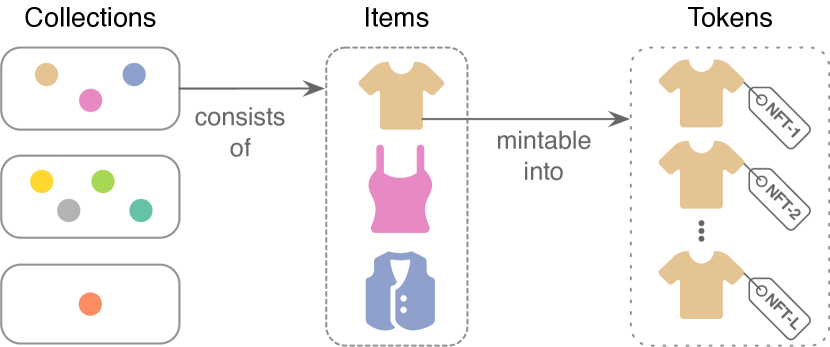
Among the earliest projects to combine the Metaverse and non-fungible tokens (NFTs) we find Decentraland, a blockchain-based virtual world that touts itself as the first to be owned by its users. In particular, the platform's virtual wearables (which allow avatar appearance customization) have attracted much attention from users, content creators, and the fashion industry. In this work, we present the first study to quantitatively characterize Decentraland's wearables, their publication, minting, and sales on the platform's marketplace. Our results indicate that wearables are mostly given away to promote and increase engagement on other cryptoasset or Metaverse projects, and only a small fraction is sold on the platform's marketplace, where the price is mainly driven by the preset wearable's rarity. Hence, platforms that offer virtual wearable NFTs should pay particular attention to the economics around this kind of assets beyond their mere sale.
研究动机与目标
- 对Decentraland虚拟时尚穿戴装备的发布、铸造及市场销售进行定量表征。
- 理解元宇宙中基于区块链的数字时尚资产背后的经济动态。
- 调查在该平台上NFT穿戴装备的生命周期中,销售还是促销分发占主导地位。
- 评估稀有度、系列规模和3D模型复杂度在决定穿戴装备价值中的作用。
提出的方法
- 从Decentraland的v2 NFT系统中收集关于穿戴装备铸造、所有权及市场交易的链上数据。
- 分析Decentraland官方市场及OpenSea等外部平台的初级和二级销售数据。
- 构建线性回归模型,评估稀有度、系列基数和纹理数量对价格的影响。
- 通过人工验证高铸造量和高复杂度物品,以确认其分发方式和促销意图。
- 利用Decentraland DAO内容筛选流程和代币经济数据,为铸造和治理机制提供背景信息。
- 将研究发现与更广泛的NFT及虚拟世界文献进行对比,以定位Decentraland穿戴装备经济在元宇宙生态系统中的位置。
实验结果
研究问题
- RQ1Decentraland穿戴装备的分发模式是什么——主要通过销售还是赠送?
- RQ2稀有度、系列规模和3D模型复杂度等因素如何影响穿戴装备的定价?
- RQ3穿戴装备在多大程度上被用于促销而非直接变现?
- RQ4Decentraland中穿戴装备的经济模式与更广泛的NFT市场动态相比如何?
- RQ5将链上所有权数据作为实际元世界时尚使用情况的代理指标,存在哪些局限性?
主要发现
- 仅有3.4%的穿戴装备铸造是通过Decentraland市场上的初级销售完成的,表明销售并非主要分发机制。
- 绝大多数穿戴装备(96.6%)通过空投或奖励方式分发,主要目的是推广其他加密项目或元宇宙项目。
- 铸造量最高的穿戴装备“CCC - Hat - Gray”被分发了99,961次,主要作为促销活动的一部分。
- “Sophia 42 - #2”穿戴装备(包含8,657个三角形和7种纹理)被创建用于推广Sophia The Robot,体现了复杂设计在促销中的应用。
- “Royal Family Crown”在零价格下完成了7,781次初级销售(仅需支付网络费用),证实了促销价值常超过经济收益。
- 稀有度是定价的最关键因素,其次为系列规模和纹理数量,且在回归模型中稀有度是最重要的预测变量。
更好的研究,从现在开始
从阅读论文到最终审阅,大幅缩短您的研究时间。
无需绑定信用卡
本解读由 AI 生成,并经人工编辑审核。