
[论文解读] Toward Robust Corrections for Stellar Contamination in JWST Exoplanet Transmission Spectra
本文研究了恒星模型在修正JWST系外行星掩星光谱中光球不均匀性(如黑子和亮斑)污染问题时的可靠性。研究发现,对于光球结构复杂的恒星,模型差异主导了噪声预算;但使用高保真度模型时,恒星污染对噪声的贡献低于光子噪声,因此主张采用数据驱动的恒星建模和经验组分反演方法,以实现稳健的大气表征。
Transmission spectroscopy is still the preferred characterization technique for exoplanet atmospheres, although it presents unique challenges that translate into characterization bottlenecks when robust mitigation strategies are missing. Stellar contamination is one such challenge that can overpower the planetary signal by up to an order of magnitude, and thus not accounting for it can lead to significant biases in the derived atmospheric properties. Yet this accounting may not be straightforward, as important discrepancies exist between state-of-the-art stellar models and measured spectra and between models themselves. Here we explore the extent to which stellar models can be used to reliably correct for stellar contamination and yield a planet's uncontaminated transmission spectrum. We find that discrepancies between stellar models can significantly contribute to the noise budget of JWST transmission spectra of planets around stars with heterogeneous photospheres, the true number of unique photospheric spectral components and their properties can only be accurately retrieved when the stellar models have sufficient fidelity, and under such optimistic circumstances the contribution of stellar contamination to the noise budget of a transmission spectrum is considerably below that of the photon noise for the standard transit observation setup. Therefore, we advocate for further development of model spectra of stars and their active regions in a data-driven manner, empirical approaches for deriving spectra of photospheric components using the observatories with which the atmospheric explorations are carried out, and analysis techniques accounting for multimodal posterior distributions for photospheric parameters of interest, which will be increasingly revealed by precise JWST measurements.
研究动机与目标
- 解决JWST掩星光谱中恒星污染的问题,该问题可使大气反演结果产生高达一个数量级的偏差。
- 研究当前恒星模型是否能可靠地反演光球组分(如黑子、亮斑)以校正污染。
- 评估模型不准确或数据质量限制了掩星光谱中污染校正精度的程度。
- 探索基于数据的、经验性的方法,以独立于理论模型的方式推导光球组分。
- 确定在何种条件下,恒星污染在整体噪声预算中变得低于光子噪声。
提出的方法
- 使用合成的非掩星JWST光谱,模拟具有光球不均匀性的恒星(包括K0和M6型)的观测。
- 应用直接反演技术,从未掩星光谱中反演光球组分的温度和覆盖因子。
- 将反演得到的组分属性与真实输入值进行比较,以量化偏差和不确定性。
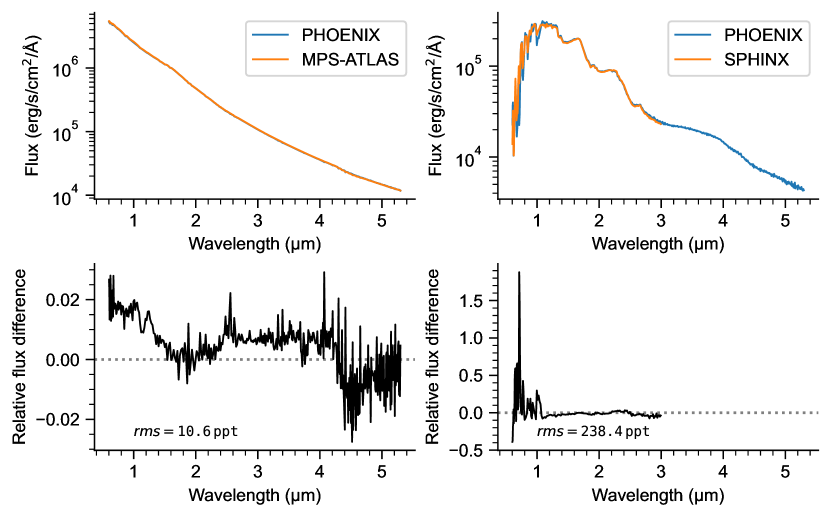
- 利用PHOENIX和SPHINX模型网格,评估不同恒星类型下模型光谱对温度变化的敏感性。
- 通过对比多个恒星模型网格(包括更新、更真实的模型)的结果,评估模型保真度的影响。
- 研究污染噪声相对于光子噪声的缩放关系,作为非掩星与掩星观测时间比的函数。
实验结果
研究问题
- RQ1在具有光球不均匀性的恒星周围系外行星的JWST掩星光谱中,恒星模型之间的差异在多大程度上主导了噪声预算?
- RQ2高保真度恒星模型是否能够以足够高的精度反演光球组分属性(温度、覆盖因子),使污染贡献低于光子噪声?
- RQ3光谱对温度变化的敏感性在较冷的(M6)和较暖的(K0)恒星之间有何差异,这对组分检测意味着什么?
- RQ4在何种情况下,即使使用高信噪比的非掩星数据,模型不准确仍会导致校正偏差?
- RQ5基于数据的经验性、模型无关的方法是否能够超越当前基于模型的方法,改善光球组分的校正效果?
主要发现
- 对于光球结构复杂的恒星,特别是像M6型矮星这样更活跃的较冷恒星,恒星模型之间的差异主导了噪声预算。
- 对于K0型恒星,即使使用高信噪比的非掩星光谱,模型不准确仍可能导致校正偏差。
- 与2500 K模型相比,K0型恒星的光谱对温度变化的敏感性显著降低(约为其20%),使得组分检测更具挑战性。
- 当使用高保真度模型时,在标准掩星观测设置下,恒星污染对噪声预算的贡献低于光子噪声。
- 亮斑中由磁场引起的特征——在1D模型中难以准确捕捉——增加了光谱拟合的难度,但也增强了不均匀性的可探测性。
- 从JWST数据中通过经验方法推导光球组分,可绕过模型不准确的问题,提升校正的鲁棒性,尤其适用于活跃恒星。
更好的研究,从现在开始
从阅读论文到最终审阅,大幅缩短您的研究时间。
无需绑定信用卡
本解读由 AI 生成,并经人工编辑审核。