
[论文解读] Toward Value-oriented Renewable Energy Forecasting: An Iterative Learning Approach
本文提出了一种面向可再生能源的价值导向点预测方法,通过将预测模型训练表述为双层优化问题,最小化预期的两阶段运行成本(日前与实时调度)。该方法通过迭代方式使预测结果与运行结果对齐,在保持比高质量导向方法低15 %总成本的同时,计算速度比随机规划快4,500倍。
Energy forecasting is an essential task in power system operations. Operators usually issue forecasts and leverage them to schedule energy dispatch ahead of time. However, forecast models are typically developed in a way that overlooks the operational value of the forecasts. To bridge the gap, we design a value-oriented point forecasting approach for sequential energy dispatch problems with renewable energy sources. At the training phase, we align the loss function with the overall operation cost function, thereby achieving reduced operation costs. The forecast model parameter estimation is formulated as a bilevel program. Under mild assumptions, we convert the upper-level objective into an equivalent form using the dual solutions obtained from the lower-level operation problems. Additionally, a novel iterative solution strategy is proposed for the newly formulated bilevel program. Under such an iterative scheme, we show that the upper-level objective is locally linear regarding the forecast model output, and can act as the loss function. Numerical experiments demonstrate that, compared to commonly used statistical quality-oriented point forecasting methods, forecasts obtained by the proposed approach result in lower operation costs. Meanwhile, the proposed approach is more computationally efficient than traditional two-stage stochastic programs.
研究动机与目标
- 解决统计上准确的预测与其在电力系统调度中实际运行价值之间的差距。
- 开发一种直接优化日前与实时电能调度预期运行成本的预测框架。
- 实现计算高效的预测,同时保持与电力系统中标准的“先预测,后优化”范式兼容。
- 证明针对运行成本优化的预测优于针对统计准确性优化的预测,尤其是在高比例风电渗透场景下。
- 建立一种可扩展的、迭代的训练框架,通过双层优化将预测模型参数与运行结果关联起来。
提出的方法
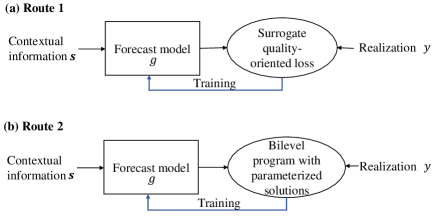
- 将预测模型训练表述为双层规划:上层优化模型参数以最小化预期两阶段运行成本,下层则使用预测结果作为输入求解日前与实时调度问题。
- 采用迭代求解策略,其中上层损失函数由下层优化返回的最优运行成本导出。
- 证明上层目标函数相对于预测模型输出具有局部线性特性,从而支持基于梯度的优化。
- 采用基于预测结果与真实实现结果之间运行成本差距的代理损失函数,实现高效训练。
- 将该方法应用于具有线性规划(LP)形式的集中式风电功率调度问题,日前与实时阶段均采用LP建模。
- 通过交替求解下层调度问题与使用梯度下降更新预测模型参数的方式,迭代求解双层规划。

实验结果
研究问题
- RQ1通过最小化运行成本训练的预测模型,是否在真实调度问题中优于传统质量导向的预测方法?
- RQ2所提出的面向价值的预测方法在计算效率上与两阶段随机规划相比如何?
- RQ3在两阶段调度中,预测质量(以RMSE衡量)与运行成本降低之间存在何种权衡?
- RQ4迭代式双层学习框架是否能有效将预测输出与多个时间周期内的最优调度决策对齐?
- RQ5在无需完整随机优化的情况下,所提出方法能否在高比例可再生能源渗透下维持低运行成本?
主要发现
- 尽管RMSE更高,所提方法相比质量导向预测方法将平均总运行成本降低了15 %。
- 所提方法的平均运行成本为2,036美元,低于随机规划的2,051美元,表明其成本表现更优。
- 计算时间从随机规划的17.8秒缩短至所提方法的3.99毫秒,提速达4,500倍。
- 所提方法的平均日前成本为2,106美元,低于随机规划的2,201美元,表明调度更高效。
- 所提方法的实时成本为-70美元(负值),表明调节有效且惩罚减少,而随机规划下为-150美元。
- 该方法保持了损失函数相对于预测输出的局部线性,从而可通过梯度下降实现稳定高效的优化。
更好的研究,从现在开始
从阅读论文到最终审阅,大幅缩短您的研究时间。
无需绑定信用卡
本解读由 AI 生成,并经人工编辑审核。