
[论文解读] Towards a Modular Architecture for Science Factories
本文提出了一种面向科学工厂的模块化架构——一种集成人工智能与高性能计算(HPC)的自主实验室系统,采用可重构硬件模块、机械臂及软件工作流。该系统实现了在多样化科学领域中可扩展、可重用且可组合的科学实验,已在生物学与材料科学领域通过五个实际应用得到验证,集成15套机器人系统并集成数字孪生技术。
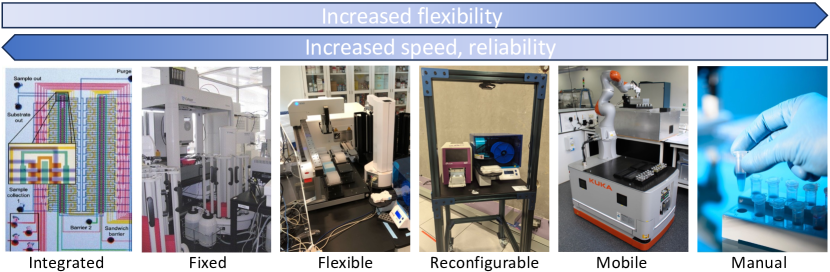
Advances in robotic automation, high-performance computing (HPC), and artificial intelligence (AI) encourage us to conceive of science factories: large, general-purpose computation- and AI-enabled self-driving laboratories (SDLs) with the generality and scale needed both to tackle large discovery problems and to support thousands of scientists. Science factories require modular hardware and software that can be replicated for scale and (re)configured to support many applications. To this end, we propose a prototype modular science factory architecture in which reconfigurable modules encapsulating scientific instruments are linked with manipulators to form workcells, that can themselves be combined to form larger assemblages, and linked with distributed computing for simulation, AI model training and inference, and related tasks. Workflows that perform sets of actions on modules can be specified, and various applications, comprising workflows plus associated computational and data manipulation steps, can be run concurrently. We report on our experiences prototyping this architecture and applying it in experiments involving 15 different robotic apparatus, five applications (one in education, two in biology, two in materials), and a variety of workflows, across four laboratories. We describe the reuse of modules, workcells, and workflows in different applications, the migration of applications between workcells, and the use of digital twins, and suggest directions for future work aimed at yet more generality and scalability. Code and data are available at https://ad-sdl.github.io/wei2023 and in the Supplementary Information
研究动机与目标
- 解决当前缺乏通用性、可扩展且可重构的平台用于自主科学发现的问题。
- 克服现有自主实验室系统普遍存在的刚性、不可移动且难以扩展的局限性。
- 实现在多样化实验领域中大规模、并行且可编程的科学工作流。
- 通过标准化接口,支持物理模块、计算资源与人工智能/机器学习(AI/ML)流程之间的互操作性。
- 促进工作流在不同实验室配置间的可重用性、可迁移性以及基于数字孪生的仿真。
提出的方法
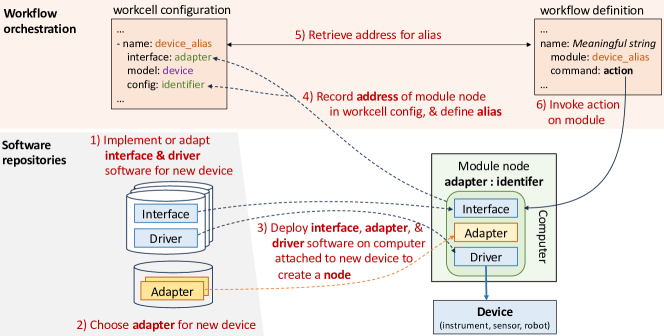
- 设计六功能程序化接口,用于模块化科学仪器,以标准化硬件与软件之间的交互。
- 引入一种物理形态(“小车”),以标准化模块的机械与电气集成。
- 将工作单元定义为模块与机械臂的组合,实现模块化、可重构的实验单元。
- 开发符号表示系统,用于指定模块与工作单元的配置,以支持可复现性与组合性。
- 实现工作流引擎,协调跨模块的动作序列,支持并发执行。
- 集成数字孪生技术,用于在物理执行前对工作流进行仿真与验证,从而提高可靠性并减少试错成本。
实验结果
研究问题
- RQ1模块化架构在多学科科学领域中,如何实现自主科学实验室的可扩展与可重用部署?
- RQ2标准化接口与形态是否能有效支持异构机器人仪器之间的互操作性与可重构性?
- RQ3在统一、可组合的工作流系统中,人工智能、仿真与物理实验的集成效果如何?
- RQ4数字孪生与工作流在不同工作单元间的迁移是否能提升实验效率并缩短开发时间?
- RQ5在多个实验室与应用中部署模块化科学工厂,面临哪些实际挑战与优势?
主要发现
- 该模块化架构成功支持了五个不同的科学应用——其中两个在生物学领域,两个在材料科学领域,一个在教育领域——覆盖四个实验室。
- 系统集成了15种不同的机器人装置,证明了其广泛的硬件兼容性与可重构能力。
- 工作流与应用在不同工作单元之间成功实现重用与迁移,验证了该架构的可组合性。
- 数字孪生技术实现了工作流在物理执行前的仿真与验证,降低了实验风险与迭代时间。
- 系统展示了多个应用的并行执行能力,完整集成了AI模型训练、推理与基于HPC的仿真。
- 已建立公开的代码与数据仓库,包含用于可复现性的标签发布版本,核心工作流执行软件可通过 https://github.com/AD-SDL/rpl_wei 获取。
更好的研究,从现在开始
从阅读论文到最终审阅,大幅缩短您的研究时间。
无需绑定信用卡
本解读由 AI 生成,并经人工编辑审核。