
[论文解读] Towards an MLOps Architecture for XAI in Industrial Applications
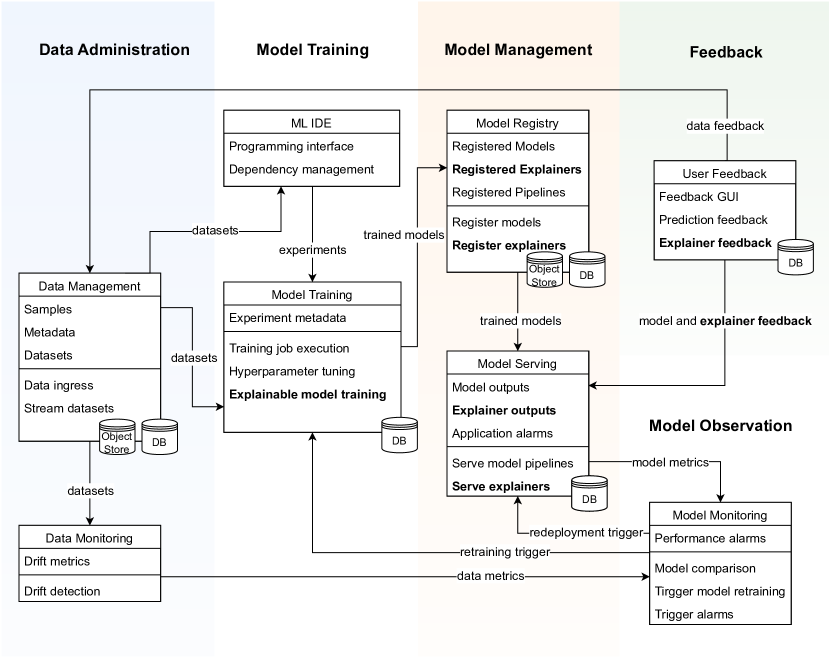
本文提出了一种新颖的MLOps架构,将可解释人工智能(XAI)集成到工业机器学习工作流中,实现端到端的可解释性、反馈收集和模型管理。该架构在工业用例中通过EXPLAIN项目实现,采用MLflow、Seldon Core和Evidently等标准化工具,简化了模型生命周期管理,内置XAI与反馈机制,增强了非技术利益相关者的信任与透明度。
Machine learning (ML) has become a popular tool in the industrial sector as it helps to improve operations, increase efficiency, and reduce costs. However, deploying and managing ML models in production environments can be complex. This is where Machine Learning Operations (MLOps) comes in. MLOps aims to streamline this deployment and management process. One of the remaining MLOps challenges is the need for explanations. These explanations are essential for understanding how ML models reason, which is key to trust and acceptance. Better identification of errors and improved model accuracy are only two resulting advantages. An often neglected fact is that deployed models are bypassed in practice when accuracy and especially explainability do not meet user expectations. We developed a novel MLOps software architecture to address the challenge of integrating explanations and feedback capabilities into the ML development and deployment processes. In the project EXPLAIN, our architecture is implemented in a series of industrial use cases. The proposed MLOps software architecture has several advantages. It provides an efficient way to manage ML models in production environments. Further, it allows for integrating explanations into the development and deployment processes.
研究动机与目标
- 填补工业MLOps解决方案中缺乏本机可解释性与利益相关者反馈支持的空白。
- 使不具备机器学习专业知识的领域专家能够积极参与模型开发、部署与验证。
- 构建一个可扩展、模块化的MLOps堆栈,本机集成XAI工具与反馈循环,适用于工业应用。
- 通过持续监控数据漂移、概念漂移与预测质量,确保模型可靠性。
- 通过使模型决策透明且可交互,弥合技术ML团队与工业实践者之间的鸿沟。
提出的方法
- 基于工业项目需求与真实部署约束,设计模块化MLOps架构。
- 将H2O、IBM AI Explainability 360及自定义解释器等XAI工具集成到模型训练与推理管道中。
- 使用MLflow追踪实验、版本化模型与解释结果,并管理模型注册表。
- 通过Kubernetes上的Seldon Core部署模型,实现可扩展的生产级推理,并支持可解释性。
- 使用Evidently与Grafana实现数据监控,实时检测数据漂移与概念漂移。
- 开发基于Django的原型反馈GUI,用于图像数据的标注与修正,计划集成先进的图像专用解释器。
![Figure 1: Adopted explain life cycle from [ 14 ] .](https://ar5iv.labs.arxiv.org/html/2309.12756/assets/x1.png)
实验结果
研究问题
- RQ1如何扩展MLOps以本机支持工业机器学习部署中的可解释性与反馈?
- RQ2为使非技术领域专家能够理解并参与机器学习模型开发与推理,需要哪些架构组件?
- RQ3如何在集成的MLOps与XAI管道中检测并管理数据漂移与概念漂移?
- RQ4标准化工具如MLflow与Seldon Core在实现可扩展、版本化与可解释的模型管理中发挥何种作用?
- RQ5如何系统性地捕获并整合领域专家的反馈以改进模型迭代周期?
主要发现
- 所提出的MLOps架构成功将XAI集成到完整的机器学习生命周期中,实现了工业环境下的透明性与利益相关者参与。
- 使用MLflow进行模型与解释结果的版本化,实现了模型决策的可重现性与可审计性。
- 通过Evidently与Grafana有效监控数据与概念漂移,支持主动的模型维护。
- 已实现图像数据标注与修正的原型反馈GUI,计划进一步集成最先进的图像解释器。
- 通过Seldon Core实现模型服务,支持水平扩展,并在推理时集成可解释性。
- 尽管已取得进展,自动化再训练、告警机制与完整反馈循环集成仍不充分,被确定为未来工作的关键领域。
更好的研究,从现在开始
从阅读论文到最终审阅,大幅缩短您的研究时间。
无需绑定信用卡
本解读由 AI 生成,并经人工编辑审核。