
[论文解读] Towards Generative Modeling of Urban Flow through Knowledge-enhanced Denoising Diffusion
该论文提出KSTDiff,一种知识增强的时空扩散模型,通过利用可学习的体积估计器和编码城市环境与空间关系的知识图谱,为缺乏历史数据的区域生成动态城市流量。该模型在流量生成任务中达到最先进性能,并在长期生成与预测任务中表现出良好泛化能力,生成数据在关键指标上与真实数据相差不超过7.5%。
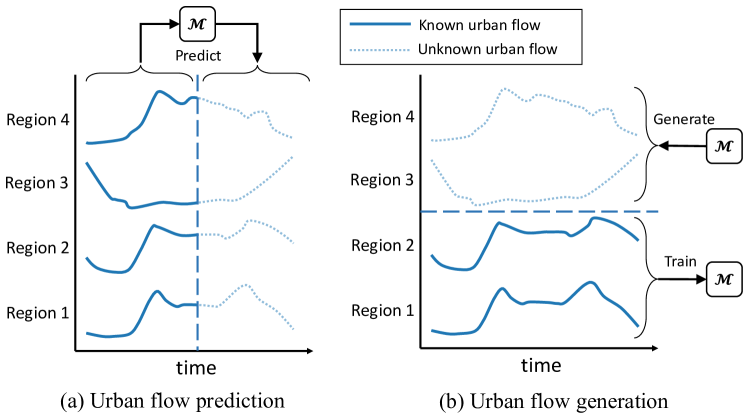
Although generative AI has been successful in many areas, its ability to model geospatial data is still underexplored. Urban flow, a typical kind of geospatial data, is critical for a wide range of urban applications. Existing studies mostly focus on predictive modeling of urban flow that predicts the future flow based on historical flow data, which may be unavailable in data-sparse areas or newly planned regions. Some other studies aim to predict OD flow among regions but they fail to model dynamic changes of urban flow over time. In this work, we study a new problem of urban flow generation that generates dynamic urban flow for regions without historical flow data. To capture the effect of multiple factors on urban flow, such as region features and urban environment, we employ diffusion model to generate urban flow for regions under different conditions. We first construct an urban knowledge graph (UKG) to model the urban environment and relationships between regions, based on which we design a knowledge-enhanced spatio-temporal diffusion model (KSTDiff) to generate urban flow for each region. Specifically, to accurately generate urban flow for regions with different flow volumes, we design a novel diffusion process guided by a volume estimator, which is learnable and customized for each region. Moreover, we propose a knowledge-enhanced denoising network to capture the spatio-temporal dependencies of urban flow as well as the impact of urban environment in the denoising process. Extensive experiments on four real-world datasets validate the superiority of our model over state-of-the-art baselines in urban flow generation. Further in-depth studies demonstrate the utility of generated urban flow data and the ability of our model for long-term flow generation and urban flow prediction. Our code is released at: https://github.com/tsinghua-fib-lab/KSTDiff-Urban-flow-generation.
研究动机与目标
- 为解决在缺乏历史数据的区域(如新规划或郊区区域)生成逼真城市流量的挑战。
- 建模受区域特征和城市环境影响的动态、时变城市流量特性。
- 开发一种条件生成模型,可在不同条件下生成多样化且逼真的流量模式。
- 在真实流量数据不可用的城市规划与交通管理等实际应用中实现应用。
- 展示生成数据在下游任务(如起讫(OD)流量估计)中的实用性。
提出的方法
- 构建城市知识图谱(UKG),以编码区域之间的空间关系以及土地利用、基础设施等环境特征。
- 设计一种知识增强的去噪网络,在反向去噪过程中同时关注时空流量模式与UKG编码的上下文信息。
- 引入基于可学习体积估计器的区域定制化扩散过程,该估计器可预测流量体积并按区域条件化生成过程。
- 通过条件扩散建模生成多步动态城市流量,条件输入包括区域特征、UKG上下文和估计体积。
- 使用去噪目标进行模型训练,以最小化噪声输入与真实流量序列之间的重建误差。
- 通过将体积估计器替换为历史流量作为输入,将模型适配用于城市流量预测,实现端到端预测。
实验结果
研究问题
- RQ1基于扩散的生成模型能否为缺乏历史流量数据的区域生成逼真且动态的城市流量模式?
- RQ2知识增强的扩散模型在多大程度上能捕捉城市流量的时空依赖性及环境影响?
- RQ3生成的城市流量数据在多大程度上可替代真实数据用于下游任务(如OD流量估计)?
- RQ4该模型能否泛化至长期流量生成,并支持城市流量的预测建模?
- RQ5基于区域的体积估计组件在不同流量规模区域中如何提升生成质量?
主要发现
- KSTDiff在城市流量生成方面优于最先进基线模型,在纽约市数据集上CPC达到0.715,在北京数据集上达到0.554,接近真实数据(分别为0.773和0.582)。
- KSTDiff生成的数据在纽约市和北京市的CPC分别比真实数据低7.50%和4.81%,表明其在OD生成任务中具有强大实用性。
- 在城市流量预测任务中,KSTDiff在华盛顿特区数据集上将RMSE降低14.2%,MAE相比基线提升5.5%,展现出强泛化能力。
- 该模型成功生成了保持逼真时间动态与空间模式的长期流量序列。
- 知识增强的去噪网络通过将UKG上下文整合到去噪过程中,显著提升了性能,优于未引入此类上下文的模型。
- 区域定制的体积估计器有效应对了不同区域间流量体积的高方差,提升了高流量与低流量区域的生成保真度。
更好的研究,从现在开始
从阅读论文到最终审阅,大幅缩短您的研究时间。
无需绑定信用卡
本解读由 AI 生成,并经人工编辑审核。