
[论文解读] Towards Openness Beyond Open Access: User Journeys through 3 Open AI Collaboratives
本文分析三个人工智能开放协作组织——BigScience、The Turing Way,以及 Mozilla Festival 的 Building Trustworthy AI Working Group(TAIWG)—以绘制其社区结构和从发现到领导的用户旅程,突出开放协作如何扩大 AI 的参与。
Open Artificial Intelligence (Open source AI) collaboratives offer alternative pathways for how AI can be developed beyond well-resourced technology companies and who can be a part of the process. To understand how and why they work and what additionality they bring to the landscape, we focus on three such communities, each focused on a different kind of activity around AI: building models (BigScience workshop), tools and ways of working (The Turing Way), and ecosystems (Mozilla Festival's Building Trustworthy AI Working Group). First, we document the community structures that facilitate these distributed, volunteer-led teams, comparing the collaboration styles that drive each group towards their specific goals. Through interviews with community leaders, we map user journeys for how members discover, join, contribute, and participate. Ultimately, this paper aims to highlight the diversity of AI work and workers that have come forth through these collaborations and how they offer a broader practice of openness to the AI space.
研究动机与目标
- 理解开放 AI 协作在实践中的组织与治理方式。
- 绘制成员在三种不同社区中如何发现、加入、贡献并领导的过程。
- 识别这些倡议如何扩大参与并使 AI 超越传统科技公司的民主化。
提出的方法
- 使用公开材料(GitHub、Hugging Face Hub、会议记录)对三个人工智能开放社区进行定性分析,以记录其结构与活动。
- 通过对社区领导者的访谈,了解明确与隐性的治理及成员体验。
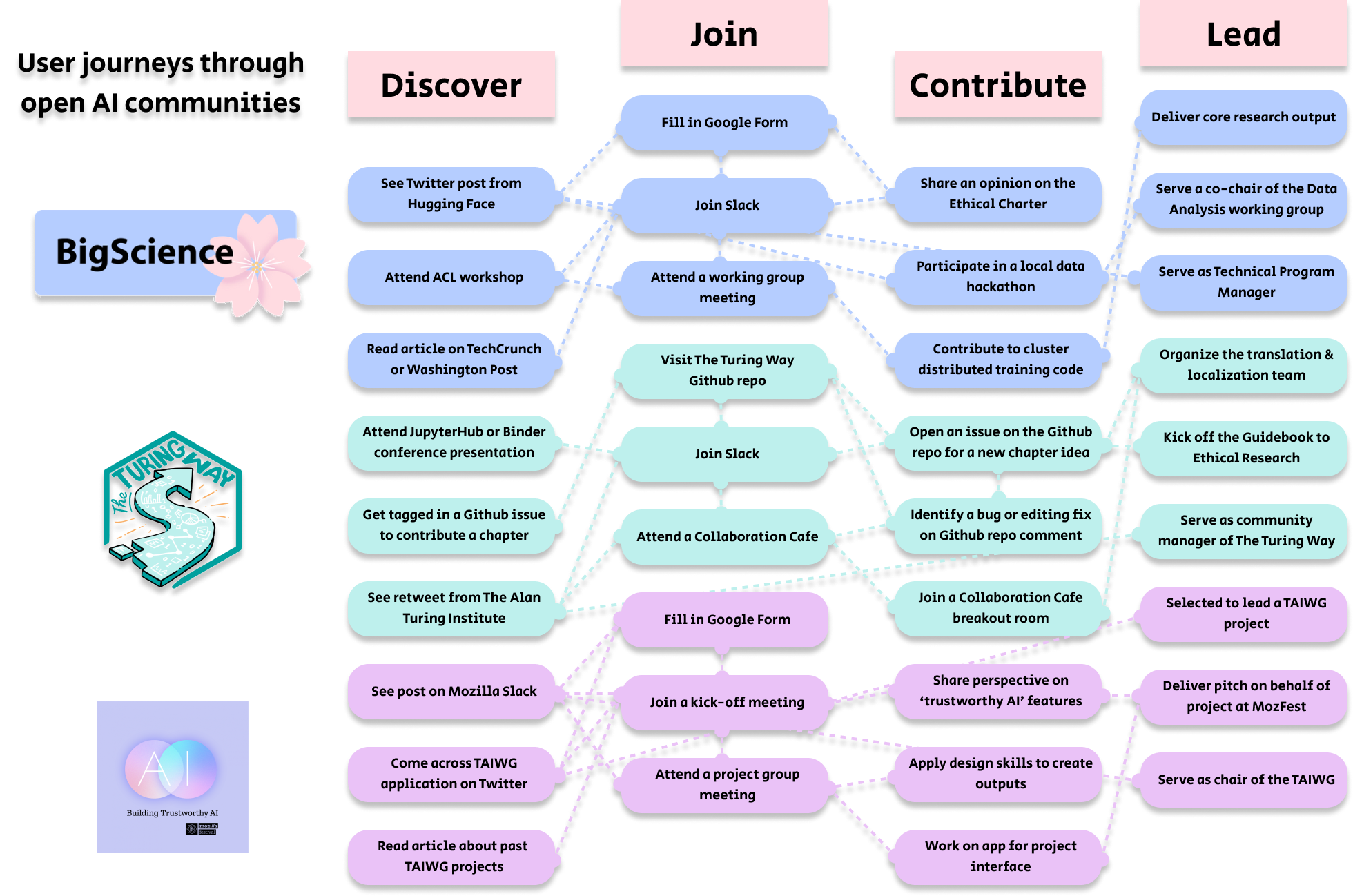
- 对成员在发现、加入、贡献与领导四个阶段的旅程进行比较映射。
实验结果
研究问题
- RQ1这三个人工 AI 开放社区是如何被结构化以实现分布式、志愿者驱动的工作?
- RQ2成员在这些社区中从发现到领导的典型用户旅程是什么?
- RQ3这些社区以何种方式多样化参与,扩大 AI 生态系统超越传统组织?
主要发现
- BigScience、The Turing Way 以及 MozFest TAIWG 各通过数字入口和公开材料来实现开放参与。
- 发现阶段通常依赖于组织声誉和知名成员,同时进行多元化努力以吸引更广泛的成员。
- 加入由开放渠道促进,但在积极贡献前可能存在潜伏参与。
- 贡献受到各社区特定入口点的引导,某些情况下可能需要与经验丰富的成员配对。
- 领导路径通过正式角色、项目所有权或邀请等方式产生,并伴随认可与基础设施支持。
- 这些协作共同展示了开放 AI 工作的多样模型,并为更广泛、包容性的 AI 合作提供模板。
更好的研究,从现在开始
从论文设计到论文写作,大幅缩短您的研究时间。
无需绑定信用卡
本解读由 AI 生成,并经人工编辑审核。