
[论文解读] Towards quantum-enabled cell-centric therapeutics
该论文设想利用量子计算,包括量子机器学习和优化,推动健康与生命科学领域以细胞为中心的治疗,并概述量子在HCLS研究中潜在领域、工具与未解决问题。
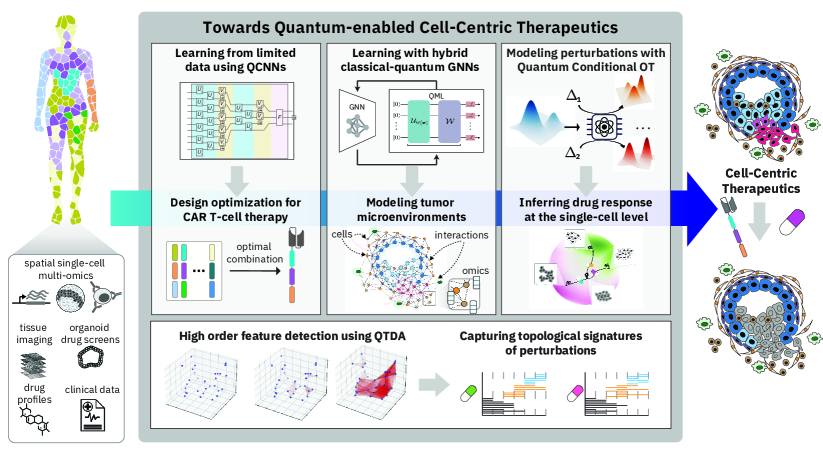
In recent years, there has been tremendous progress in the development of quantum computing hardware, algorithms and services leading to the expectation that in the near future quantum computers will be capable of performing simulations for natural science applications, operations research, and machine learning at scales mostly inaccessible to classical computers. Whereas the impact of quantum computing has already started to be recognized in fields such as cryptanalysis, natural science simulations, and optimization among others, very little is known about the full potential of quantum computing simulations and machine learning in the realm of healthcare and life science (HCLS). Herein, we discuss the transformational changes we expect from the use of quantum computation for HCLS research, more specifically in the field of cell-centric therapeutics. Moreover, we identify and elaborate open problems in cell engineering, tissue modeling, perturbation modeling, and bio-topology while discussing candidate quantum algorithms for research on these topics and their potential advantages over classical computational approaches.
研究动机与目标
- 推动量子计算在健康与生命科学(HCLS)中的潜力,超越密码学与化学。
- 识别细胞为中心的治疗领域,量子方法相较经典方法可能的优势。
- 评述与HCLS应用相关的当前量子硬件、软件工具与算法。
- 提出将单细胞与空间组学数据与量子驱动工作流整合以设计治疗的愿景。
- 强调细胞工程、组织建模、扰动建模与生物拓扑领域中的未解决问题。
提出的方法
- 讨论量子硬件的最新进展(量子比特、误差缓解、电路裁剪)及其对HCLS工作流的影响。
- 概述量子工具箱和服务(例如 Qiskit Runtime)以及它们如何使云端量子计算在HCLS任务中可用。
- 评述与HCLS相关的量子算法,包括量子仿真(VQE、QSE、qEOM)、量子优化(QAOA、量子蒙特卡洛)和量子机器学习(QSVM、QNNs)。
- 描述量子数据科学技术,如量子拓扑数据分析、累积量计算和量子网络医学,作为细胞为中心的治疗范式的组成部分。
- 提出一个量子驱动的细胞为中心治疗的概念框架,利用单细胞和空间技术描绘代谢与动力学以用于治疗设计。
- 讨论近端量子与容错量子计算的考量,以及需要领域专家协作以在规模上发现可处理的问题。
![Figure 1: Quantum computing state-of-the-art. A : Reproduced with permission from [ 63 ] . Different levels of metrics to express the quality of quantum hardware. Along with number of qubits, quantum gate quality is an important quality metric. This is typically expressed in terms of Quantum Volume](https://ar5iv.labs.arxiv.org/html/2307.05734/assets/x1.png)
实验结果
研究问题
- RQ1哪些是对细胞为中心的治疗设计最具潜力的量子驱动方法?
- RQ2量子机器学习和优化如何改进对单细胞和空间组学数据的分析以用于治疗发现?
- RQ3细胞工程、组织建模、扰动建模和生物拓扑中有哪些可以通过量子算法解决的未解决问题?
- RQ4实现对HCLS应用具有实际量子优势所需的硬件/软件发展是什么?
- RQ5如何将量子网络医学概念整合到以细胞为中心的治疗工作流中?
主要发现
- 量子硬件与软件的进展正在扩大在人类健康与生命科学任务中进行有意义的量子计算的可行性。
- 具备误差缓解和电路裁剪的近端量子设备能够解决比早期设备更大规模的问题,从而在医疗保健情境中实现早期量子驱动实验。
- 一套量子算法(仿真、优化、ML)与工具箱(如 Qiskit Runtime)正在定位为补充经典方法,在药物设计、生物标志物发现和组织建模方面。
- 量子数据科学概念,如量子 TDA、累积量、重描述和网络医学,为从复杂的多组学数据中提取模式提供新途径。
- 该论文提出了量子驱动的细胞为中心治疗的愿景与路线图,呼吁量子领域和HCLS研究者协同共同创造灵感来源于生物学的量子算法。
更好的研究,从现在开始
从论文设计到论文写作,大幅缩短您的研究时间。
无需绑定信用卡
本解读由 AI 生成,并经人工编辑审核。