
[论文解读] Towards Self-Interpretable Graph-Level Anomaly Detection
SIGNET 共同检测图级异常并通过从图及其对偶超图学习跨视图瓶颈子图来提供解释,且无需监督。
Graph-level anomaly detection (GLAD) aims to identify graphs that exhibit notable dissimilarity compared to the majority in a collection. However, current works primarily focus on evaluating graph-level abnormality while failing to provide meaningful explanations for the predictions, which largely limits their reliability and application scope. In this paper, we investigate a new challenging problem, explainable GLAD, where the learning objective is to predict the abnormality of each graph sample with corresponding explanations, i.e., the vital subgraph that leads to the predictions. To address this challenging problem, we propose a Self-Interpretable Graph aNomaly dETection model (SIGNET for short) that detects anomalous graphs as well as generates informative explanations simultaneously. Specifically, we first introduce the multi-view subgraph information bottleneck (MSIB) framework, serving as the design basis of our self-interpretable GLAD approach. This way SIGNET is able to not only measure the abnormality of each graph based on cross-view mutual information but also provide informative graph rationales by extracting bottleneck subgraphs from the input graph and its dual hypergraph in a self-supervised way. Extensive experiments on 16 datasets demonstrate the anomaly detection capability and self-interpretability of SIGNET.
研究动机与目标
- 定义可解释的图级异常检测(Explainable GLAD),其中模型输出一个异常分数和一个推理子图。
- 开发一个自解释的 GLAD 模型,在没有真实异常标签的情况下学习解释。
- 提出一个多视图子图信息瓶颈(MSIB)框架,用于提取有信息量的瓶颈子图。
- 利用对偶超图变换创建不同视图并实现自监督学习。
- 证明 SIGNET 在异常检测性能方面具有很强的表现并提供有意义的解释。
提出的方法
- 引入 MSIB 作为自解释 GLAD 的设计基础。
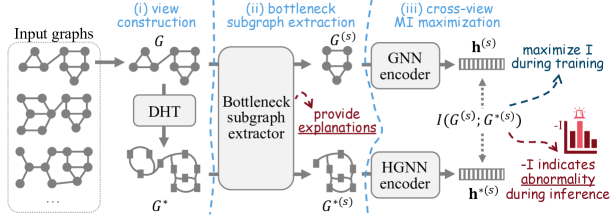
- 通过 Dual Hypergraph Transformation (DHT) 为每个图构建两个视图:原始图 G 及其对偶超图 G*。
- 使用瓶颈子图提取器生成对 G^(s) 和 G^(s)* 定义的概率性节点/边选择。
- 通过 Info-NCE 目标最大化跨视图互信息 I(h_{G^(s)}; h_{G^(s)*}),以学习表征和解释。
- 在推断阶段,将异常分数计算为 -I(h_{G^(s)}; h_{G^(s)*}),并通过瓶颈子图中前 k 的节点/边提供解释。
- 可选地,将节点概率提升为边概率,以在不同视图之间对齐子图,并使用单一提取器以简化结构。

实验结果
研究问题
- RQ1SIGNET 是否能够为 GLAD 的预测提供有信息量的解释(通过瓶颈子图的解释)?
- RQ2SIGNET 在跨多样数据集识别异常图方面的效果如何?
- RQ3SIGNET 的核心设计选择对性能和可解释性有哪些贡献?
主要发现
- SIGNET 在六个可解释的 GLAD 数据集上实现了最先进的解释性能,平均 NX-AUC 提升 27.89%,EX-AUC 提升 8.99% 相对于基线。
- SIGNET 在 16 个数据集中的 10 个数据集上在异常检测方面超越基线,在其余数据集上具有竞争力。
- 对偶超图变换提供了清晰、稳定的视图,并实现了基于边的解释。
- 使用单个提取器为两个视图生成瓶颈子图可提升一致性并降低模型复杂度。
- 定量和定性结果表明 SIGNET 给到判别性动机的概率更高,从而产生有意义的解释。
更好的研究,从现在开始
从论文设计到论文写作,大幅缩短您的研究时间。
无需绑定信用卡
本解读由 AI 生成,并经人工编辑审核。