
[论文解读] Towards Zero-trust Security for the Metaverse
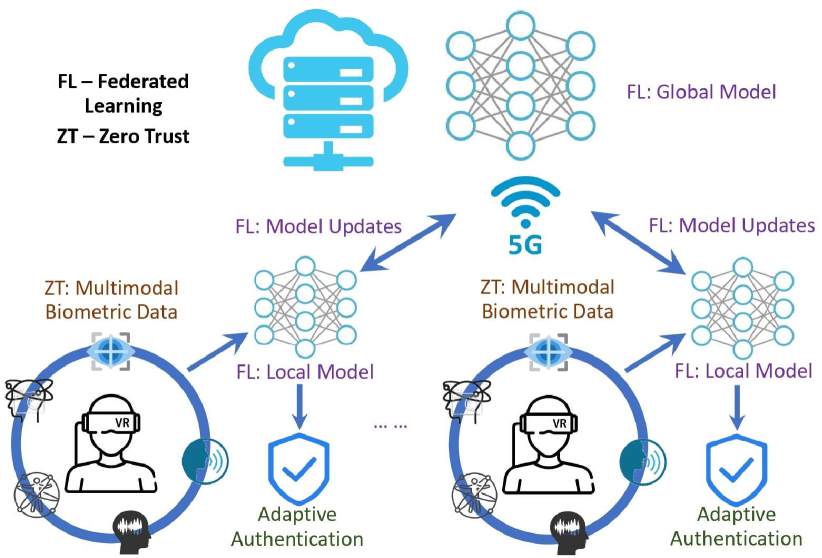
提出 MetaGuard,一个隐私保护的、基于联邦学习的框架,用于社交VR中的连续、多模态生物识别认证,以在元宇宙中实现零信任安全。
By focusing on immersive interaction among users, the burgeoning Metaverse can be viewed as a natural extension of existing social media. Similar to traditional online social networks, there are numerous security and privacy issues in the Metaverse (e.g., attacks on user authentication and impersonation). In this paper, we develop a holistic research agenda for zero-trust user authentication in social virtual reality (VR), an early prototype of the Metaverse. Our proposed research includes four concrete steps: investigating biometrics-based authentication that is suitable for continuously authenticating VR users, leveraging federated learning (FL) for protecting user privacy in biometric data, improving the accuracy of continuous VR authentication with multimodal data, and boosting the usability of zero-trust security with adaptive VR authentication. Our preliminary study demonstrates that conventional FL algorithms are not well suited for biometrics-based authentication of VR users, leading to an accuracy of less than 10%. We discuss the root cause of this problem, the associated open challenges, and several future directions for realizing our research vision.
研究动机与目标
- 推动元宇宙的零信任安全与社交VR中的持续用户认证。
- 提出利用多模态生物识别的隐私保护、基于FL的认证框架。
- 识别仅使用正标签本地数据时的FL挑战并勾勒未来改进。
- 探索自适应、多模态和个性化认证以平衡易用性与安全性。
提出的方法
- 将MetaGuard定义为面向VR用户的基于FL的隐私保护连续认证框架。
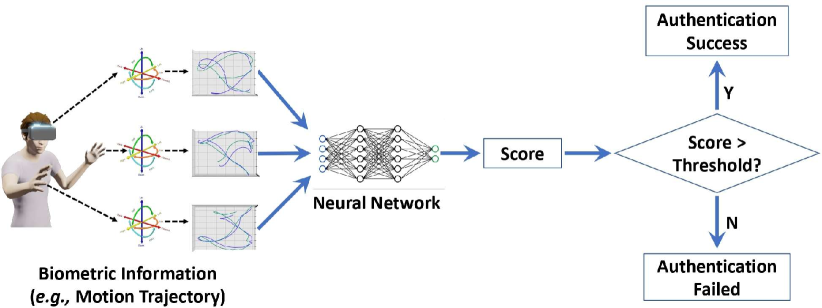
- 研究用于认证的多模态生物识别数据(如头部/身体运动、凝视、语音)。
- 演示在VR认证中仅使用正标签数据时,标准FL(FedAvg)的局限性。
- 提出个性化的多模态数据融合与基于时间序列的模型(如VRNN/LSTM)以提高准确性。
- 讨论自适应认证以平衡可靠性、易用性和资源使用。
实验结果
研究问题
- RQ1在不共享原始生物识别数据的情况下,联邦学习是否能够实现VR中的隐私保护连续认证?
- RQ2在现实VR使用场景下,哪些生物识别模态及融合策略能在元宇宙中实现稳健的零信任认证?
- RQ3随着用户数量增加,基于FL的VR认证面临哪些可扩展性挑战,个性化如何提供帮助?
- RQ4在保持可靠性和隐私的同时,如何通过自适应认证降低资源消耗?
主要发现
- Conventional FL like FedAvg with positive-label-only data performs poorly (6.34% accuracy) in VR authentication.
- Non-privacy-preserving models (Siamese, FCN, ResNet) achieve 87–90% accuracy on the dataset used, highlighting privacy costs.
- FedAvg + FCN accuracy drops dramatically as the number of users increases (e.g., from >90% with 2 users to <10% with 25 users).
- Using all six modalities yields very low FedAvg+FCN accuracy (6.34%), while using fewer modalities can improve performance (e.g., 19.32% with three modalities).
- There is significant variability in best modality combinations across users, underscoring the need for personalized modality selection.
更好的研究,从现在开始
从论文设计到论文写作,大幅缩短您的研究时间。
无需绑定信用卡
本解读由 AI 生成,并经人工编辑审核。