
[论文解读] Trajectory Design for Energy Minimization in UAV-enabled Wireless Communications with Latency Constraints
本文提出一种两阶段无人机轨迹设计方法,用于在满足用户时延约束的前提下最小化能量消耗。该方法基于带时间窗的旅行商问题(TSPTW)使用动态规划(DP)寻找近似最优路径,随后联合优化各航段的无人机速度;DP在显著降低复杂度的同时实现接近穷举搜索的性能,优于基准方法在能量效率和中断性能方面的表现。
This paper studies energy-efficient unmanned aerial vehicle (UAV)-enabled wireless communications, where the UAV acts as a flying base station (BS) to serve the ground users (GUs) within some predetermined latency constraints, e.g., requested timeout (RT). Our goal is to design the UAV trajectory to minimize the total energy consumption while satisfying the RT requirement and energy budget, which is accomplished via jointly optimizing the trajectory and UAV's velocities along subsequent hops. The corresponding optimization problem is difficult to solve due to its non-convexity and combinatorial nature. To overcome this difficulty, we solve the original problem via two consecutive steps. Firstly, we propose two algorithms, namely heuristic search, and dynamic programming (DP) to obtain a feasible set of trajectories without violating the GU's RT requirements based on the traveling salesman problem with time window (TSPTW). Then, they are compared with exhaustive search and traveling salesman problem (TSP) used as reference methods. While the exhaustive algorithm achieves the best performance at a high computation cost, the heuristic algorithm exhibits poorer performance with low complexity. As a result, the DP is proposed as a practical trade-off between the exhaustive and heuristic algorithms. Specifically, the DP algorithm results in near-optimal performance at a much lower complexity. Secondly, for given feasible trajectories, we propose an energy minimization problem via a joint optimization of the UAV's velocities along subsequent hops. Finally, numerical results are presented to demonstrate the effectiveness of our proposed algorithms. ...
研究动机与目标
- 解决在严格用户时延要求下最小化无人机在无线网络中的能量消耗的挑战。
- 克服联合轨迹与速度优化问题的非凸性和组合性。
- 设计一种满足地面用户请求超时(RT)约束和能量预算的可行轨迹。
- 通过在穷举搜索与启发式方法之间提出实用的性能与计算复杂度权衡,实现性能与复杂度的平衡。
- 实现在传统基础设施不切实际的动态或稀疏网络环境中,无人机的节能运行。
提出的方法
- 将轨迹设计问题建模为带时间窗的旅行商问题(TSPTW),以纳入用户时延约束。
- 提出两种算法——启发式搜索与动态规划(DP)——以生成不违反RT要求的可行无人机路径。
- 将动态规划作为穷举搜索的实用替代方案,以显著降低计算复杂度,同时实现接近最优的性能。
- 对于每条可行路径,利用式(11)中的能量模型,联合优化各航段的无人机速度,以最小化总能量消耗。
- 将DP算法中性能最佳的路径集成到两阶段优化中:首先进行路径选择,然后进行速度优化。
- 作为潜在扩展,应用块坐标下降与连续凸逼近(SCA)方法对轨迹进行细调,以对准航点。
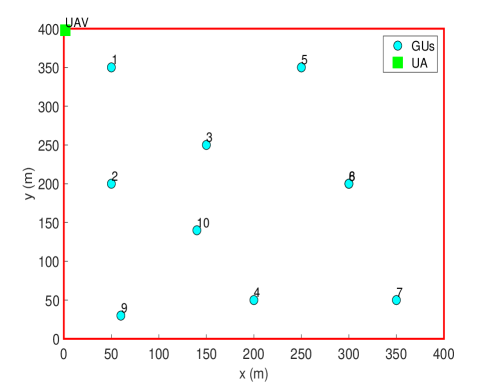
实验结果
研究问题
- RQ1如何联合优化无人机轨迹与速度,以在严格时延约束下最小化能量消耗?
- RQ2在寻找满足用户RT要求的可行无人机路径时,计算复杂度与性能之间的权衡是什么?
- RQ3动态规划能否在无人机轨迹规划中提供接近最优的解,且复杂度远低于穷举搜索?
- RQ4与基准方法(如TSP和启发式搜索)相比,所提方法在能量效率和中断性能方面表现如何?
- RQ5相较于固定速度方案,可变速度轨迹设计在多大程度上能提升无人机的能量效率?
主要发现
- 动态规划(DP)算法在显著降低计算复杂度的同时,实现了接近穷举搜索的能量消耗性能。
- 基于DP的轨迹设计将平均能量消耗降低至接近穷举搜索的水平,且运行时间大幅缩短。
- 启发式算法的性能劣于DP和穷举搜索,且随着网络规模增大,能量差距持续扩大。
- 由于航程变长及速度要求提高,能量消耗随网络规模增加而上升,尤其在$V_{ ext{max}}$受限时更为明显。
- 穷举搜索的运行时间随地面用户数量呈指数增长,使其在大规模部署中不切实际。
- 所提DP方法在能量消耗和中断概率方面均优于基于TSP的参考方案,展现出更优的鲁棒性与效率。
更好的研究,从现在开始
从阅读论文到最终审阅,大幅缩短您的研究时间。
无需绑定信用卡
本解读由 AI 生成,并经人工编辑审核。