
[论文解读] Transparency and Privacy: The Role of Explainable AI and Federated Learning in Financial Fraud Detection
本文提出了一种基于联邦学习(FL)的欺诈检测系统,并引入可解释人工智能(XAI),以解决金融机构在数据隐私和模型透明度方面的问题。通过在银行数据上本地训练模型并仅共享加密的模型更新,该方法在保护隐私的同时,实现了对罕见欺诈交易93%的检测准确率,且通过SHAP分析实现了可解释、可信的预测。
Fraudulent transactions and how to detect them remain a significant problem for financial institutions around the world. The need for advanced fraud detection systems to safeguard assets and maintain customer trust is paramount for financial institutions, but some factors make the development of effective and efficient fraud detection systems a challenge. One of such factors is the fact that fraudulent transactions are rare and that many transaction datasets are imbalanced; that is, there are fewer significant samples of fraudulent transactions than legitimate ones. This data imbalance can affect the performance or reliability of the fraud detection model. Moreover, due to the data privacy laws that all financial institutions are subject to follow, sharing customer data to facilitate a higher-performing centralized model is impossible. Furthermore, the fraud detection technique should be transparent so that it does not affect the user experience. Hence, this research introduces a novel approach using Federated Learning (FL) and Explainable AI (XAI) to address these challenges. FL enables financial institutions to collaboratively train a model to detect fraudulent transactions without directly sharing customer data, thereby preserving data privacy and confidentiality. Meanwhile, the integration of XAI ensures that the predictions made by the model can be understood and interpreted by human experts, adding a layer of transparency and trust to the system. Experimental results, based on realistic transaction datasets, reveal that the FL-based fraud detection system consistently demonstrates high performance metrics. This study grounds FL's potential as an effective and privacy-preserving tool in the fight against fraud.
研究动机与目标
- 解决金融欺诈检测中的数据隐私挑战,其中集中式数据共享违反监管和机构约束。
- 克服交易数据集中欺诈交易稀少导致的类别不平衡问题。
- 通过集成可解释人工智能(XAI)技术,提升模型可信度,实现透明、可解释的预测。
- 开发一种去中心化的欺诈检测框架,实现在不共享原始客户数据的前提下协同模型训练。
- 在真实交易数据集上评估基于联邦学习的系统与XAI集成的性能,重点关注准确率、精确率、召回率和F1分数。
提出的方法
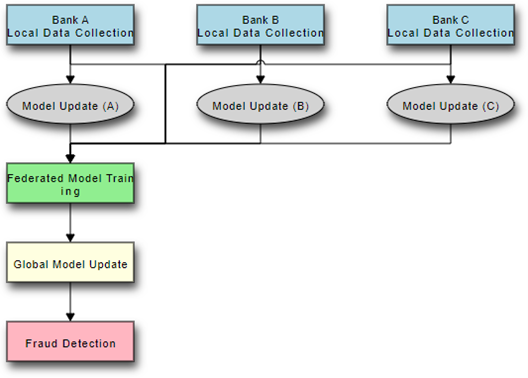
- 采用联邦学习(FL)在多个金融机构之间训练全局欺诈检测模型,而无需共享原始交易数据。
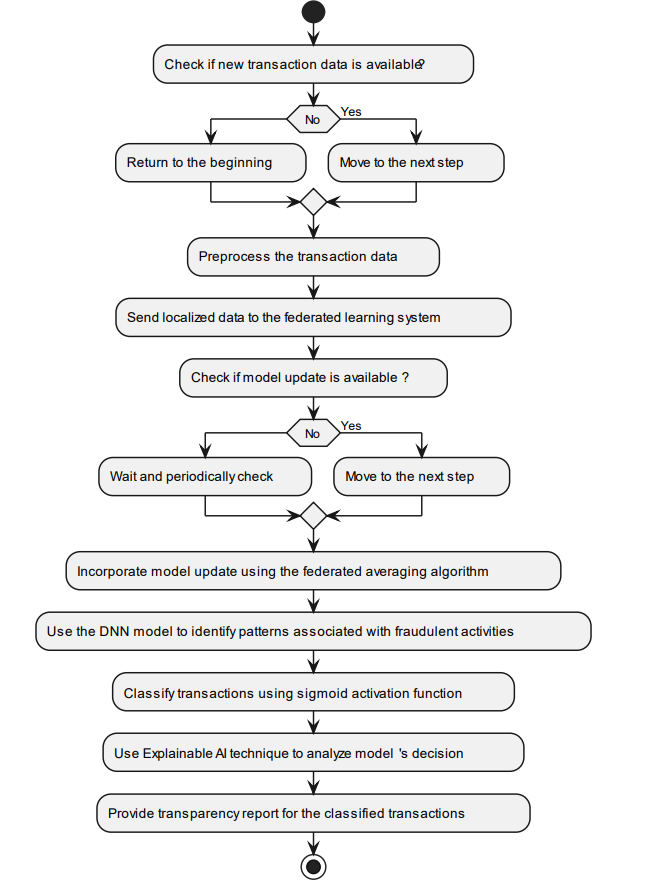
- 每个客户端(银行)在其专有的、类别不平衡的交易数据集上训练本地神经网络,并仅将更新后的模型权重发送至中央服务器。
- 中央服务器使用FedAvg(联邦平均)算法聚合这些模型更新,形成全局模型,通过迭代方式提升所有客户端的性能。
- 通过SHAP(SHapley Additive exPlanations)集成可解释人工智能(XAI)技术,以解释特征对模型预测的贡献,颜色编码的SHAP图显示正向(红色)和负向(蓝色)影响。
- 使用标准指标评估模型性能:准确率、精确率、召回率和F1分数,计算结果基于多个训练周期。
- 系统使用Flask实现服务器-客户端通信,并采用多线程技术以确保可扩展性和实时模型聚合。
实验结果
研究问题
- RQ1基于联邦学习的欺诈检测系统是否能在保护金融机构间数据隐私的前提下实现高性能?
- RQ2可解释人工智能(XAI)的集成在多大程度上提升了欺诈检测预测的透明度与可信度?
- RQ3FL框架在多大程度上缓解了交易数据集中因数据不平衡导致的性能下降问题?
- RQ4FL模型在多个训练周期中的收敛行为和性能稳定性如何?
- RQ5通过SHAP分析,哪些交易特征对欺诈预测的影响最大?
主要发现
- 经过收敛,基于联邦学习的欺诈检测模型最终达到93%的准确率,表明其在类别不平衡交易数据上表现出色。
- 精确率在约40个训练周期内线性增长,之后出现波动,表明模型已达到性能平台期。
- 召回率随训练周期数持续上升,表明模型随时间推移对欺诈案例的识别能力不断增强。
- F1分数随训练周期提升,表明精确率与召回率均得到平衡改善,但40个周期后改善幅度逐渐减小。
- SHAP分析显示,特征如2.15、0.418和0.517对欺诈预测具有最强正向影响,而1.15和-0.8等特征影响较弱。
- 通过SHAP图,模型的可解释性得到显著提升,清晰展示了各特征值对预测的贡献,支持在关键金融应用中实现信任与可审计性。
更好的研究,从现在开始
从阅读论文到最终审阅,大幅缩短您的研究时间。
无需绑定信用卡
本解读由 AI 生成,并经人工编辑审核。