
[论文解读] TSLANet: Rethinking Transformers for Time Series Representation Learning
TSLANet 提出了一种通用、轻量化的时间序列卷积模型,使用带自适应谱块的 FFT 基处理和自适应阈值,以及交互卷积块和自监督预训练,以应对多样化任务。
Time series data, characterized by its intrinsic long and short-range dependencies, poses a unique challenge across analytical applications. While Transformer-based models excel at capturing long-range dependencies, they face limitations in noise sensitivity, computational efficiency, and overfitting with smaller datasets. In response, we introduce a novel Time Series Lightweight Adaptive Network (TSLANet), as a universal convolutional model for diverse time series tasks. Specifically, we propose an Adaptive Spectral Block, harnessing Fourier analysis to enhance feature representation and to capture both long-term and short-term interactions while mitigating noise via adaptive thresholding. Additionally, we introduce an Interactive Convolution Block and leverage self-supervised learning to refine the capacity of TSLANet for decoding complex temporal patterns and improve its robustness on different datasets. Our comprehensive experiments demonstrate that TSLANet outperforms state-of-the-art models in various tasks spanning classification, forecasting, and anomaly detection, showcasing its resilience and adaptability across a spectrum of noise levels and data sizes. The code is available at https://github.com/emadeldeen24/TSLANet.
研究动机与目标
- 引入一个用于多样化时间序列任务的通用轻量级网络。
- 通过卷积运算捕捉长程和短程依赖。
- 相比 Transformer,降低对噪声的敏感性并提升效率。
- 通过自适应谱处理和交互卷积提升特征表示。
- 利用自监督预训练以提升跨数据集的鲁棒性。
提出的方法
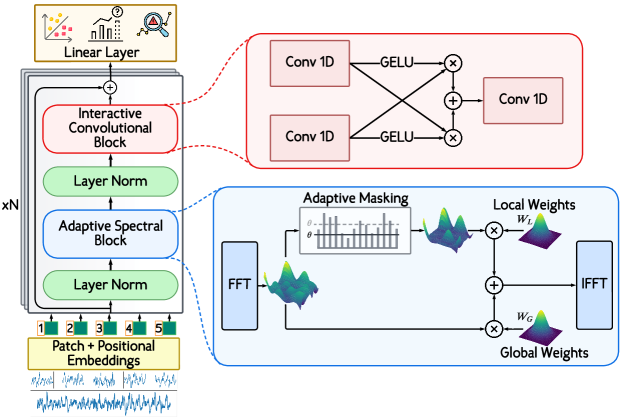
- 用自适应谱块替代自注意力,实现傅里叶域处理和自适应高频阈值化。
- 在谱域中使用全局和局部可学习滤波器,形成集成的谱表示。
- 引入一个具有多核卷积的交互卷积块,其输出相互作用调制。
- 将输入序列拆分为带有可学习位置嵌入的补丁,以形成用于处理的嵌入。
- 在谱处理后应用逆FFT回到时域。
- 通过掩码自编码器范式,将自监督预训练聚焦于补丁级重建。
实验结果
研究问题
- RQ1基于卷积的架构结合自适应谱处理,是否能够在时间序列分类、预测和异常检测方面达到或超过基于 Transformer 的模型?
- RQ2自适应频域滤波如何影响噪声鲁棒性以及长程/短程依赖建模?
- RQ3交互卷积块在捕捉多尺度时序模式方面的影响是什么?
- RQ4自监督预训练是否在多样化时间序列数据集上提升性能和鲁棒性?
主要发现
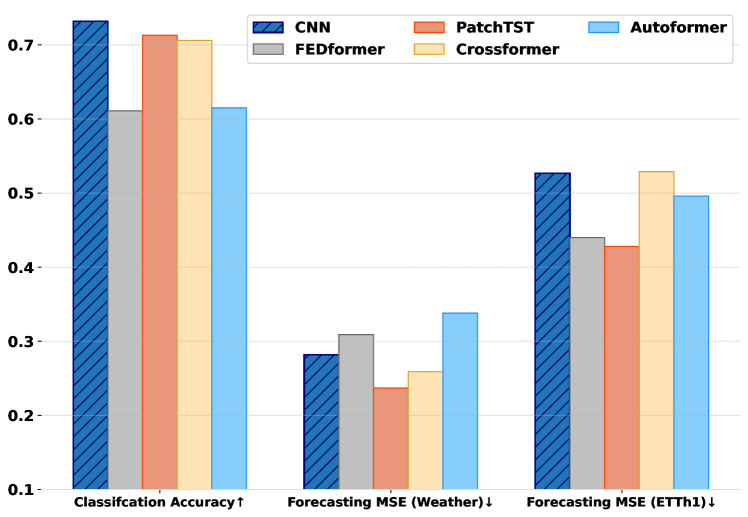
- TSLANet 在分类、预测和异常检测任务中实现了优于若干最新基线的性能。
- 具有自适应高频阈值的自适应谱块(ASB)在降低噪声的同时保留了相关的谱信息。
- 交互卷积块通过使多尺度卷积之间发生交互,提升了特征提取。
- 自监督预训练进一步提升了跨数据集的表示质量和鲁棒性。
- TSLANet 在 FLOPs 和参数量方面相比某些 Transformer 基模型具有竞争力的准确性。
- 消融研究表明在去除 ASB 或 ICB 时性能显著下降,验证了它们的贡献。
更好的研究,从现在开始
从论文设计到论文写作,大幅缩短您的研究时间。
无需绑定信用卡
本解读由 AI 生成,并经人工编辑审核。