
[论文解读] TuRMoiL of Survival: A Unified Survival Criterion for Cloud-Wind Interactions
该论文提出了一种新的统一云体生存准则,用于热超音速风中的云体,其基础是将热风流体微元穿越云体的剪切 timescale 与混合气体的最大冷却 timescale 进行比较。该准则通过使用物理解释一致的 timescale,解决了先前模型中长期存在的不一致问题,并在高风/云密度对比的流体动力学模拟中准确预测了云体的生存状态。
Cloud-wind interactions play an important role in long-lived multiphase flows in many astrophysical contexts. When this interaction is primarily mediated by hydrodynamics and radiative cooling, the survival of clouds can be phrased in terms of the comparison between a timescale that dictates the evolution of the cloud-wind interaction, (the dynamical time-scale $τ_{ m dyn}$) and the relevant cooling timescale $τ_{ m cool}$. Previously proposed survival criteria, which can disagree by large factors about the size of the smallest surviving clouds, differ in both their choice of $τ_{ m cool}$ and (to a lesser extent) $τ_{ m dyn}$. Here we present a new criterion which agrees with a previously proposed empirical formulae but is based on simple physical principles. The key insight is that clouds can grow if they are able to mix and cool gas from the hot wind faster than it advects by the cloud. Whereas prior criteria associate $τ_{ m dyn}$ with the cloud crushing timescale, our new criterion links it to the characteristic cloud-crossing timescale of a hot-phase fluid element, making it more physically consistent with shear-layer studies. We develop this insight into a predictive expression and validate it with hydrodynamic ENZO-E simulations of ${\sim}10^4\, { m K}$, pressure-confined clouds in hot supersonic winds, exploring, in particular, high wind/cloud density contrasts, where disagreements are most pronounced. Finally, we illustrate how discrepancies among previous criteria primarily emerged due to different choices of simulation conditions and cooling properties, and discuss how they can be reconciled.
研究动机与目标
- 解决压力约束云体在热超音速风中云体生存准则的长期争议。
- 识别云体-风体相互作用中物理上正确的动力学 timescale,以云体穿越 timescale 取代先前研究中使用的云体粉碎 timescale。
- 定义一个与湍流辐射混合层(TRML)卷吸过程和相依赖冷却一致的冷却 timescale。
- 在高密度对比条件下,通过 enzo-e 流体动力学模拟验证新准则。
- 通过追溯模拟条件和冷却方案的差异,调和先前准则之间的不一致。
提出的方法
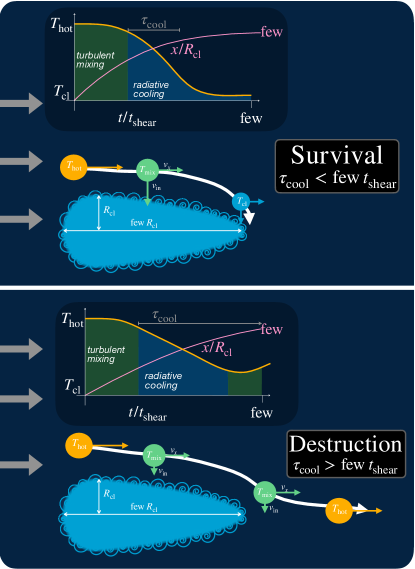
- 提出一种新生存准则,通过比较剪切 timescale $ t_{\rm shear} $(表示热风流体微元穿越云体所需时间)与混合气体的最大冷却 timescale $ t_{\rm cool,max} $。
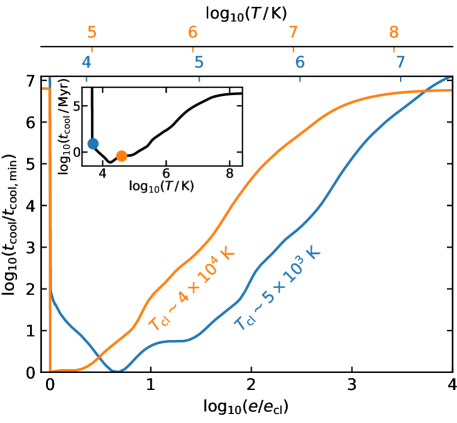
- 将 $ t_{\rm cool,max} $ 定义为云体温度 $ T_{\rm cl} $ 与混合层中达到的最低温度 $ T_{\rm min,cool} $ 之间的冷却 timescale 的最大值。
- 采用基于剪切层动力学推导出的物理上合理的 $ \tau_{\rm dyn} $,而非先前研究中使用的云体粉碎 timescale。
- 使用高分辨率 enzo-e 模拟验证该准则,模拟对象为温度约为 $ \sim 10^4 \, \text{K} $、压力约束的云体在热超音速风中,密度对比度 $ \chi \sim 10^4 $。
- 采用具有下限 $ T_{\rm min,cool} = \max(T_{\rm cl}, \, 10^{4.25} \, \text{K}) $ 的相依赖冷却函数,以真实模拟混合层中的冷却行为。
- 将新准则与先前的经验和理论生存准则进行比较,结果表明其与模拟观测结果一致,并解决了先前的不一致问题。
实验结果
研究问题
- RQ1在湍流辐射混合层中,云体-风体相互作用的物理上正确的动力学 timescale 是什么?
- RQ2在多相流中,应如何定义冷却 timescale 以准确预测云体生存?
- RQ3为何先前的生存准则在预测最小存活云体尺寸方面存在显著差异?
- RQ4是否可以使用单一、物理上合理的准则,重现经验校准准则的准确性?
- RQ5模拟设置和冷却方案的差异如何解释现有生存准则之间的不一致?
主要发现
- 基于 $ t_{\rm shear} \gtrsim t_{\rm cool,max} $ 的新准则,在高风/云密度对比($ \chi \sim 10^4 $)的 enzo-e 模拟中,能准确预测云体生存。
- 该准则通过揭示先前研究的不一致源于 $ \tau_{\rm dyn} $ 和 $ \tau_{\rm cool} $ 的不一致选择,而非根本物理差异,从而解决了这些不一致。
- 由热相流体穿越推导出的剪切 timescale $ t_{\rm shear} $,相比云体粉碎 timescale,与剪切层研究更符合物理实际。
- 在 $ T_{\rm cl} $ 与 $ T_{\rm min,cool} $ 之间计算的最大冷却 timescale $ t_{\rm cool,max} $,提供了一个稳健且物理基础坚实的冷却 timescale。
- 即使在极端条件下(如 $ T_{\rm cl} \gtrsim 10^4 \, \text{K} $),该准则依然表现良好,而此前的准则在此类条件下失效或需要非物理解释的云体尺寸。
- 该准则与 Farber & Gronke (2022) 对冷云体($ \sim 10^3 \, \text{K} $)的研究结果一致,表明其在星暴外流中冷相的广泛应用潜力。
更好的研究,从现在开始
从阅读论文到最终审阅,大幅缩短您的研究时间。
无需绑定信用卡
本解读由 AI 生成,并经人工编辑审核。