
[论文解读] Type II t-J model and shared antiferromagnetic spin coupling from Hund's rule in superconducting La$_3$Ni$_2$O$_7$
本文在高压下为 La3Ni2O7 提出了一种 Type II 双层 t-J 模型,表明 Hund’s 耦合介导层间自旋交换,并在高达 x≈0.5 的空洞掺杂量下仍能产生稳健的层间 s 波配对。
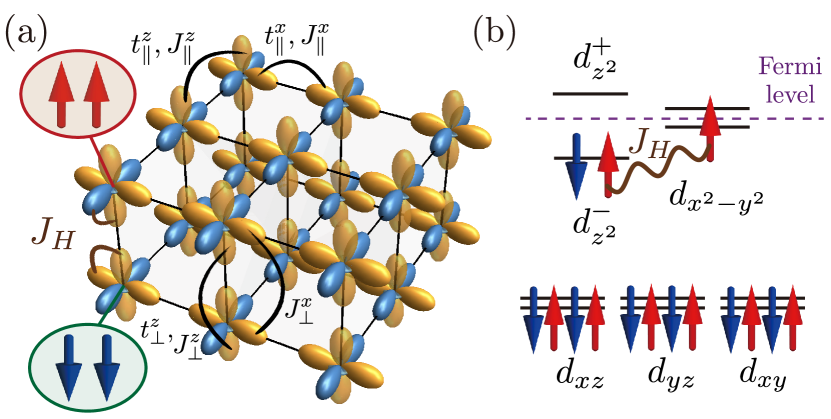
Recently, a 80 K superconductor was discovered in La$_3$Ni$_2$O$_7$ under high pressure. Density function theory (DFT) calculations identify $d_{x^2-y^2}$, $d_{z^2}$ as the active orbitals on the bilayer square lattice with a $d^{8-x}$ configuration of of Ni per site. One naive expectation is to describe this system in terms of a two-orbital t-J model. However, we emphasize the importance of Hund's coupling $J_H$ and the $x=0$ limit should be viewed as a spin-one Mott insulator. Especially, the significant Hund's coupling shares the inter-layer super-exchange $J_\perp$ of the $d_{z^2}$ orbital to the $d_{x^2-y^2}$ orbital, an effect that cannot be captured by conventional perturbation or mean-field approaches. In this study, we first explore the limit where the $d_{z^2}$ orbital is Mott localized, dealing with a one-orbital bilayer t-J model focused on the $d_{x^2-y^2}$ orbital. Notably, we find that strong inter-layer pairing survives up to $x=0.5$ hole doping driven by the transmitted $J_\perp$, which explains the existence of a high Tc superconductor in the experiment at this doping level. Next, we uncover the more realistic situation where the $d_{z^2}$ orbital is slightly hole-doped and cannot be simply integrated out. We take the $J_H ightarrow +\infty$ limit and propose a type II t-J model with four extit{spin-half} singlon ($d^7$) states and three extit{spin-one} doublon ($d^8$) states. Employing a parton mean-field approach, we recover similar results as in the one-orbital t-J model, but now with the effect of the $J_\perp$ automatically generated. We propose future experiments to electron dope the system to further enhance $T_c$.
研究动机与目标
- 为具有两个活性 Ni 轨道(d_x2−y2 和 d_z2)的 La3Ni2O7 的超导性提供最小低能建模的动机。
- 强调 Hund’s 耦合 J_H 在将层间交换 J_perp 共享给不同轨道中的作用。
- 研究较大的 J_perp 与自旋态约束如何影响配对与超导性。
- 探讨一个轨道被 Mott 局域化与两个轨道都活跃时的极限。
- 将微观模型与高压下实验观测到的 Tc≈80 K 联系起来。
提出的方法
- 在方格晶格上用两个 Ni 轨道构建双层双线性模型。
- 利用奴隶玻色平均场理论推导并分析具有层间 J_perp 的单轨道 t-J 极限。
- 在强 Hund’s 耦合下,引入具有四个自旋-1/2 单粒子态和三个自旋-1 双粒子态的 Type II t-J 模型。
- 应用三费米子部分子构造以处理受约束的希尔伯特空间。
- 进行自洽平均场解耦以获得层内和层间配对序参数。
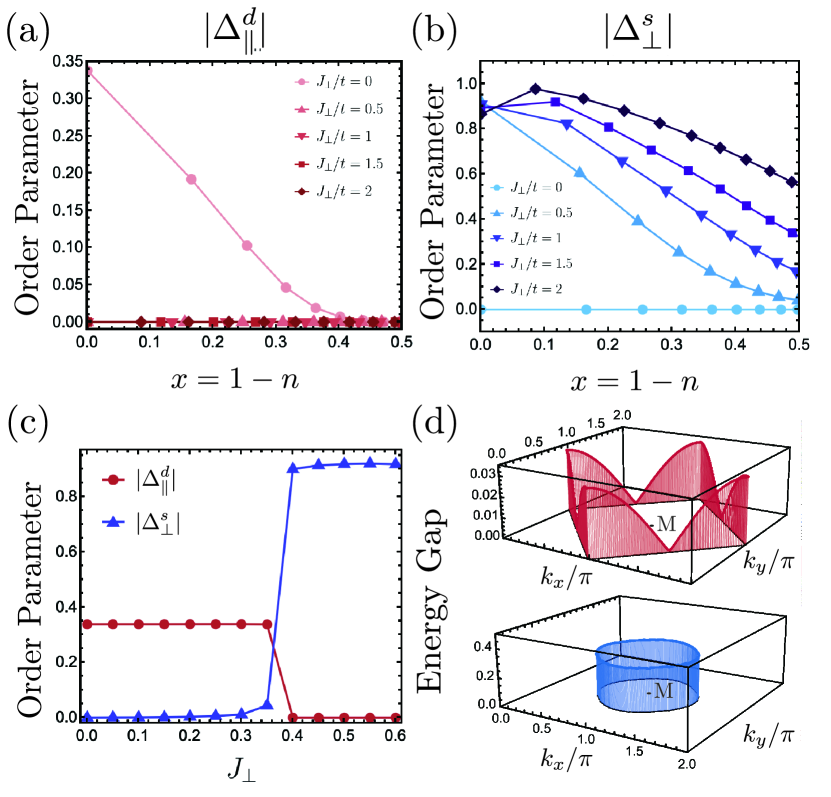
- 展示 J_perp 如何诱发从 d 波到层间 s 波配对的一阶转变。
实验结果
研究问题
- RQ1 Hund’s 耦合是否能够在镍酸盐轨道之间共享层间交换?
- RQ2在高空穴掺杂(x≈0.5)下,双层或 Type II t-J 框架是否能支持层间 s 波配对?
- RQ3层间交换 J_perp 如何随掺杂变化影响配对对称性与强度?
- RQ4当 d_z2 轨道在低能模型中为 Mott 局域化与否以及被适度掺杂时,会发生什么?
- RQ5三费米子部分子构造是否能够再现实验观测到的配对物理?
主要发现
- 双层单轨道 t-J 模型在强层间交换 J_perp 下,在 x 接近 0 时产生主导的层间 s 波配对,并在较大的 J_perp 下持续到 x≈0.5。
- 随着 J_perp 增加,配对从 d 波向 s 波发生一阶转变。
- 在大 J_perp 区间,层间配对间隙 Delta_perp 在 x=0.5 处保持有限,使 s 波配对的费米面完全开Gap。
- 在 Type II t-J 模型中,来自两轨道的增强 J_perp 传给 emergent 的 d_x2−y2 轨道,甚至在没有 t_perp 时也如此。
- 平均场结果与在约 50% 空洞掺杂下的高 Tc 超导实验观测相吻合,并显示层间配对对掺杂具有鲁棒性。
- 该框架还预测在电子掺杂时 Tc 将进一步提高,指向实验方向。
更好的研究,从现在开始
从论文设计到论文写作,大幅缩短您的研究时间。
无需绑定信用卡
本解读由 AI 生成,并经人工编辑审核。