
[论文解读] UAV-Enabled Mobile Edge Computing: Offloading Optimization and Trajectory Design
本文提出了一种用于无人机(UAV)增强型移动边缘计算的联合优化框架,通过联合设计计算卸载、CPU频率分配和无人机轨迹,最小化无人机能耗。采用序列凸优化方法,该方案实现了显著的节能效果和快速收敛,在动态用户卸载需求与能量采集约束条件下,仿真结果优于基准方法。
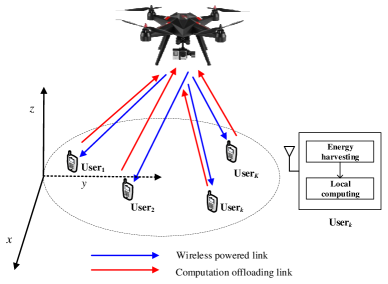
With the emergence of diverse mobile applications (such as augmented reality), the quality of experience of mobile users is greatly limited by their computation capacity and finite battery lifetime. Mobile edge computing (MEC) and wireless power transfer are promising to address this issue. However, these two techniques are susceptible to propagation delay and loss. Motivated by the chance of short-distance line-of-sight achieved by leveraging unmanned aerial vehicle (UAV) communications, an UAV-enabled wireless powered MEC system is studied. A power minimization problem is formulated subject to the constraints on the number of the computation bits and energy harvesting causality. The problem is non-convex and challenging to tackle. An alternative optimization algorithm is proposed based on sequential convex optimization. Simulation results show that our proposed design is superior to other benchmark schemes and the proposed algorithm is efficient in terms of the convergence.
研究动机与目标
- 为解决在增强现实等时延敏感型应用中移动用户计算能力有限和电池寿命短的问题。
- 克服因路径损耗和非视 Line-of-Sight 传播导致的固定位置移动边缘计算(MEC)与无线功率传输(WPT)系统能效受限的问题。
- 设计一种无人机增强型无线供能移动边缘计算系统,通过动态能量传输与轨迹控制实现可持续的计算卸载。
- 联合优化卸载比特数、用户与无人机的CPU频率以及无人机轨迹,以最小化无人机传输能耗,同时满足因果性与计算约束。
提出的方法
- 构建一个非凸的功率最小化问题,整合了计算卸载、能量采集因果性与无人机移动性。
- 应用序列凸逼近(SCA)方法,将联合优化问题分解为可处理的子问题,以迭代求解。
- 采用交替优化方法,在时分复用约束下,迭代优化卸载决策、CPU频率与无人机轨迹。
- 利用拉格朗日对偶与Karush-Kuhn-Tucker(KKT)条件,推导出子问题的闭式解。
- 实现一种基于SCA的替代算法,交替优化无人机轨迹与用户卸载/频率分配。
- 通过包含无人机速度、发射功率与用户计算需求等真实参数的仿真,验证了该方法的有效性。
实验结果
研究问题
- RQ1如何通过无人机轨迹设计提升无线供能移动边缘计算系统的能效?
- RQ2在动态无人机移动性条件下,计算卸载、本地处理与能量采集之间的最优权衡是什么?
- RQ3与基准方案相比,联合优化卸载比特数、CPU频率与无人机轨迹在降低无人机能耗方面效果如何?
- RQ4所提出的序列凸优化算法在多大程度上能实现快速收敛并达到近似最优性能?
主要发现
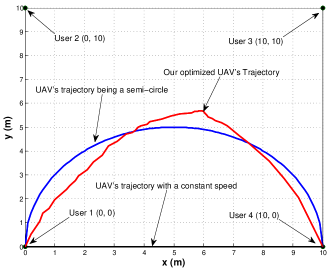
- 所提方案在仿真中比基准方案更有效地降低无人机能耗,总能耗最低。
- 所提方案下的无人机轨迹表现出自适应飞行行为——在高卸载需求用户附近飞行较慢,末段加速以平衡能耗。
- 所提算法仅需少数几次迭代即可收敛,展现出高计算效率与实际可行性。
- 仿真结果证实,联合优化卸载、CPU频率与无人机轨迹显著优于采用固定轨迹或静态资源分配的方案。
- 随着飞行时间增加,无人机总能耗降低,原因在于速度与CPU频率需求减少。
- 通过利用无人机移动性实现视 Line-of-Sight 能量传输与动态任务卸载,系统实现了更高的计算速率与更优的能效利用。
更好的研究,从现在开始
从阅读论文到最终审阅,大幅缩短您的研究时间。
无需绑定信用卡
本解读由 AI 生成,并经人工编辑审核。