
[论文解读] Ubiquitous Late Radio Emission from Tidal Disruption Events
本研究对23个光学发现的潮汐瓦解事件(TDEs)进行了射电观测,观测时间跨度为发现后500至3,200天,结果表明约40%的事件在发现后500至2,000天出现晚期射电辐射峰值。作者发现存在延迟的非相对论性喷流,其动能为10⁴⁷–10⁴⁹ erg,速度为0.02–0.15c,表明TDE演化中存在一种广泛但此前被忽视的阶段,其驱动力为延迟形成的吸积盘,而非非轴向喷流。
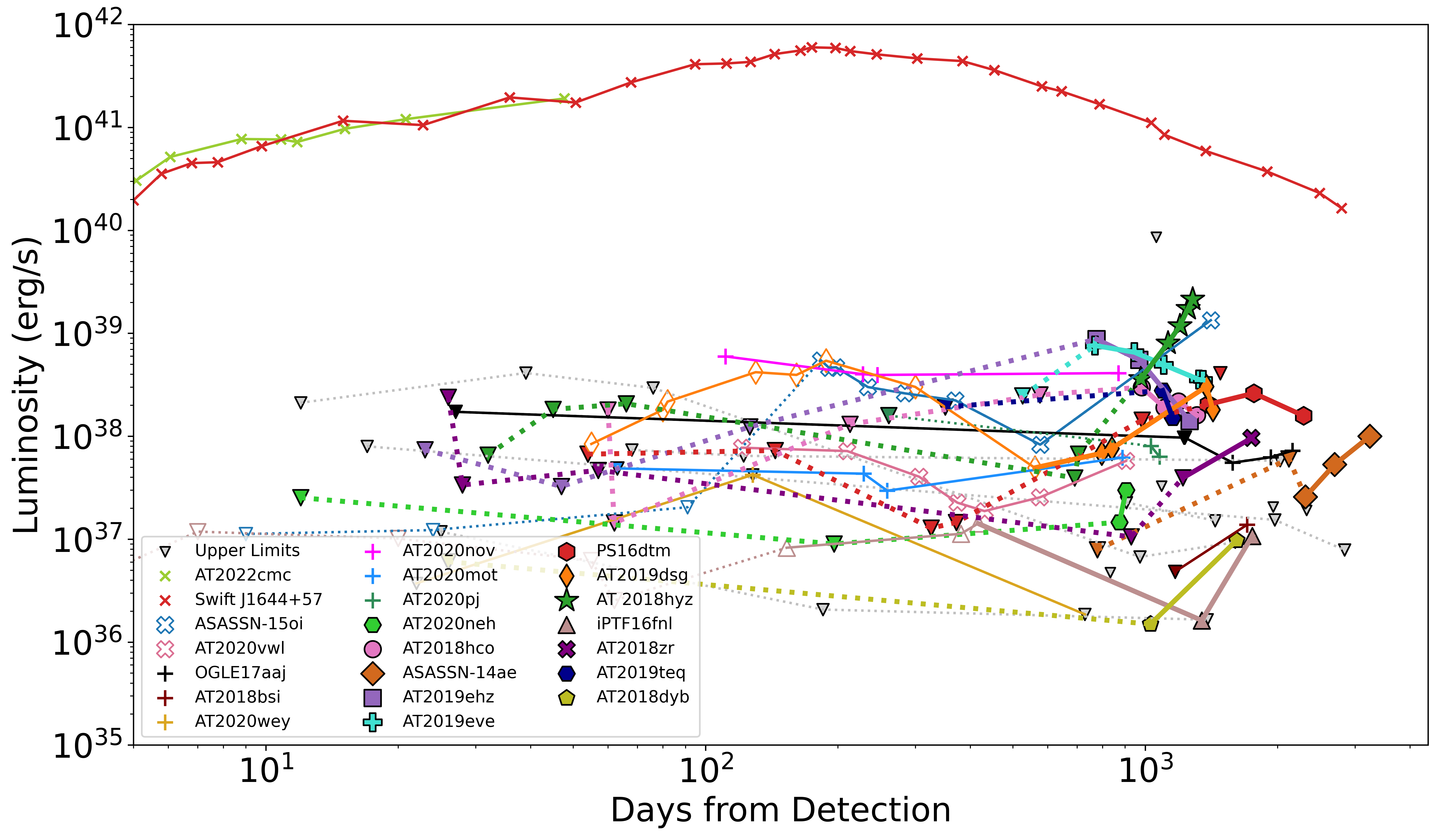
We present radio observations of 23 optically discovered tidal disruption events (TDEs) on timescales of 500-3200 days post discovery. We detect nine new TDEs that did not have detectable radio emission at earlier times, indicating a late-time brightening after several hundred (and up to 2300) days; an additional seven TDEs exhibit radio emission whose origin is ambiguous or may be attributed to the host galaxy or an active galactic nucleus. We also report a new rising component in one TDE previously detected in the radio at 10^3 days. While the radio emission in some of the detected TDEs peaked on a timescale 2-4 yr, over half of the sample still show rising emission. The range of luminosities for the sample is 10^37-10^39 erg/s, about 2 orders of magnitude below the radio luminosity of the relativistic TDE Sw J1644+57. Our data set indicates 40% of all optical TDEs are detected in radio hundreds to thousands of days after discovery, and that this is probably more common than early radio emission peaking at 10^2 days. Using an equipartition analysis, we find evidence for a delayed launch of the radio-emitting outflows, with delay timescales of 500-2000 days, inferred velocities of 0.02-0.15c, and kinetic energies of 10^47-10^49 erg. We rule out off axis relativistic jets as a viable explanation for this population, and conclude delayed outflows are a more likely explanation, possibly from delayed disk formation. We conclude late radio emission marks a fairly ubiquitous but heretofore overlooked phase of TDE evolution.
研究动机与目标
- 调查在发现后100天以外的晚期射电辐射在潮汐瓦解事件(TDEs)中的普遍性及其特性。
- 确定晚期射电辐射是由延迟喷流还是非轴向相对论性喷流引起的。
- 利用等离子体分配分析法表征TDE中射电辐射喷流的能量和运动学特性。
- 评估表现出晚期射电辐射的TDE的核周环境密度及膨胀动力学。
- 确定晚期射电辐射是否为光学TDE中普遍存在的演化阶段。
提出的方法
- 利用甚长基 baseline 射电望远镜(VLA)、MeerKAT和ATCA对23个光学发现的TDEs在发现后500至3,200天内进行深度射电观测。
- 采用等离子体分配分析法,根据射电光度和谱指数估算动能、洛伦兹因子和喷流速度。
- 将观测到的射电光变曲线与自由膨胀模型及相对论性喷流减速模型进行比较,以推断喷流动力学特性。
- 采用3–5%系统不确定性的流量密度校准,以提高光度和流量测量的可靠性。
- 分析射电光变曲线,识别上升、峰值和衰减阶段,重点关注初始未检测到后的延迟亮升温现象。
- 通过对比射电流量与档案数据及上限值,评估宿主星系和活动星系核(AGN)的污染影响。
实验结果
研究问题
- RQ1晚期射电辐射在光学TDE中是否普遍?其典型峰值时间尺度为何?
- RQ2何种物理机制——延迟喷流还是非轴向相对论性喷流——最能解释观测到的晚期射电增亮现象?
- RQ3晚期辐射TDE中射电辐射喷流的动能和速度分别为多少?
- RQ4晚期辐射TDE的核周环境与早期辐射TDE相比有何异同?
- RQ5仍处于光度上升阶段的TDE是否与自由膨胀或激波动力学一致?
主要发现
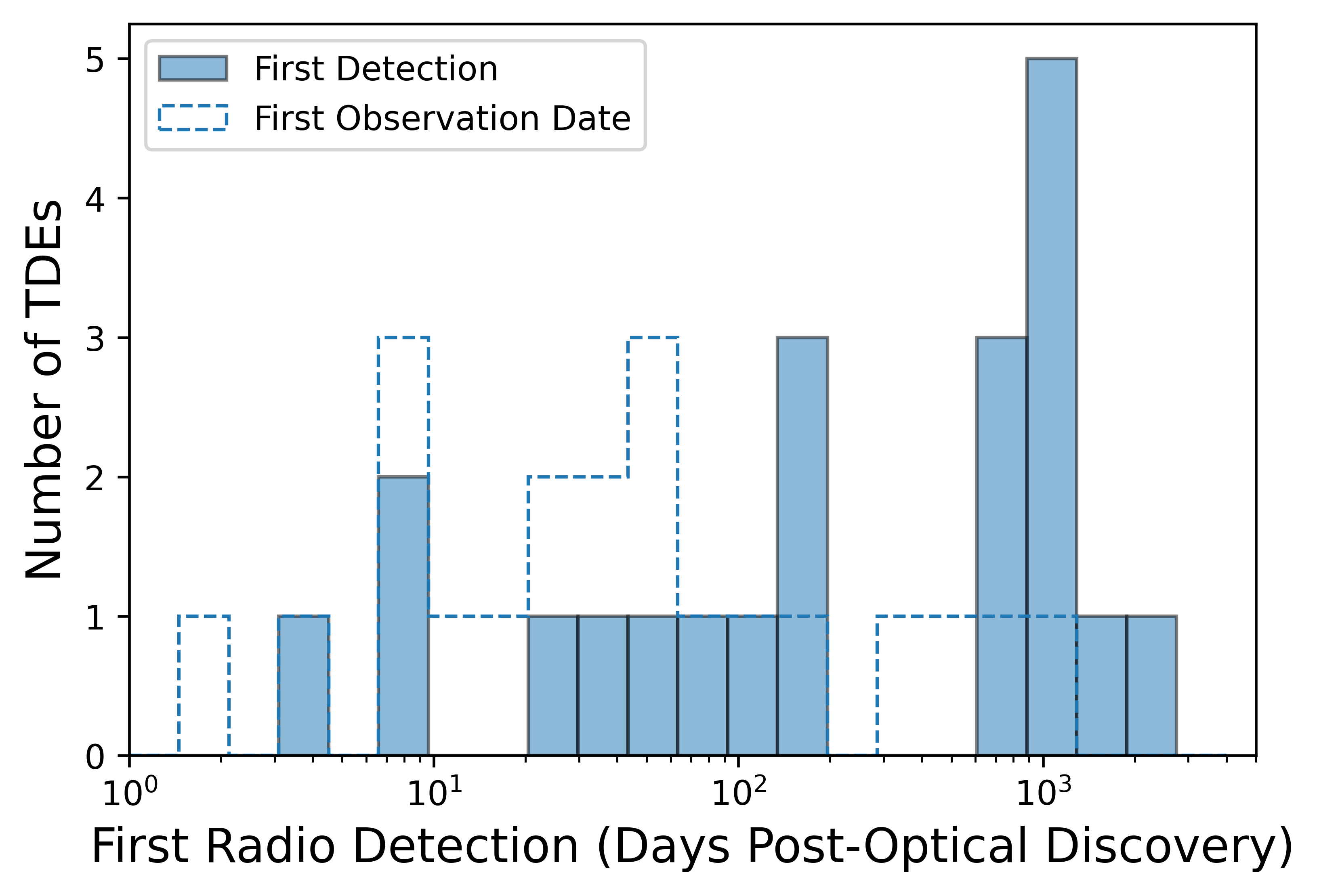
- 40%的光学TDE在发现后500至3,200天内表现出可检测的射电辐射,表明这是一种广泛存在但此前被忽视的演化阶段。
- 晚期射电辐射的峰值出现在2至4年的时间尺度,且超过一半的样本在观测时仍处于上升阶段。
- 等离子体分配分析显示存在延迟喷流,其动能为10⁴⁷–10⁴⁹ erg,速度为0.02–0.15c,与非相对论性激波一致。
- 观测到的射电辐射延迟(500至2,000天)排除了即时相对论性喷流的可能性,支持延迟吸积盘形成作为辐射起源。
- 晚期辐射TDE的核周密度与早期辐射TDE相当,表明其环境相似。
- 仍处于光度上升阶段的TDE与自由膨胀模型一致,支持激波驱动喷流模型,而非喷流减速模型。
更好的研究,从现在开始
从阅读论文到最终审阅,大幅缩短您的研究时间。
无需绑定信用卡
本解读由 AI 生成,并经人工编辑审核。