
[论文解读] Ubiquitous radio emission in quasars: predominant AGN origin and a connection to jets, dust and winds
本研究确立了红移 z < 2.5 的类星体中,紧凑射电辐射主要由活动星系核(AGN)驱动,而非恒星形成,射电光度与尘埃消光及致密核区环境中的喷流相互作用密切相关。作者发现射电探测率随 E(B-V) 持续增加,支持一种模型:即在尘埃介质中,喷流引发的激波增强射电辐射,尤其在具有紧凑形态和中等射电噪度的红类星体中更为显著。
We present a comprehensive study of the physical origin of radio emission in optical quasars at redshifts z < 2.5. We focus particularly on the associations between compact radio emission, dust reddening, and outflows identified in our earlier work. Leveraging the deepest low-frequency radio data available to date (LoTSS Deep DR1), we achieve radio detection fractions of up to 94%, demonstrating the virtual ubiquity of radio emission in quasars, and a continuous distribution in radio loudness. Through our analysis of radio properties, combined with spectral energy distribution modeling of multiwavelength photometry, we establish that the primary source of radio emission in quasars is the AGN, rather than star formation. Modeling the dust reddening of the accretion disk emission shows a continuous increase in radio detection in quasars as a function of the reddening parameter E(B-V), suggesting a causal link between radio emission and dust reddening. Confirming previous findings, we observe that the radio excess in red quasars is most pronounced for sources with compact radio morphologies and intermediate radio loudness. We find a significant increase in [Oiii] and Civ outflow velocities for red quasars not seen in our control sample, with particularly powerful [Oiii] winds in those around the radio-quiet/radio-loud threshold. Based on the combined characterisation of radio, reddening, and wind properties in our sample, we favor a model in which the compact radio emission observed in quasars originates in compact radio jets and their interaction with a dusty, circumnuclear environment. Our results align with the theory that jet-induced winds and shocks resulting from this interaction are the origin of the enhanced radio emission in red quasars. Further investigation of this model is crucial for advancing our understanding of quasar feedback mechanisms and their role in galaxy evolution.
研究动机与目标
- 确定 z < 2.5 光学类星体中微弱射电辐射的主要物理起源。
- 研究类星体中射电辐射、尘埃消光(E(B-V))和外流之间的关联。
- 检验紧凑射电喷流与致密、富含尘埃的核区环境相互作用是否可解释红类星体中观测到的射电过量。
- 评估喷流诱导激波与反馈在类星体演化及星系反馈机制中的作用。
提出的方法
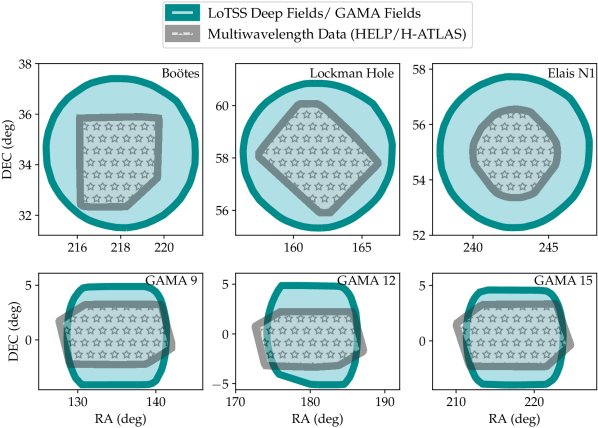
- 利用迄今最深的低频射电数据(LoTSS Deep DR1),在类星体中实现高达 94% 的射电探测率。
- 结合多波段测光与谱谱能谱分布(SED)建模,以区分射电辐射中 AGN 与恒星形成贡献。
- 通过 SED 拟合获得的 E(B-V) 量化尘埃消光,并将其与射电探测率及射电噪度相关联。
- 分析 [OIII] 和 CIV 发射线外流速度,以识别红类星体与对照样本中的风活动。
- 将射电形态分类为紧凑或延展,以评估环境在喷流约束与射电光度中的作用。
- 提出一个物理模型:即喷流与致密、富含尘埃的介质相互作用产生激波,从而增强射电辐射,尤其在紧凑源中更为显著。
实验结果
研究问题
- RQ1在 z < 2.5 的类星体中,射电辐射的主要物理起源是什么:AGN 喷流还是恒星形成?
- RQ2类星体中射电辐射与尘埃消光(E(B-V))之间有何关联?这是否暗示因果关系?
- RQ3紧凑射电喷流形态与环境在增强红类星体射电辐射中扮演何种角色?
- RQ4[OIII] 与 CIV 线的外流速度在红类星体与对照样本之间如何变化?这是否与射电特性相关?
- RQ5在富含尘埃的核区环境中,喷流诱导的激波是否可解释具有紧凑形态的红类星体中观测到的射电过量?
主要发现
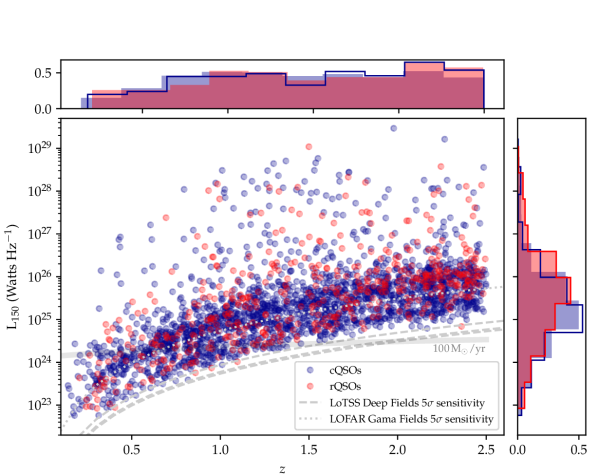
- 利用 LoTSS Deep DR1,类星体的射电探测率最高可达 94%,表明射电辐射在类星体中近乎普遍存在。
- 射电辐射的主要来源是 AGN,而非恒星形成,这一点通过 SED 建模以及紧凑、陡谱射电成分的主导性得到证实。
- 射电探测率随尘埃消光(E(B-V))持续上升,表明尘埃柱密度与增强射电辐射之间存在因果关联。
- 在具有紧凑射电形态和中等射电噪度(L_1.4GHz ~ 10^44–10^45 erg/s)的红类星体中,射电过量最为显著。
- 与对照样本相比,红类星体表现出显著更高的 [OIII] 和 CIV 外流速度,其中最强的 [OIII] 风速出现在射电安静/射电噪度阈值附近。
- 数据支持一种模型:即紧凑射电喷流与致密、富含尘埃的核区环境相互作用,产生激波,从而增强射电辐射并驱动外流,将射电、尘埃与反馈机制联系起来。
更好的研究,从现在开始
从阅读论文到最终审阅,大幅缩短您的研究时间。
无需绑定信用卡
本解读由 AI 生成,并经人工编辑审核。