
[论文解读] Ultra-fast interpretable machine-learning potentials
本文提出了超高速、可解释的机器学习势(UF² 和 UF²,³),结合三次 B 样条基函数与正则化线性回归,在计算速度上媲美传统经验势(如 Morse 势、Lennard-Jones 势)的同时,保持了接近最先进机器学习势的精度。该方法实现了大体系长时间尺度的全原子动力学模拟,其力和物理性质(如声子谱、弹性常数、熔点)与参考的密度泛函理论(DFT)数据高度一致。
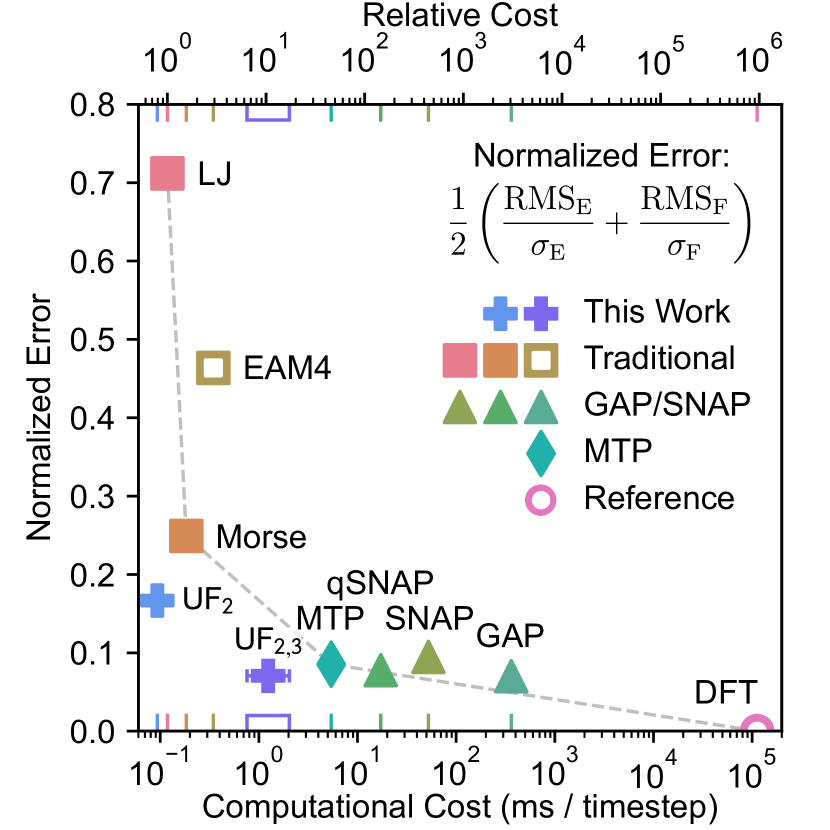
All-atom dynamics simulations are an indispensable quantitative tool in physics, chemistry, and materials science, but large systems and long simulation times remain challenging due to the trade-off between computational efficiency and predictive accuracy. To address this challenge, we combine effective two- and three-body potentials in a cubic B-spline basis with regularized linear regression to obtain machine-learning potentials that are physically interpretable, sufficiently accurate for applications, as fast as the fastest traditional empirical potentials, and two to four orders of magnitude faster than state-of-the-art machine-learning potentials. For data from empirical potentials, we demonstrate exact retrieval of the potential. For data from density functional theory, the predicted energies, forces, and derived properties, including phonon spectra, elastic constants, and melting points, closely match those of the reference method. The introduced potentials might contribute towards accurate all-atom dynamics simulations of large atomistic systems over long time scales.
研究动机与目标
- 开发兼具计算超高速与物理解释性的机器学习势,突破原子模拟中速度与精度之间的权衡。
- 通过结合经验势的速度与机器学习势的精度,实现大尺度全原子长时间动力学模拟。
- 提出一种基于灵活 B 样条基函数的可解释线性模型框架,用于训练基于有效二体与三体相互作用的模型。
- 证明所提方法在预测关键物理性质(如力、声子谱、弹性常数、熔点)方面可达到接近 DFT 的精度。
- 通过表格化力场实现训练后势函数与主流分子动力学软件(如 LAMMPS 和 GROMACS)的兼容与互操作。
提出的方法
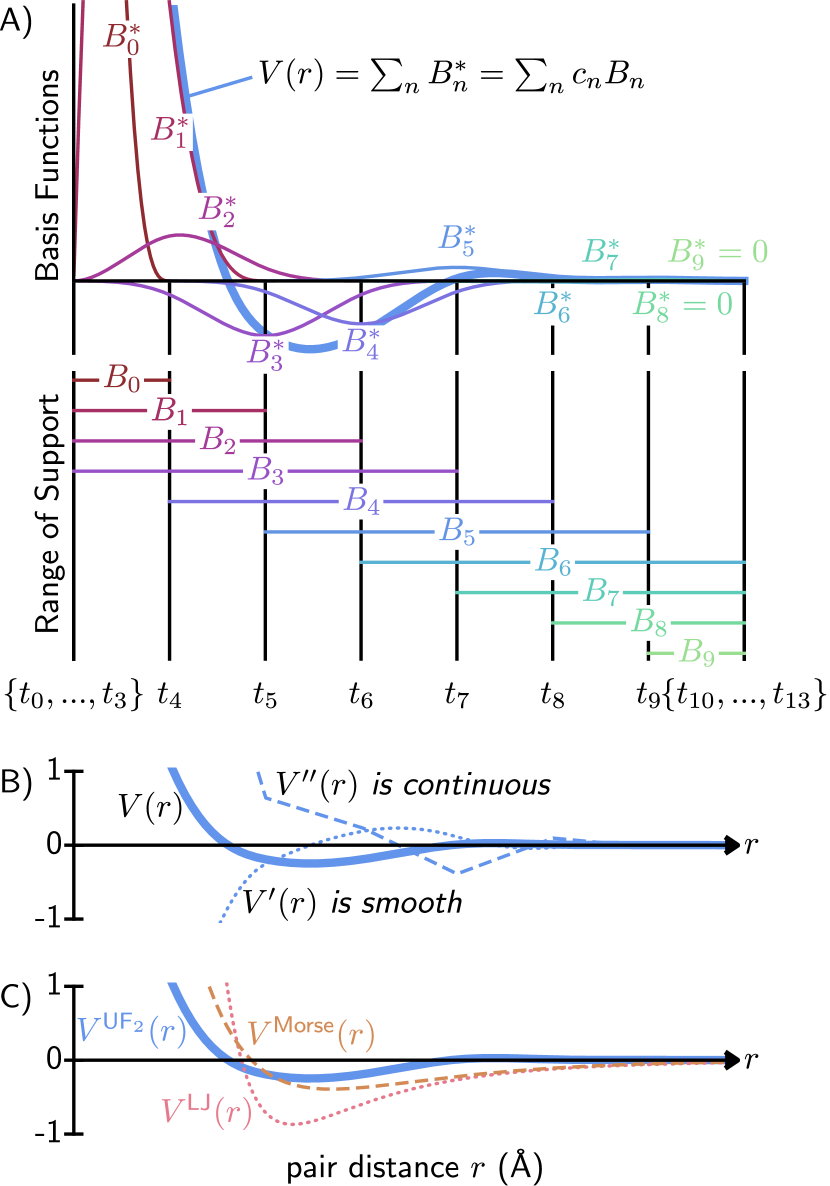
- 该方法使用三次 B 样条基函数表示有效二体与三体势,实现能量与力数据的平滑、灵活且可微分的插值。
- 应用正则化线性回归,将 B 样条系数拟合至来自经验势或密度泛函理论(DFT)的参考数据。
- 该方法在多体展开中截断至二体与三体项,聚焦于成对与角相互作用,忽略高阶项以提升计算效率。
- 模型在 DFT 或经验势数据上进行训练,当在经验势数据上训练时可精确还原原始势能,验证其表示保真度。
- 所得势能以兼容 LAMMPS、GROMACS 等 MD 软件的查找表形式导出,支持在 CPU 与 GPU 上快速评估。
- 通过将 B 样条基函数自然扩展至包含元素种类,该方法可轻松推广至多组分体系。
实验结果
研究问题
- RQ1是否可以设计一种线性机器学习势,使其在计算速度上媲美传统经验势,同时在精度上达到最先进机器学习势的水平?
- RQ2将可解释的、基于物理动机的函数形式(如二体与三体项)与 B 样条基函数结合,能在多大程度上在最小参数化下重现参考 DFT 数据?
- RQ3所提出的超高速势能预测的物理性质(如声子谱、弹性常数、熔点)与 DFT 及其他机器学习势相比表现如何?
- RQ4该方法是否可推广至多组分体系,同时保持精度与计算效率?
- RQ5在不同体系尺寸下,该超高速势能的计算成本与现有机器学习势及经验势相比如何?
主要发现
- 超高速势(UF²,³)的计算速度与最快的经验势(如 Morse 势、Lennard-Jones 势)相当,在 AMD EPYC 7702 CPU 上的基准耗时为 0.76–2.03 ms/步。
- 当在经验势数据上训练时,模型可精确还原原始势能,证实其表示能力的保真度。
- 在 DFT 衍生的训练数据上,预测的能量、力、声子谱、弹性常数与熔点均与参考 DFT 结果高度一致,表现出高精度。
- UF²,³ 势预测的熔点为 3650 K,与 DFT 参考值 3650 K 完美一致,验证了其热力学精度。
- 使用 UF²,³ 势计算的弹性常数与声子色散关系与 DFT 结果高度一致,证实其在力学与振动性质上的准确性。
- 该方法实现了对大体系(如 2048 个原子)长时间尺度的全原子动力学模拟,通过成功的双相熔点计算得到验证。
更好的研究,从现在开始
从阅读论文到最终审阅,大幅缩短您的研究时间。
无需绑定信用卡
本解读由 AI 生成,并经人工编辑审核。