
[论文解读] Ultrashort dissipative Raman solitons in Kerr resonators driven with phase-coherent optical pulses
本论文通过相位相干脉冲泵浦,在标准电信光纤克尔谐振器中实现了确定性生成超短耗散型拉曼孤子,脉冲全宽半最大值(FWHM)小于100 fs。通过利用熔融石英中的本征拉曼增益并精确控制色散,作者在保持亚GHz重复频率的同时实现了创纪录的超短脉冲,从而实现了可扩展、芯片兼容的频率梳,且线间距可定制。
External driving of passive, nonlinear optical resonators has emerged over the past decade as a novel route for the generation of ultrashort optical pulses and corresponding broadband frequency combs. Whilst the pulse formation dynamics in such systems differ dramatically from those manifesting themselves in conventional mode-locked lasers, the demarcation between the two traditionally distinct paradigms has recently begun to blur, with demonstrations of hybrid systems incorporating both external driving and active media shown to offer specific advantages. Here we explore a new pathway for ultrashort pulse generation at the interface of externally-driven passive resonators and lasers. By leveraging the nonlinear Raman gain inherent to fused silica, we achieve deterministic generation of low-noise dissipative solitons with durations well below 100 fs via phase-coherent pulsed driving of resonators made of standard, commercially-available optical fibre. We explore and explain the physics of the new dissipative Raman soliton states, identifying scaling laws that govern the pulses' characteristics and that allow output repetition rates to be scaled at will without influencing the soliton duration. The scheme explored in our work enables the shortest ever pulses generated in resonators (active or passive) made from a single commercially-available optical fibre, and it has the potential to be transferred into a chip-scale format by using existing dispersion-engineered silica microresonators.
研究动机与目标
- 克服被动克尔谐振器中超短脉冲宽度与低重复频率之间的根本性权衡。
- 利用熔融石英中的本征拉曼增益,实现无需外部增益介质的确定性、低噪声孤子形成。
- 证明通过尺度律可将孤子脉冲宽度与重复频率解耦,从而实现灵活的频率梳设计。
- 建立基于色散工程的熔融石英微谐振器实现芯片级集成的路径。
- 通过引入混合拉曼-耗散型孤子机制,弥合外部驱动的被动谐振器与传统锁模激光器之间的差距。
提出的方法
- 在标准单模光纤谐振器往返时间处采用相位相干脉冲泵浦,激发耗散型孤子。
- 利用熔融石英中的本征受激拉曼散射(SRS)增益提供非线性放大,无需外部增益介质。
- 通过工程化谐振器的色散特性,实现群速度匹配,从而实现稳定、相位锁定的孤子运转。
- 采用无量纲形式的广义Lugiato-Lefever方程(GLE)建模孤子动力学,关键参数包括失锁量 $d_1$、归一化 timescale $ au_s$ 和三阶色散 $d_3$。
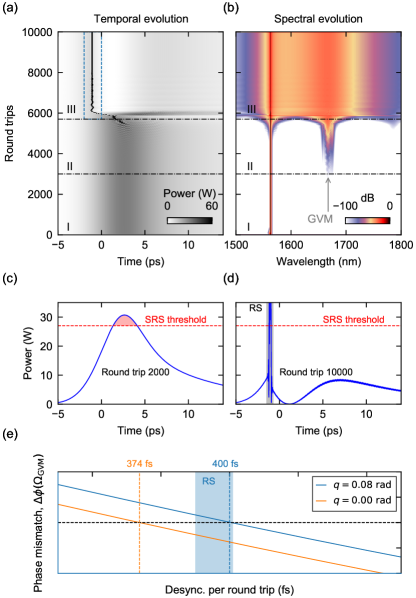
- 通过数值模拟发现,孤子特性主要取决于 $ au_s$ 和 $ au_R$(拉曼响应时间尺度),而非失谐或泵浦幅度。
- 通过与模拟结果对比验证实验结果,确认了确定性孤子形成及脉冲宽度的尺度规律。
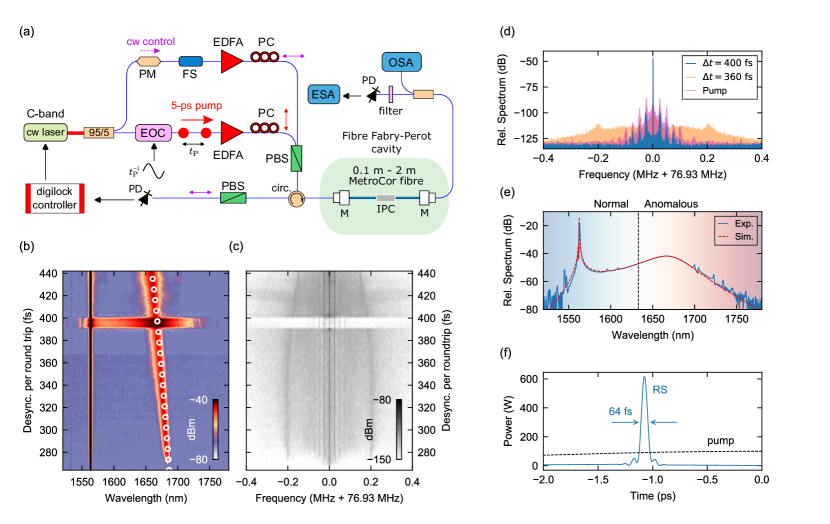
实验结果
研究问题
- RQ1熔融石英中的本征拉曼增益是否可在无需主动增益介质的情况下,实现标准光纤谐振器中超短耗散型孤子的生成?
- RQ2与传统的同步泵浦拉曼振荡器相比,相位相干脉冲泵浦如何影响孤子的相干性与脉冲宽度?
- RQ3通过色散和泵浦时序控制,孤子脉冲宽度在多大程度上可与重复频率解耦?
- RQ4该系统中拉曼孤子的脉冲宽度与稳定性受何种尺度律支配?
- RQ5该机制是否可迁移至芯片级微谐振器中,用于集成频率梳应用?
主要发现
- 作者在标准电信光纤谐振器中实现了全宽半最大值(FWHM)脉冲宽度低于100 fs的耗散型拉曼孤子,创下此类系统中生成脉冲最短的纪录。
- 脉冲宽度与重复频率无关,尺度律表明孤子特性仅取决于 $ au_s$ 和 $ au_R$,从而可在不改变脉宽的前提下任意调节重复频率。
- 由于相位相干泵浦和群速度匹配,系统实现了确定性、高保真度的孤子形成,克服了早期拉曼振荡器中常见的低相干性与展宽脉冲问题。
- 模拟结果证实,拉曼响应函数 $ ilde{ au}_R$ 和归一化 timescale $ au_s$ 是决定孤子宽度与稳定性的主导参数。
- 该方案可扩展至芯片级熔融石英微谐振器,因其基本物理原理与尺度律与色散工程的集成平台兼容。
- 该方法可生成带宽宽、线间距精细(亚GHz)的频率梳,适用于双梳光谱学等应用,同时保持超短脉冲特性。
更好的研究,从现在开始
从阅读论文到最终审阅,大幅缩短您的研究时间。
无需绑定信用卡
本解读由 AI 生成,并经人工编辑审核。