
[论文解读] UNCOVER: A NIRSpec Identification of a Broad Line AGN at z = 8.50
本论文通过UNCOVER巡天的JWST/NIRSpec光谱,确认了红移z = 8.50处一个宽线活动星系核(AGN)的存在。该源表现出Hβ谱线,其全宽半最大值(FWHM)为3439 ± 413 km s⁻¹,表明其黑洞质量为log₁₀(M_BH/M☉) = 8.17 ± 0.42,吸积率约为爱丁顿极限的40%,黑洞与宿主星系质量比超过30%,暗示其可能经历了快速早期增长或存在大质量黑洞种子。
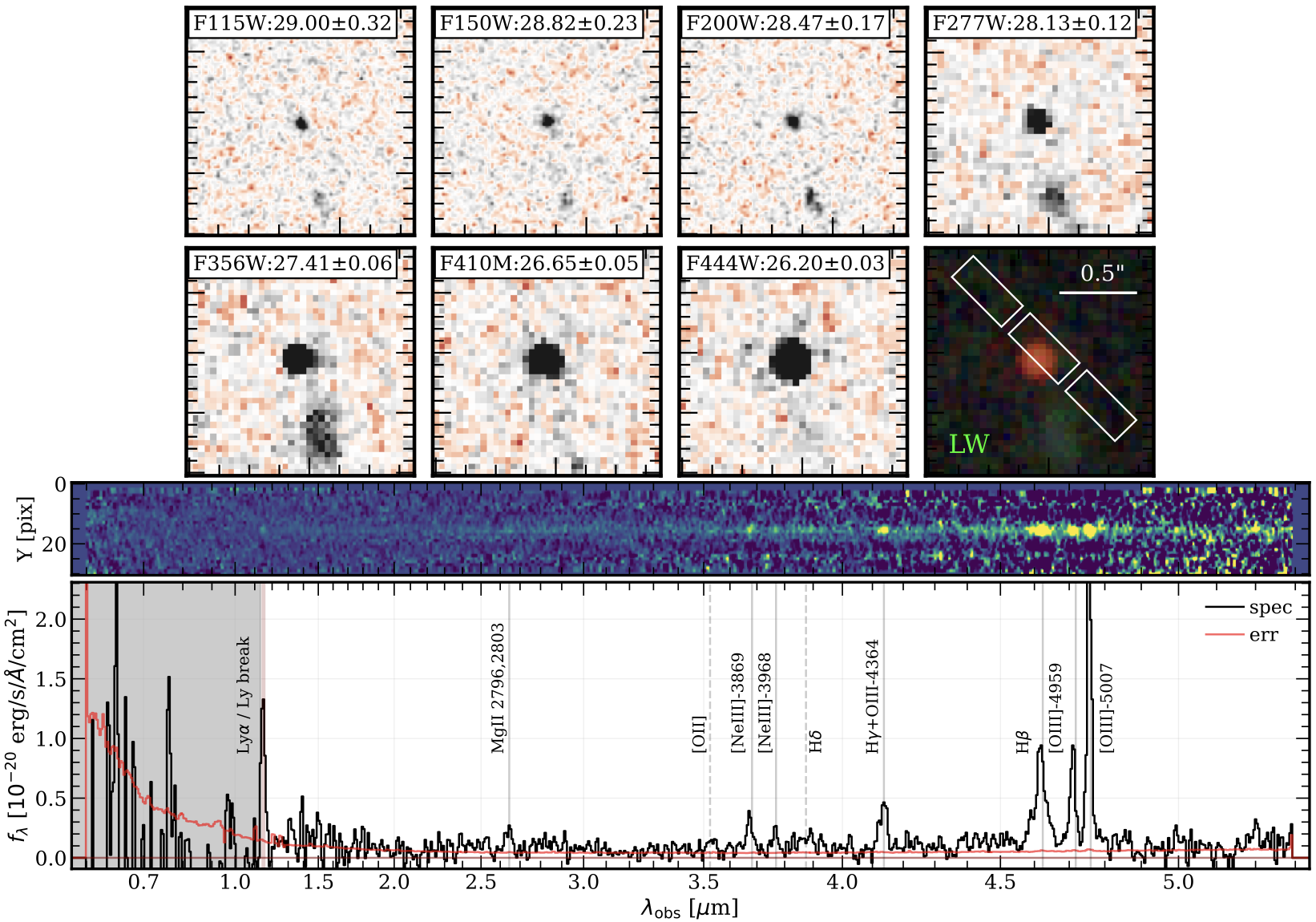
Deep observations with JWST have revealed an emerging population of red point-like sources that could provide a link between the postulated supermassive black hole seeds and observed quasars. In this work we present a JWST/NIRSpec spectrum from the JWST Cycle 1 UNCOVER Treasury survey, of a massive accreting black hole at $z=8.50$, displaying a clear broad-line component as inferred from the H$β$ line with FWHM = $3439\pm413$ km s$^{-1}$, typical of the broad line region of an active galactic nucleus (AGN). The AGN nature of this object is further supported by high ionization, as inferred from emission lines, and a point-source morphology. We compute the black hole mass of log$_{10}(M_{ m BH}/M_\odot)=8.17\pm0.42$, and a bolometric luminosity of $L_{ m bol}\sim6.6 imes10^{45}$ erg s$^{-1}$. These values imply that our object is accreting at $\sim 40\%$ of the Eddington limit. Detailed modeling of the spectral energy distribution in the optical and near-infrared, together with constraints from ALMA, indicate an upper limit on the stellar mass of log$_{10}(M_{ m *}/M_\odot)<8.7$, which would lead to an unprecedented ratio of black hole to host mass of at least $\sim 30 \%$. This is orders of magnitude higher compared to the local QSOs, but is consistent with recent AGN studies at high redshift with JWST. This finding suggests that a non-negligible fraction of supermassive black holes either started out from massive seeds and/or grew at a super-Eddington rate at high redshift. Given the predicted number densities of high-$z$ faint AGN, future NIRSpec observations of larger samples will allow us to further investigate the galaxy-black hole co-evolution in the early Universe.
研究动机与目标
- 利用深度JWST观测识别并表征红移z > 8的高红移AGN。
- 确定z = 8.50处候选AGN的黑洞质量和吸积率。
- 研究黑洞与宿主星系质量比及其对早期黑洞种子形成的影响。
- 评估此类AGN在宇宙再电离和早期星系演化中的作用。
- 通过多波段SED建模和ALMA约束,限制早期宇宙中超大质量黑洞的形成路径。
提出的方法
- 获取来自UNCOVER巡天计划的JWST/NIRSpec光谱,针对一个高红移候选源。
- 通过识别宽发射线(特别是Hβ线)并测量其FWHM = 3439 ± 413 km s⁻¹,确认AGN性质。
- 利用virial质量估算法,基于Hβ线的FWHM和连续谱亮度估算黑洞质量。
- 通过FSPS和EAZY进行SED拟合,推导出总辐射亮度,得到L_bol ~ 6.6 × 10⁴⁵ erg s⁻¹。
- 通过SED建模和ALMA约束,得出恒星质量上限为log₁₀(M*/M☉) < 8.7。
- 计算爱丁顿比和黑洞与宿主星系质量比,以评估吸积历史和形成模型。
实验结果
研究问题
- RQ1通过JWST/NIRSpec识别的最远AGN的红移和黑洞质量是多少?
- RQ2该AGN的吸积是否接近或超过爱丁顿极限,这对黑洞种子形成意味着什么?
- RQ3黑洞与宿主星系的质量比是多少?与本地类星体及其他高红移AGN相比如何?
- RQ4这种极端的黑洞与宿主星系质量比能否通过直接坍缩黑洞种子或高红移超爱丁顿吸积来解释?
- RQ5此类高红移AGN对宇宙再电离的贡献如何?
主要发现
- 通过JWST/NIRSpec光谱中Hβ线的FWHM = 3439 ± 413 km s⁻¹,确认了z = 8.50处一个宽线AGN的存在。
- 测得黑洞质量为log₁₀(M_BH/M☉) = 8.17 ± 0.42,表明其为约1.5 × 10⁸ M☉的超大质量黑洞。
- 该源以约40%的爱丁顿极限速率吸积,总辐射亮度为L_bol ~ 6.6 × 10⁴⁵ erg s⁻¹。
- 恒星质量被限制在log₁₀(M*/M☉) < 8.7,导致黑洞与宿主星系质量比至少为30%,远超本地类星体。
- 高黑洞与宿主星系质量比与大质量黑洞种子模型(如10⁴ M☉)或高红移超爱丁顿吸积模型一致。
- 该AGN位于半径为7.6光年(共动)的大型电离泡中,表明其在早期宇宙再电离中可能扮演了重要角色。
![Figure 2: Top: Best fit narrow (blue) and broad (green) line Gaussian components fit to the H $\beta$ , [OIII] 4959,5007 line complex. A dual fit to the H $\beta$ is necessary to account for both the broad (FWHM $\sim 3400$ km s -1 ) and narrow (FWHM $\sim 200$ km s -1 ) components. The combined fit](https://ar5iv.labs.arxiv.org/html/2308.11610/assets/figures/fig2.png)
更好的研究,从现在开始
从阅读论文到最终审阅,大幅缩短您的研究时间。
无需绑定信用卡
本解读由 AI 生成,并经人工编辑审核。