
[论文解读] UNCOVER spectroscopy confirms a surprising ubiquity of AGN in red galaxies at $z>5$
JWST UNCOVER 光谱揭示,大量紧凑的红色 z>5 源是尘埃遮蔽的AGN,具备宽度的 H-alpha,表明活跃黑洞且隐含的数量密度很高。
JWST is revealing a new population of dust-reddened broad-line active galactic nuclei (AGN) at redshifts $z\gtrsim5$. Here we present deep NIRSpec/Prism spectroscopy from the Cycle 1 Treasury program UNCOVER of 15 AGN candidates selected to be compact, with red continua in the rest-frame optical but with blue slopes in the UV. From NIRCam photometry alone, they could have been dominated by dusty star formation or AGN. Here we show that the majority of the compact red sources in UNCOVER are dust-reddened AGN: $60\%$ show definitive evidence for broad-line H$α$ with FWHM$\, >2000$ km/s, for $20\%$ current data are inconclusive, and $20\%$ are brown dwarf stars. We propose an updated photometric criterion to select red $z>5$ AGN that excludes brown dwarfs and is expected to yield $>80\%$ AGN. Remarkably, among all $z_{ m phot}>5$ galaxies with F277W$-$F444W$>1$ in UNCOVER at least $33\%$ are AGN regardless of compactness, climbing to at least $80\%$ AGN for sources with F277W$-$F444W$>1.6$. The confirmed AGN have black hole masses of $10^7-10^9$ M$_{\odot}$. While their UV-luminosities ($-16>M_{ m UV}>-20$ AB mag) are low compared to UV-selected AGN at these epochs, consistent with percent-level scattered AGN light or low levels of unobscured star formation, the inferred bolometric luminosities are typical of $10^7-10^9$ M$_{\odot}$ black holes radiating at $\sim 10-40\%$ of Eddington. The number densities are surprisingly high at $\sim10^{-5}$ Mpc$^{-3}$ mag$^{-1}$, 100 times more common than the faintest UV-selected quasars, while accounting for $\sim1\%$ of the UV-selected galaxies. While their UV-faintness suggest they may not contribute strongly to reionization, their ubiquity poses challenges to models of black hole growth.
研究动机与目标
- 利用 JWST 的红外能力,激励研究 z>5 时黑洞生长与星系共同演化。
- 评估在光度学样本中占主导地位的紧凑红色 z>5 源,是AGN还是尘埃遮蔽的恒星形成星系。
- 量化红色、紧凑的 z>5 源中的AGN分数,并推导黑洞质量及吸积特性。
- 评估光度学颜色切线在选择 z>5 AGN 的有效性,并与 UV 选择的星系群体进行比较。
提出的方法
- Utilize UNCOVER JWST imaging (NIRCam) to select compact red sources with specific color criteria favoring red optical continua and blue UV slopes.
- Obtain NIRSpec/PRISM spectroscopy for 17 AGN candidates to search for broad Balmer lines (H-alpha) and other AGN indicators.
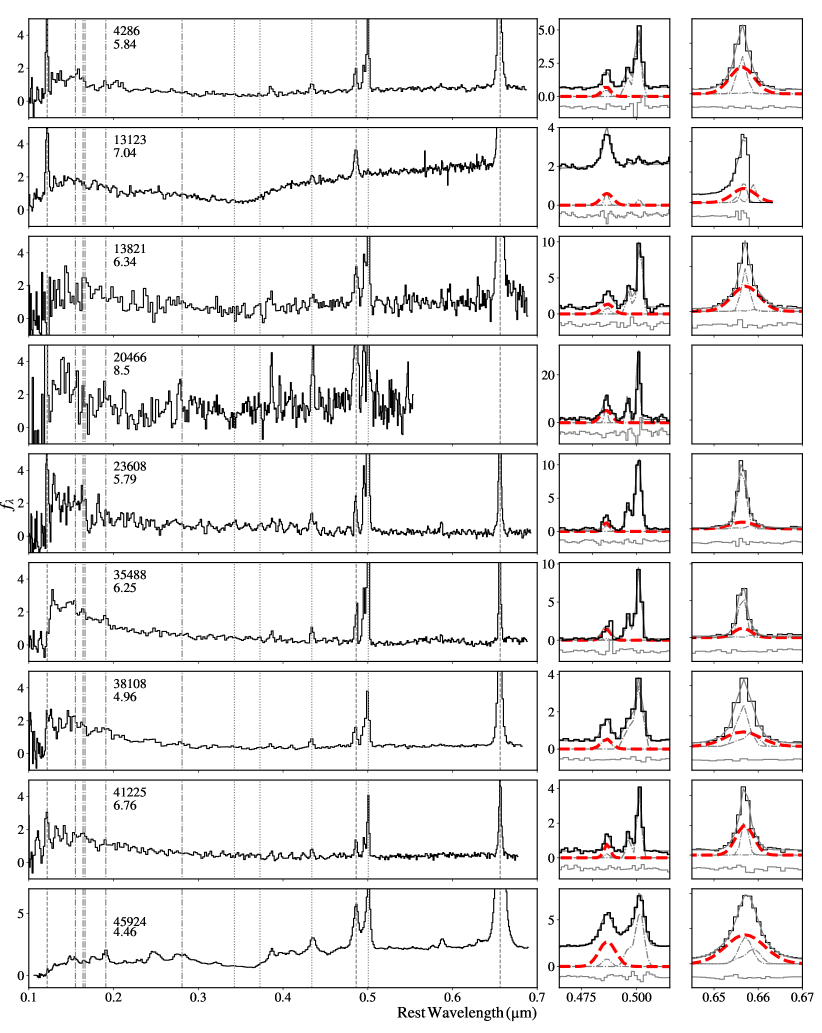
- Fit emission-line complexes (H-beta, [O III], H-alpha, [N II]) with narrow and broad components to identify broad H-alpha (FWHM > 2000 km/s).
- Estimate black hole masses from H-alpha widths and luminosities, dereddened and demagnified using lensing models, and compute bolometric luminosities.
- Assess contamination (e.g., brown dwarfs) and use Balmer decrement and continuum slopes to constrain extinction.
- Explore photometric AGN selection efficiency and derive AGN fractions as a function of color cuts (e.g., F277W−F444W).
实验结果
研究问题
- RQ1What fraction of compact red z>5 sources are broad-line AGN as revealed by NIRSpec/PRISM spectroscopy?
- RQ2What are the black hole masses and accretion properties (bolometric luminosities, Eddington ratios) of these AGN?
- RQ3How effective are JWST color and morphology cuts at selecting AGN at z>5, and how do AGN fractions vary with color thresholds?
- RQ4How do the AGN identified in red z>5 sources compare to UV-selected AGN populations in terms of luminosity and number density?
主要发现
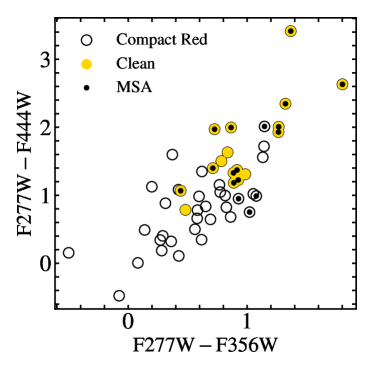
- 60% of the targeted compact red sources show definitive broad-line H-alpha emission (FWHM > 2000 km/s).
- 20% of targets yield inconclusive results, and 20% are brown dwarfs.
- Among zphot>5 galaxies with F277W−F444W >1, at least 33% are AGN, rising to at least 80% for F277W−F444W >1.6.
- Confirmed AGN have black hole masses in the range 10^7–10^9 solar masses.
- UV luminosities are relatively low (-16 > M_UV > -20 AB mag), but bolometric luminosities imply accretion at ~10–40% of Eddington.
- AGN number densities are ~10^-5 Mpc^-3 mag^-1, about 100x fainter UV-selected quasars, and represent ~1% of UV-selected galaxies.
- The ubiquity of these red z>5 AGN poses challenges to models of early black hole growth and co-evolution with galaxies.
更好的研究,从现在开始
从论文设计到论文写作,大幅缩短您的研究时间。
无需绑定信用卡
本解读由 AI 生成,并经人工编辑审核。