
[论文解读] Understanding Stokes drift mechanism via crest and trough phase estimates
本文通过使用拉格朗日相位 θ 参数化流体粒子运动,为理解斯托克斯漂移提供了一个统一的数学框架,使一维声波和二维水波的轨迹方程能够获得精确的渐近解。它量化了粒子在波峰相位停留时间更长且经历的速度更大,从而导致净前向漂移——这是首次对不同波型中波峰与波谷相位的时间持续、位移和平均速度提供二阶精度的估计。
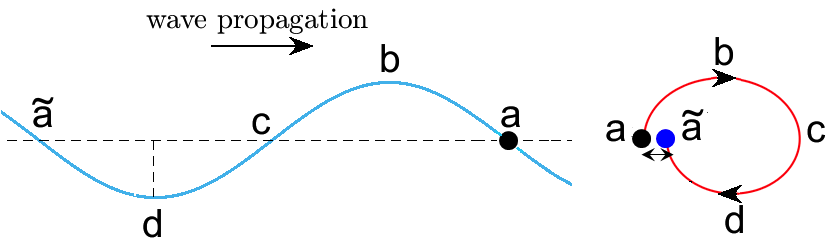
By providing mathematical estimates, this paper answers a fundamental question -- "what leads to Stokes drift"? Although overwhelmingly understood for water waves, Stokes drift is a generic mechanism that stems from kinematics and occurs in any non-transverse wave in fluids. To showcase its generality, we undertake a comparative study of the pathline equation of sound (1D) and intermediate-depth water (2D) waves. Although we obtain a closed-form solution $\mathbf{x}(t)$ for the specific case of linear sound waves, a more generic and meaningful approach involves the application of asymptotic methods and expressing variables in terms of the Lagrangian phase $θ$. We show that the latter reduces the 2D pathline equation of water waves to 1D. Using asymptotic methods, we solve the respective pathline equation for sound and water waves, and for each case, we obtain a parametric representation of particle position $\mathbf{x}(θ)$ and elapsed time $t(θ)$. Such a parametric description has allowed us to obtain second-order-accurate expressions for the time duration, horizontal displacement, and average horizontal velocity of a particle in the crest and trough phases. All these quantities are of higher magnitude in the crest phase in comparison to the trough, leading to a forward drift, i.e. Stokes drift. We also explore particle trajectory due to second-order Stokes waves and compare it with linear waves. While finite amplitude waves modify the estimates obtained from linear waves, the understanding acquired from linear waves is generally found to be valid.
研究动机与目标
- 解决关于非横波中斯托克斯漂移物理起源及其定量动力学的根本未解问题。
- 开发一种基于拉格朗日相位的渐近框架,避免经典斯托克斯理论中使用的微小位移近似。
- 为一维(声波)和二维(水波)中的波峰与波谷相位,提供时间、位移和速度的二阶精度估计。
- 通过分析纵向(声波)波,证明斯托克斯漂移的普适性不仅限于表面重力波。
- 验证当对波峰与波谷相位域进行二阶抬升效应修正时,线性波理论能给出准确的斯托克斯漂移估计。
提出的方法
- 使用拉格朗日相位 θ 参数化粒子运动,通过基于相位的渐近展开,将二维轨迹方程转化为一维问题。
- 通过对声波和水波的轨迹方程进行渐近求解,至 O(ε²) 阶,推导出粒子位置 x(θ) 和时间 t(θ) 的参数解。
- 利用参数描述,计算波峰与波谷相位中时间持续、水平位移和平均水平速度的二阶精度表达式。
- 将该方法应用于线性波与二阶斯托克斯波,通过比较结果评估有限振幅修正效应。
- 通过分别从 z 分量和 x 分量的轨迹方程推导 dθ/dt,并证明其在 O(ε²) 阶下等价,验证一致性。
- 将该框架扩展至任意深度的内部界面,推导材料表面的 θ-轨迹方程与净漂移速度。
实验结果
研究问题
- RQ1在基本运动学层面上,斯托克斯漂移的根本原因是什么,且与波型或横结构无关?
- RQ2在非横波中,流体粒子在波峰相位比在波谷相位多停留多久?
- RQ3能否基于拉格朗日相位形式,推导出波峰与波谷相位中时间、位移和速度的二阶精度估计?
- RQ4当包含二阶抬升效应时,线性波理论是否能提供可靠的斯托克斯漂移估计?
- RQ5在 1D 纵向波(如声波)中,由于不存在横向速度变化,斯托克斯漂移机制如何体现?
主要发现
- 粒子在波峰相位停留时间显著长于波谷相位,由于时间与速度贡献的不对称性,导致净前向漂移。
- 波峰相位期间的平均水平速度大于波谷相位,直接贡献于净斯托克斯漂移。
- 推导出波峰与波谷相位中时间持续、位移和平均速度的二阶精度表达式,并证明其在声波与水波中的一致性。
- 深度 z = -h 处材料界面的斯托克斯漂移速度为 ū^SD = (c/2)(cosh 2β / sinh²α) ε²,其依赖于相对深度与波陡度。
- 有限振幅效应会修正线性波估计,但当引入二阶抬升修正后,线性理论的定性理解依然成立。
- 基于 θ 相位参数化的参数解成功地将二维轨迹问题简化为一维渐近系统,实现了无需小位移近似的精确二阶分析。
更好的研究,从现在开始
从阅读论文到最终审阅,大幅缩短您的研究时间。
无需绑定信用卡
本解读由 AI 生成,并经人工编辑审核。