
[论文解读] Understanding the polaritonic ground state in cavity quantum electrodynamics
本文在 Pauli-Fierz 框架内发展了一种微扰的 Rayleigh-Schrödinger 方法,以计算分子在光学腔中的基态能量,并显示与 ab initio cQED 方法良好一致性,同时将腔效应与 van der Waals 力联系起来。
Molecular polaritons arise when molecules interact so strongly with light that they become entangled with each other. This light-matter hybridization alters the chemical and physical properties of the molecular system and allows chemical reactions to be controlled without the use of external fields. We investigate the impact of strong light-matter coupling on the electronic structure using perturbative approaches and demonstrate that Rayleigh-Schrödinger perturbation theory can reproduce the ground state energies in optical cavities to comparable accuracy as ab initio cavity quantum electrodynamics methodologies for currently relevant coupling strengths. The method is effective in both low and high cavity frequency regimes and straightforward to implement via response functions. Furthermore, we establish simple relations between cavity-induced intermolecular forces and van der Waals forces. These findings provide valuable insight into the manipulation of ground-state polaritonic energy landscapes, shedding light on the systems and conditions in which modifications can be achieved.
研究动机与目标
- 阐明腔内强光–物质耦合如何改变电子基态以及分子间相互作用的动机。
- 提供一个可与任意电子结构方法配合的扰动框架,用于在 cQED 下计算基态能量。
- 推导并实现腔改变量子对响应函数的表达式,以获得一/二体能量。
- 通过偶极极化率积分,将腔诱导的力与标准的 van der Waals 相互作用联系起来。
提出的方法
- 在长度表象下采用 Pauli-Fierz 哈密顿量,包含单一腔模与偶极耦合(Eq. 1)。
- 使用 Rayleigh-Schrödinger 微扰理论,将光物质耦合 λ 视为微扰(Eq. 3)。
- 将二阶基态能量表示为偶极涨落与响应函数项的形式(Eq. 4)。
- 将逐态和表达式改写为响应函数,以避免涉及大量激发态(Eq. 5–7)。
- 在耦合簇理论中引入电子光子响应,以获得一个实际的基态能量(Eq. 8,Eq. 30)。
- 推导腔诱导的分子间能量:偶极-偶极相互作用、van der Waals 以及腔修改的远程项(Eqs. 9–18,22,24)。
- 通过 α(iω) 及相关积分,将二体及以上体项与频率相关极化率联系起来(Eq. 14)。
- 讨论腔源 Born-Oppenheimer 近似(CBOA)及其有效性范围(Section III.1)。
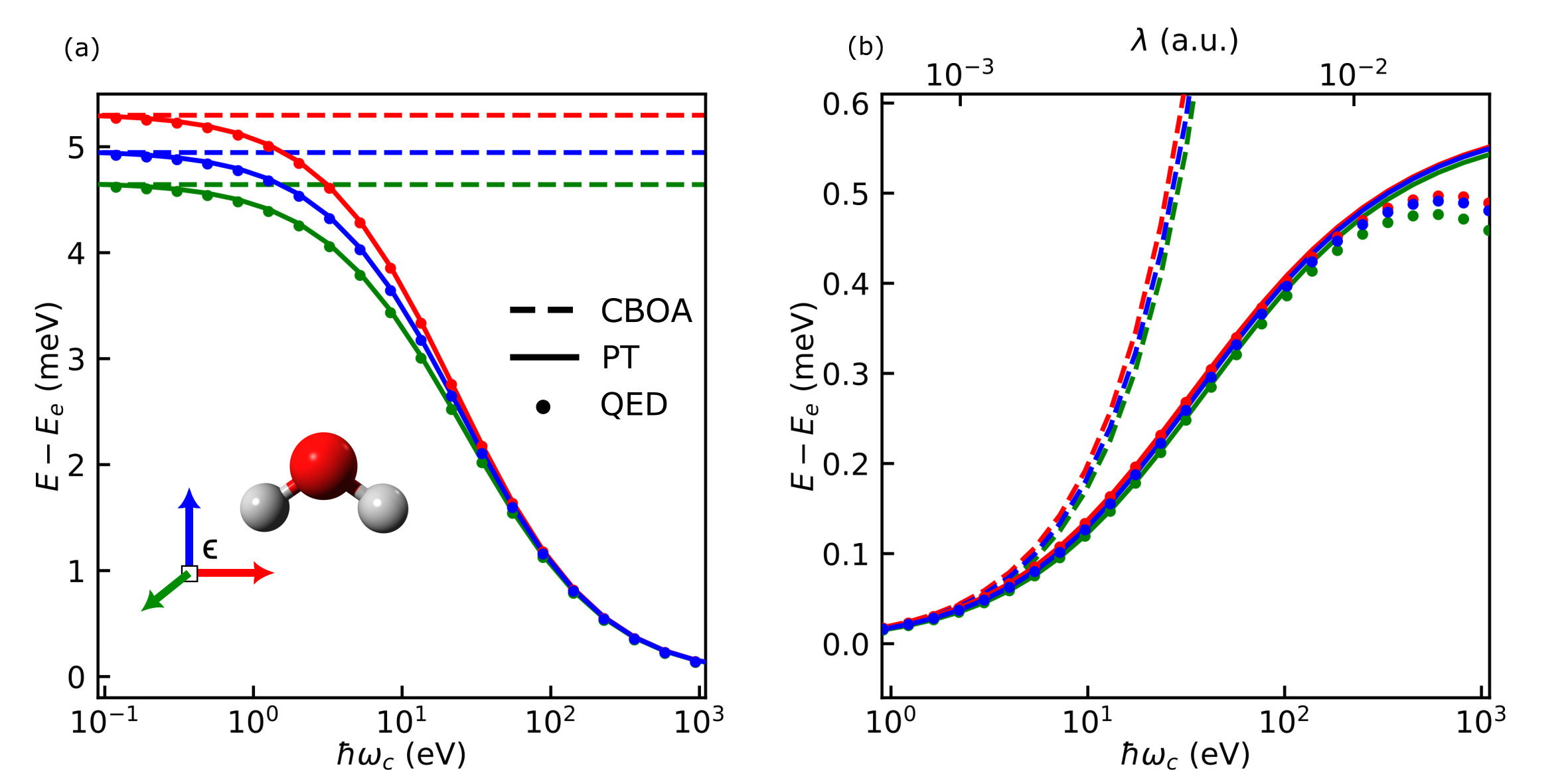
实验结果
研究问题
- RQ1腔内强光–物质耦合如何改变单个分子的电子基态?
- RQ2腔诱导的分子间力(包括 van der Waals 与远程项)如何被腔修改,并且它们如何随几何与浓度变化?
- RQ3一个扰动响应理论框架是否能够在不同腔频和耦合强度下重现 ab initio cQED 的结果?
- RQ4腔诱导的力与传统的 van der Waals 相互作用之间的关系如何,高阶体项如何贡献?
- RQ5在腔内的大型体系中,定向性与集体效应在何种条件下出现或减弱?
主要发现
- Rayleigh-Schrödinger 微扰理论能够在目前相关耦合强度(λ ≤ 0.01 a.u.)下得到与 ab initio cQED 方法相当的基态能量。
- 基态能量的变化主要受偶极自能屏蔽的支配;高腔频率放大屏蔽效应,而在该极限下双线性耦合项与偶极自能相抵消(Eq. 4 与讨论)。
- 腔诱导的分子间力包括被腔场改动的 van der Waals 项,其在距离 R 上的依赖趋向于 R^(-3) 而非 R^(-6)(Eq. 12 与 22)。
- 1体偶极自能与2体远程相互作用可以通过频率相关极化率及其积分来表示;随着腔中分子数量增多,高阶体项变得显著(Eq. 14–18)。
- 对于各向同性分子,腔诱导力简化为涉及 C6 系数的形式,将腔效应与标准 London 色散物理联系起来(Eq. 20–22)。
- 取向效应来自各向异性极化率,并在低浓度下持续存在,但随分子数量与体积增大而减弱(Section III.2)。
- 在 CC(以及 QED-CC)背景下演示了这套扰动框架,并提出作为在研究极化型基态时替代自洽 QED 的可行方法(Conclusions)。

更好的研究,从现在开始
从论文设计到论文写作,大幅缩短您的研究时间。
无需绑定信用卡
本解读由 AI 生成,并经人工编辑审核。