
[论文解读] Understanding the Trustworthiness Management in the Social Internet of Things: A Survey
本综述对社交物联网(SIoT)中的可信性管理进行了全面分析,将可信性管理方案分为四类,并评估了其在关键维度上的组件、优势、局限性和性能表现。文章指出了当前方法中的不足之处,并为可扩展、隐私保护和智能的可信性聚合在SIoT环境中的未来发展指明了研究方向。
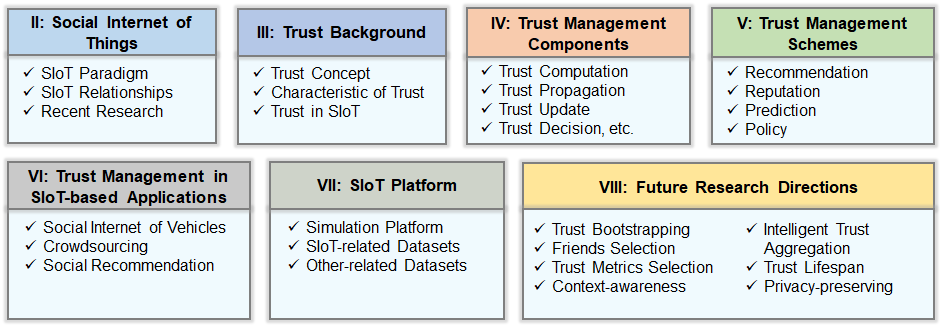
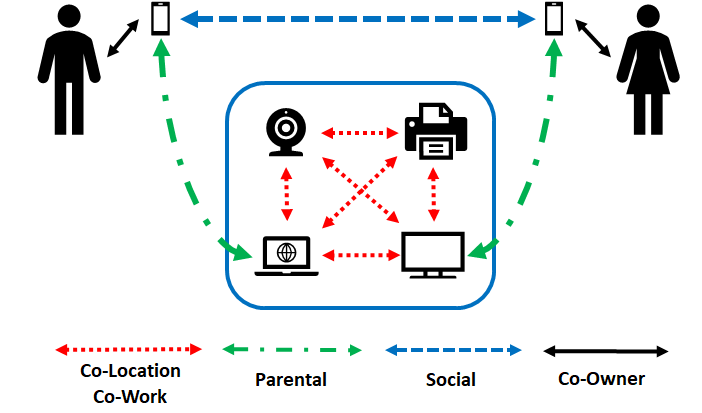
The next generation of the Internet of Things (IoT) facilitates the integration of the notion of social networking into smart objects (i.e., things) in a bid to establish the social network of interconnected objects. This integration has led to the evolution of a promising and emerging paradigm of Social Internet of Things (SIoT), wherein the smart objects act as social objects and intelligently impersonate the social behaviour similar to that of humans. These social objects are capable of establishing social relationships with the other objects in the network and can utilize these relationships for service discovery. Trust plays a significant role to achieve the common goal of trustworthy collaboration and cooperation among the objects and provide systems' credibility and reliability. In SIoT, an untrustworthy object can disrupt the basic functionality of a service by delivering malicious messages and adversely affect the quality and reliability of the service. In this survey, we present a holistic view of trustworthiness management for SIoT. The essence of trust in various disciplines has been discussed along with the Trust in SIoT followed by a detailed study on trust management components in SIoT. Furthermore, we analyzed and compared the trust management schemes by primarily categorizing them into four groups in terms of their strengths, limitations, trust management components employed in each of the referred trust management schemes, and the performance of these studies vis-a-vis numerous trust evaluation dimensions. Finally, we have discussed the future research directions of the emerging paradigm of SIoT, particularly for trustworthiness management in SIoT.
研究动机与目标
- 为新兴的SIoT范式中的可信性管理提供全面的综述,其中智能对象形成类似人类的社会关系。
- 识别并分析SIoT中可信性管理系统的组成部分,包括可信度度量、聚合机制和衰减机制。
- 将现有可信性管理方案按四种类别进行比较,评估其在不同可信度评估维度上的优势、局限性和性能表现。
- 突出关键挑战,如可信性聚合效率低下、缺乏隐私保护机制,以及对智能、低延迟可信度计算的需求。
- 概述未来研究方向,特别是在优化基于机器学习的可信性聚合以及开发稳健的隐私保护框架方面。
提出的方法
- 本文对15篇近期关于SIoT中可信性管理的研究进行了系统性综述,根据其底层可信机制和设计原则将其分为四类。
- 采用多维评估框架对可信性管理方案进行评估,涵盖可信度度量、聚合技术、衰减模型和隐私保护机制。
- 分析传统可信性聚合方法(如线性加权和),并指出其局限性,如权重分配的随意性以及无法识别特定情境下最具影响力的可信度度量。
- 探讨新兴的基于机器学习的可信性聚合方法,这些方法可根据环境上下文动态分配可信度度量的权重,尽管也指出了其高计算开销的问题。
- 提出一种面向服务的SIoT通用可信性管理框架,整合社会关系、声誉和基于经验的可信度,并引入时间衰减与隐私保护机制。
- 研究隐私保护技术,如单向哈希和同态加密,以在SIoT交互过程中保护社交资料数据。
实验结果
研究问题
- RQ1现有SIoT可信性管理方案在设计、组件和关键评估维度上的性能表现有何差异?
- RQ2传统可信性聚合技术存在哪些局限性?基于机器学习的方法如何提升其准确性和适应性?
- RQ3如何在SIoT中有效建模可信度衰减机制,以反映智能对象之间社会关系的动态性和时间敏感性?
- RQ4社会关系和交互频率在SIoT环境中对信任和声誉的形成起到何种作用?
- RQ5隐私保护型可信性管理中的关键开放挑战是什么?未来SIoT系统如何应对这些挑战?
主要发现
- 基于线性加权和的传统可信性聚合方法存在权重分配随意的问题,且在特定情境下无法识别最具影响力的可信度度量。
- 基于机器学习的可信性聚合方法在动态分配可信度度量权重方面展现出潜力,但引入了较高的计算开销和延迟,限制了其在实时系统中的部署。
- 可信度衰减对于保持可信度的时效性至关重要,Truong等人提出的基于经验-声誉的系统展示了基于时间的衰减模型,但缺乏明确定义强弱社会关系的标准。
- 仅有少数研究关注SIoT可信性管理中的隐私保护,代表性方法包括单向哈希(Chen et al.)和同态加密(Azad et al.),用于保护对象身份和社交资料。
- 本综述识别出在可扩展、高效且隐私保护的可信性聚合框架方面存在关键研究空白,尤其针对大规模、动态的SIoT网络。
- 提出了一种通用可信性管理框架,整合社会关系、声誉、经验以及时间衰减模型,未来工作将聚焦于优化机器学习模型以实现集群级别的可信性聚合,从而降低延迟。
更好的研究,从现在开始
从阅读论文到最终审阅,大幅缩短您的研究时间。
无需绑定信用卡
本解读由 AI 生成,并经人工编辑审核。