
[论文解读] Unified Differentiable Learning of Electric Response
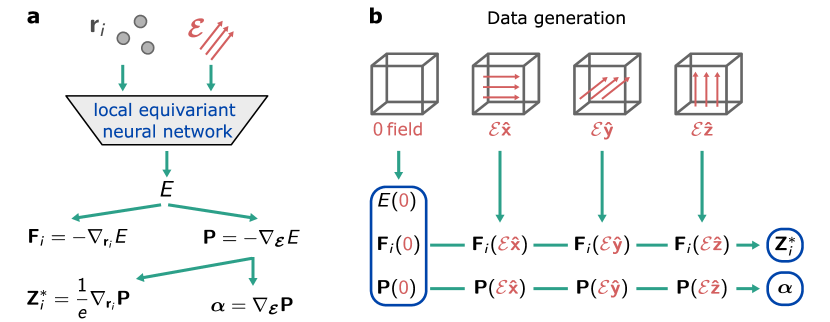
该论文提出了一种统一的可微分机器学习框架,通过对方程中电焓关于原子位置和电场的微分,联合预测电焓、原子受力、极化强度、Born电荷张量和极化率。该方法通过局部等变表征,精确强制实现保守极化、Born电荷的声学求和规则以及焓守恒等物理约束,从而在电场作用下实现具有从头算精度的高精度、大规模分子动力学模拟,已在α-SiO₂上得到验证,与密度泛函微扰理论结果高度一致。
Predicting response of materials to external stimuli is a primary objective of computational materials science. However, current methods are limited to small-scale simulations due to the unfavorable scaling of computational costs. Here, we implement an equivariant machine-learning framework where response properties stem from exact differential relationships between a generalized potential function and applied external fields. Focusing on responses to electric fields, the method predicts electric enthalpy, forces, polarization, Born charges, and polarizability within a unified model enforcing the full set of exact physical constraints, symmetries and conservation laws. Through application to $α$-SiO$_2$, we demonstrate that our approach can be used for predicting vibrational and dielectric properties of materials, and for conducting large-scale dynamics under arbitrary electric fields at unprecedented accuracy and scale. We apply our method to ferroelectric BaTiO$_3$ and capture the temperature-dependence and time evolution of hysteresis, revealing the underlying microscopic mechanisms of nucleation and growth that govern ferroelectric domain switching.
研究动机与目标
- 开发一种机器学习模型,能够以从头算精度同时预测电焓、受力、极化强度、Born电荷张量和极化率。
- 在可微分学习框架中精确强制实现物理约束,包括保守极化、Born电荷的声学求和规则以及电焓守恒。
- 通过利用原子环境的局部等变表征,实现电场下高效的大规模分子动力学模拟。
- 验证模型在预测振动和介电性质方面的准确性,包括红外光谱和频率依赖的介电常数。
- 将该方法推广至其他热力学势和复杂材料体系,包括无序体系和液态体系。
提出的方法
- 模型使用局部等变神经网络表征原子环境,确保满足$E(3)$对称性(平移、旋转、反演)。
- 电焓作为原子位置和电场的可微函数进行预测,所有物理量均通过精确微分获得。
- 极化强度通过电焓对电场的一阶导数获得,确保其为保守矢量场。
- Born电荷通过电焓对原子位置和电场的二阶导数计算,强制满足声学求和规则。
- 极化率作为电焓对电场的二阶导数推导,确保与线性响应理论的一致性。
- 该公式具有通用性,无需消息传递机制;局部性使得其在大规模和长时间尺度模拟中计算高效。
实验结果
研究问题
- RQ1单一可微分机器学习模型能否在统一框架下高精度预测电焓、受力、极化强度、Born电荷张量和极化率?
- RQ2如何在可微分机器学习模型中精确强制实现保守极化、声学求和规则和焓守恒等物理约束?
- RQ3此类模型在有限电场下实现高精度大规模分子动力学模拟的潜力有多大?
- RQ4与密度泛函微扰理论相比,该模型在再现介电和振动性质方面的表现如何,包括红外光谱和频率依赖的介电常数?
- RQ5该框架能否推广至其他热力学势和复杂材料体系,包括液体和无序体系?
主要发现
- 该模型对α-SiO₂计算得到的高频和静态介电常数分别为εzz∞ = 2.41和εzz⁰ = 4.76,与DFT结果完全一致。
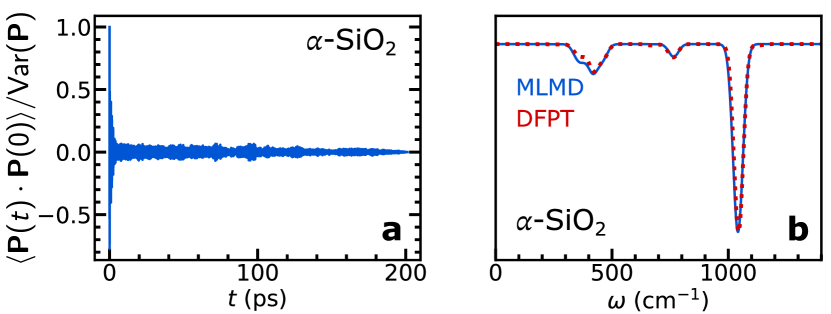
- 通过机器学习分子动力学计算得到的红外光谱和频率依赖介电常数与密度泛函微扰理论结果高度一致。
- 电场对电焓、受力和极化强度的贡献被精确捕捉,与DFT结果的偏差低于10⁻⁴ Hartree/au。
- 该模型成功强制实现了Born电荷的声学求和规则,并通过精确微分确保极化强度为保守矢量场。
- 该框架实现了具有从头算精度和计算效率的长时间、大尺度电场下分子动力学模拟。
- 该方法可轻松推广至其他热力学势,如自由能、吉布斯函数和焓,从而在材料物理中实现更广泛的应用。
更好的研究,从现在开始
从阅读论文到最终审阅,大幅缩短您的研究时间。
无需绑定信用卡
本解读由 AI 生成,并经人工编辑审核。