
[论文解读] Unified treatment of mean-field dynamo and angular-momentum transport in magnetorotational instability-driven turbulence
本文提出了一种统一的平均场模型,用于磁旋转不稳定性(MRI)驱动的湍流,该模型同时处理角动量输运和大尺度发电机效应。通过采用直接统计模拟和三阶累积量的统计闭合方法,识别出两种关键的发电机机制——旋转-剪切-电流效应和旋转-剪切-涡度效应,分别生成径向和垂直磁场,且从包含麦克斯韦、雷诺和法拉第贡献的湍流应力网络中推导出明确的非微扰输运系数。
Magnetorotational instability (MRI)-driven turbulence and dynamo phenomena are analyzed using direct statistical simulations. Our approach begins by developing a unified mean-field model that combines the traditionally decoupled problems of the large-scale dynamo and angular-momentum transport in accretion disks. The model consists of a hierarchical set of equations, capturing up to the second-order cumulants, while a statistical closure approximation is employed to model the three-point correlators. We highlight the web of interactions that connect different components of stress tensors -- Maxwell, Reynolds, and Faraday -- through shear, rotation, correlators associated with mean fields, and nonlinear terms. We determine the dominant interactions crucial for the development and sustenance of MRI turbulence. Our general mean field model for the MRI-driven system allows for a self-consistent construction of the electromotive force, inclusive of inhomogeneities and anisotropies. Within the realm of large-scale magnetic field dynamo, we identify two key mechanisms -- the rotation-shear-current effect and the rotation-shear-vorticity effect -- that are responsible for generating the radial and vertical magnetic fields, respectively. We provide the explicit (nonperturbative) form of the transport coefficients associated with each of these dynamo effects. Notably, both of these mechanisms rely on the intrinsic presence of large-scale vorticity dynamo within MRI turbulence.
研究动机与目标
- 统一传统上分离的MRI驱动吸积盘湍流中角动量输运与大尺度发电机效应的问题。
- 发展一种分层平均场模型,捕捉至二阶累积量,通过三阶相关器的统计闭合来模拟非线性相互作用。
- 识别由剪切、旋转和平均场相关器介导的麦克斯韦、雷诺和法拉第应力分量之间的主导相互作用。
- 确定MRI湍流中发电机机制的显式、非微扰输运系数。
- 确立内在大尺度涡度发电机在实现径向和垂直磁场生成中的作用。
提出的方法
- 构建包含速度、磁场及交叉相关性至二阶累积量的分层平均场方程组。
- 应用统计闭合近似以建模三阶速度-磁场相关器,从而实现矩层次的闭合。
- 使用相关张量 $R_{ij}$、$M_{ij}$ 和 $F_{ij}$ 的傅里叶空间表示,以波矢和空间依赖性表达应力和电动势。
- 自洽地推导电动势(EMF),通过 $\bar{\bf E} = \alpha_{ij}\bar{B}_j$ 包含非均匀性和各向异性的效应。
- 在波矢空间中进行泰勒展开以简化非线性项,保留涉及 $\partial R_{ij}/\partial k_l$ 和 $\nabla \bar{B}$ 的主导项。
- 通过对波矢积分计算平均应力和EMF,得到包含 $\bar{B}_m \int i k_m R_{ij} d^3k$ 和 $\bar{F}_{ij}$ 项的非微扰输运系数表达式。
实验结果
研究问题
- RQ1哪些主导的非线性相互作用维持MRI湍流,并将角动量输运与大尺度磁场生成耦合?
- RQ2剪切、旋转和涡度如何共同影响MRI湍流中径向和垂直磁场的生成?
- RQ3MRI驱动系统中发电机作用的输运系数的显式形式是什么?其如何依赖于平均场梯度?
- RQ4旋转-剪切-电流效应和旋转-剪切-涡度效应在多大程度上主导MRI湍流中的发电机过程?
- RQ5内在大尺度涡度发电机如何促进极向磁场分量的自洽再生?
主要发现
- 旋转-剪切-电流效应被确定为MRI湍流中生成径向磁场的主要机制,其非微扰输运系数源自湍流应力网络。
- 旋转-剪切-涡度效应被发现负责生成垂直磁场,其具有从同一框架中推导出的独立且明确的输运系数。
- 两种发电机机制均被证明关键依赖于MRI湍流内部在大尺度涡度发电机的存在,该发电机维持了极向磁场分量。
- 该模型自洽地构建了电动势(EMF),包含非均匀性和各向异性,解决了先前模型假设 $\bar{F}_{ij} = 0$ 的局限性。
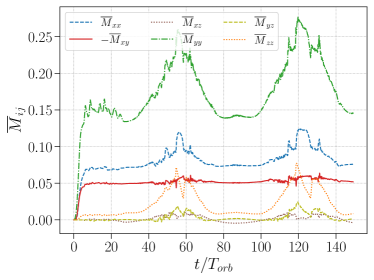
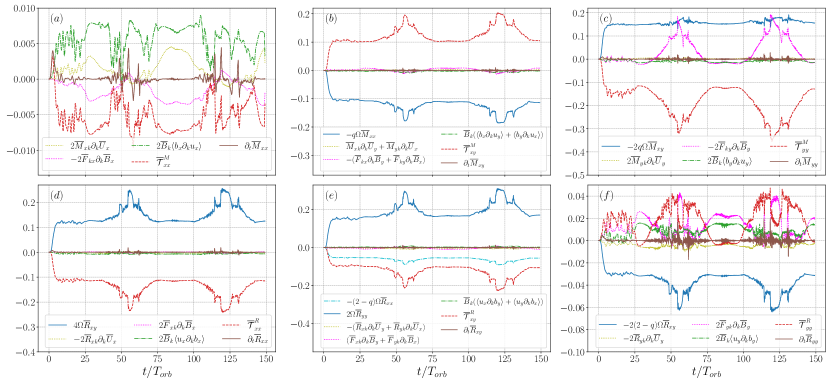
- 麦克斯韦应力主导角动量输运,证实磁涨落是MRI系统中湍流输运的主要驱动力。
- 推导出的输运系数是非微扰的,显式依赖于平均磁场梯度和湍流相关张量,从而实现了对MRI湍流的预测性建模。
更好的研究,从现在开始
从阅读论文到最终审阅,大幅缩短您的研究时间。
无需绑定信用卡
本解读由 AI 生成,并经人工编辑审核。