
[论文解读] Unified, User and Task (UUT) Centered Artificial Intelligence for Metaverse Edge Computing
本文提出了一种面向元宇宙边缘计算的统一用户与任务(UUT)中心深度强化学习(DRL)框架,通过整合用户中心和任务中心的DRL智能体,实现资源分配的优化。UUT-DRL架构在渲染成功率和目标检测准确率方面表现出更优性能,且延迟更低,证明其在处理异构、动态元宇宙工作负载方面的有效性。
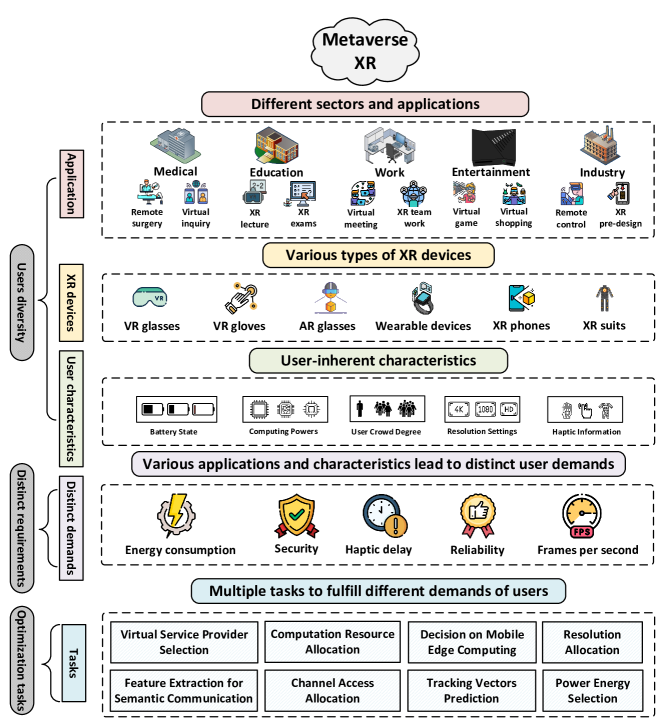
The Metaverse can be considered the extension of the present-day web, which integrates the physical and virtual worlds, delivering hyper-realistic user experiences. The inception of the Metaverse brings forth many ecosystem services such as content creation, social entertainment, in-world value transfer, intelligent traffic, healthcare. These services are compute-intensive and require computation offloading onto a Metaverse edge computing server (MECS). Existing Metaverse edge computing approaches do not efficiently and effectively handle resource allocation to ensure a fluid, seamless and hyper-realistic Metaverse experience required for Metaverse ecosystem services. Therefore, we introduce a new Metaverse-compatible, Unified, User and Task (UUT) centered artificial intelligence (AI)- based mobile edge computing (MEC) paradigm, which serves as a concept upon which future AI control algorithms could be built to develop a more user and task-focused MEC.
研究动机与目标
- 为解决现有元宇宙边缘计算方法在处理动态、计算密集型和异构工作负载方面的局限性。
- 开发一种统一的基于AI的移动边缘计算范式,同时优先考虑用户体验和任务特定性能。
- 通过整合用户中心和任务中心的DRL架构,提升元宇宙应用中的资源分配效率。
- 通过AI驱动的计算卸载和传输优化,实现无缝、超真实的元宇宙体验。
提出的方法
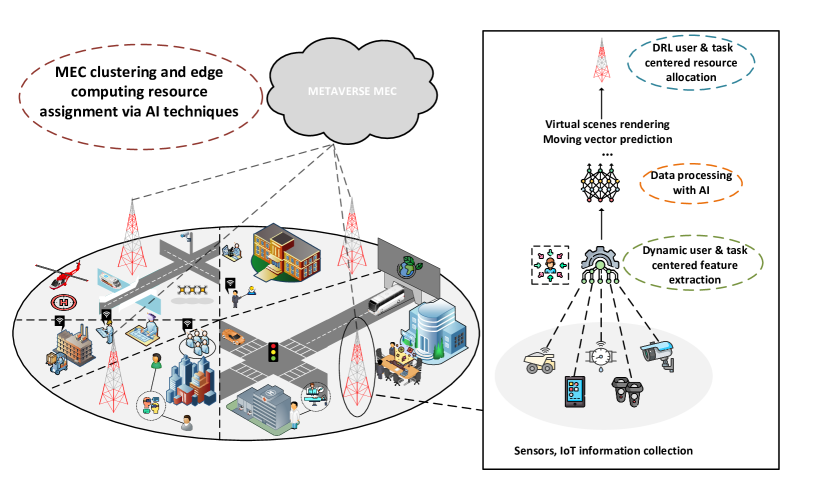
- 提出一种UUT中心的DRL框架,将用户中心和任务中心的DRL智能体整合为单一多智能体架构。
- 将各用户状态拼接后输入共享的Actor网络,使用多头Critic评估用户-任务配置。
- 由集中式云服务器管理长期、非时间敏感的任务,如知识发现和基于聚类的资源重分配。
- 设计双智能体DRL结构,其中用户中心智能体优化用户QoE,任务中心智能体最小化延迟并最大化检测准确率。
- 采用深度强化学习,奖励函数针对用户满意度和任务性能指标(如mAP和渲染成功率)进行定制。
- 通过将本地神经网络层与集中式基础网络分离,实现隐私保护设计,防止用户特定数据泄露。
实验结果
研究问题
- RQ1如何统一基于AI的元宇宙边缘计算资源分配,以同时解决用户体验和任务性能问题?
- RQ2在动态、多用户元宇宙环境中,UUT中心DRL框架相较于传统RL的性能提升如何?
- RQ3在基于智能汽车的数字孪生场景中,任务中心DRL如何优化传输延迟和目标检测准确率?
- RQ4集中式云服务器在提升元宇宙应用长期资源规划和工作负载聚类方面发挥何种作用?
- RQ5在用于个性化元宇宙边缘计算的用户定制DRL模型中,如何实现隐私保护?
主要发现
- 在整个训练过程中,用户中心DRL算法相比传统RL显著提升了VR场景渲染成功率。
- 任务中心DRL算法实现了最低的传输延迟和最高的平均精度(mAP)得分,表明其在速度与检测准确率之间达到最佳平衡。
- 联合优化用户状态和任务状态,UUT中心DRL架构能有效管理异构用户需求和复杂任务需求。
- 集中式云服务器通过聚类和数据挖掘识别应用、任务和用户需求的模式,实现高效的长期资源规划。
- 所提出的隐私保护设计通过分离本地与中心神经网络组件,有效降低了个性化AI模型中用户数据泄露的风险。
- 实验结果表明,UUT-DRL框架在用户中心和任务中心的性能指标上均优于传统优化方法。
更好的研究,从现在开始
从阅读论文到最终审阅,大幅缩短您的研究时间。
无需绑定信用卡
本解读由 AI 生成,并经人工编辑审核。