
[论文解读] Unifying and benchmarking state-of-the-art quantum error mitigation techniques
该论文将零噪声外推(ZNE)、Clifford数据回归(CDR)和虚拟反聚(VD)统一为一个名为UNITED(UNIfied Technique for Error mitigation with Data)的单一数据驱动框架。通过结合不同噪声水平和态副本数量的噪声期望值,UNITED在高采样预算下实现了更优的误差缓解性能,尤其在随机量子线路和离子阱噪声模型下的QAOA应用中,优于各项独立方法。
Error mitigation is an essential component of achieving a practical quantum advantage in the near term, and a number of different approaches have been proposed. In this work, we recognize that many state-of-the-art error mitigation methods share a common feature: they are data-driven, employing classical data obtained from runs of different quantum circuits. For example, Zero-noise extrapolation (ZNE) uses variable noise data and Clifford-data regression (CDR) uses data from near-Clifford circuits. We show that Virtual Distillation (VD) can be viewed in a similar manner by considering classical data produced from different numbers of state preparations. Observing this fact allows us to unify these three methods under a general data-driven error mitigation framework that we call UNIfied Technique for Error mitigation with Data (UNITED). In certain situations, we find that our UNITED method can outperform the individual methods (i.e., the whole is better than the individual parts). Specifically, we employ a realistic noise model obtained from a trapped ion quantum computer to benchmark UNITED, as well as other state-of-the-art methods, in mitigating observables produced from random quantum circuits and the Quantum Alternating Operator Ansatz (QAOA) applied to Max-Cut problems with various numbers of qubits, circuit depths and total numbers of shots. We find that the performance of different techniques depends strongly on shot budgets, with more powerful methods requiring more shots for optimal performance. For our largest considered shot budget ($10^{10}$), we find that UNITED gives the most accurate mitigation. Hence, our work represents a benchmarking of current error mitigation methods and provides a guide for the regimes when certain methods are most useful.
研究动机与目标
- 将多种前沿的量子误差缓解技术统一于一个共同的数据驱动框架之下。
- 在真实噪声条件下,对UNITED与ZNE、CDR、VD及vnCDR的性能进行基准测试。
- 根据采样预算、线路深度和问题类型,识别最优的误差缓解策略。
- 为近场量子计算应用中选择误差缓解方法提供实用指南。
提出的方法
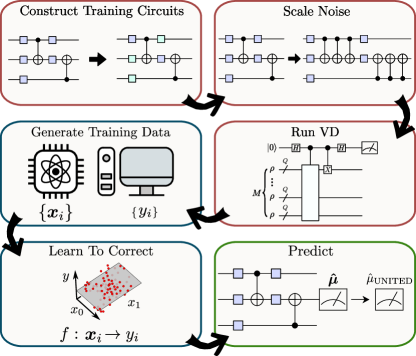
- UNITED将来自多个噪声水平(ZNE)、近-Clifford线路(CDR)以及不同态副本数量(VD)的数据整合进一个统一的回归框架。
- 该方法使用经典拟合的试探函数,将噪声期望值与VD缓解后的值映射到精确值,训练过程基于辅助线路。
- 训练数据包括量子测量得到的噪声值以及近-Clifford线路的类比计算精确值。
- 随后将统一的试探函数应用于目标线路的噪声和VD缓解数据,生成单一、改进的估计值。
- 该框架可推广现有方法,其中vnCDR为特例。
- 性能评估基于真实离子阱噪声模型,涵盖随机线路和Max-Cut的QAOA。
实验结果
研究问题
- RQ1ZNE、CDR和VD能否被统一于一个单一的数据驱动误差缓解框架下?
- RQ2UNITED在不同采样预算和线路类型下,与各项独立方法相比性能如何?
- RQ3对于不同的采样数、线路深度和噪声水平组合,最优的误差缓解策略是什么?
- RQ4结合多个缓解技术的数据是否优于单独使用各项技术?
- RQ5在何种采样预算下,UNITED的缓解精度会超越VD及其他方法?
主要发现
- 在采样预算最高达$10^{10}$时,UNITED在随机量子线路和QAOA应用中均实现了最精确的缓解效果。
- 对于$N_{\rm tot} = 10^6$和$10^8$,在随机量子线路中vnCDR表现最优,而在浅层线路中$10^5$个采样时ZNE表现最佳。
- 在QAOA中,除$10^{10}$采样外,VD在所有采样预算下均为最优;在$10^{10}$时,由于解态的噪声底限更低,UNITED超越了VD。
- 各方法的性能上限取决于采样预算,UNITED因使用更丰富的数据而达到最高上限。
- 随着采样数增加,误差缓解精度持续提升,直至达到性能上限,该上限因方法而异。
- 通过观察缓解后可观测量随采样数增加的收敛趋势,可作为判断是否已达到性能上限的实用指标。

更好的研究,从现在开始
从阅读论文到最终审阅,大幅缩短您的研究时间。
无需绑定信用卡
本解读由 AI 生成,并经人工编辑审核。