
[论文解读] Universality class of a spinor Bose-Einstein condensate far from equilibrium
本研究通过识别与序参量对称性和拓扑缺陷湮灭相关的不同标度指数,对淬火的二维铁磁自旋Bose-Einstein凝聚体中的普遍粗化动力学进行了分类。结果表明,动力学行为属于二元流体($1/z = 0.58(2)$)或扩散型O(N)普适类($1/z = 0.43(3)$),该结论通过物质波干涉测量法得到验证,并与多体模拟结果一致。
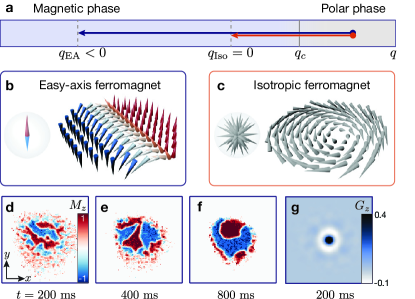
Scale invariance and self-similarity in physics provide a unified framework to classify phases of matter and dynamical properties near equilibrium in both classical and quantum systems. This paradigm has been further extended to isolated many-body quantum systems driven far from equilibrium, where physical observables exhibit dynamical scaling with universal scaling exponents. Universal dynamics appear in a wide range of scenarios, including cosmology, quark-gluon matter, ultracold atoms, and quantum spin magnets. However, how universal dynamics depend on the symmetry of the underlying Hamiltonian in nonequilibrium systems remain an outstanding challenge. Here, we report on the classification of universal coarsening dynamics in a quenched two-dimensional ferromagnetic spinor Bose gas. We observe spatiotemporal scaling of spin correlation functions with distinguishable scaling exponents that characterize binary and diffusive fluids. The universality class of the coarsening dynamics is determined by the symmetry of the order parameter and the dynamics of the topological defects, such as domain walls and vortices. Our results provide a categorization of the universality classes of far from equilibrium quantum dynamics based on symmetry properties of the system.
研究动机与目标
- 对远离平衡态的量子多体系统,特别是自旋Bose-Einstein凝聚体中的普遍粗化动力学进行分类。
- 确定序参量对称性与拓扑缺陷动力学如何在非平衡量子系统中决定普适类。
- 利用超冷原子量子模拟器,实验测量并验证淬火的二维铁磁自旋BEC中时空标度指数。
- 通过缺陷湮灭和自旋关联函数,将观测到的标度行为与既有的普适类(如二元流体和O(N)对称系统)相联系。
提出的方法
- 通过淬火二维自旋BEC中的二次Zeeman能,驱动从极向相到铁磁序的相变。
- 在不同保持时间下测量自旋关联函数和结构因子,以提取时空标度行为。
- 利用物质波干涉测量法检测并追踪自旋涡旋与反涡旋,识别其湮灭动力学。
- 对涡旋数衰减数据进行幂律拟合,以提取临界指数$1/z$。
- 将实验测得的标度指数与多体模拟结果比较,以验证普适类的归属。
- 分析结构因子中的Porod尾部,以确认尖锐畴壁的形成及惯性流体动力学区的特征。
实验结果
研究问题
- RQ1淬火的二维铁磁自旋Bose-Einstein凝聚体的粗化动力学由何种普适类主导?
- RQ2序参量对称性(Z₂与SO(3))如何影响非平衡动力学中标度指数$1/z$?
- RQ3拓扑缺陷湮灭(特别是自旋涡旋与畴壁)在决定动力学普适类中起何种作用?
- RQ4实验观测到的标度指数在多大程度上与多体模拟及非热固定点的理论预测一致?
- RQ5物质波干涉测量法如何用于识别并追踪粗化量子系统中自旋涡旋的形成与湮灭?
主要发现
- 在Z₂对称的易轴相中观测到标度指数$1/z = 0.58(2)$,表明其处于惯性流体动力学区的二元流体普适类。
- 在SO(3)对称的各向同性相中,测得$1/z = 0.43(3)$,表明其动力学属于O(N)对称哈密顿量的非热普适类。
- 自旋涡旋在淬火后$0 < t < 15~\text{ms}$内成核,并随后发生湮灭,其数量按$N_S \sim t^{-2/z}$衰减。
- 涡旋数的幂律衰减在模拟中得到$1/z = 0.43(1)$,在实验中得到$1/z = 0.48(8)$,二者表现出极佳的一致性。
- 结构因子中的Porod尾部证实了尖锐畴壁的存在,这是惯性区普遍粗化行为的典型特征。
- 观察到点状涡旋向线性畴壁的转变,且畴壁在后期普遍动力学中占主导地位。
![Figure 2: Dynamic scaling and power law growth of the domain length. a, Scaled correlation function $\mathcal{G}(r/L)$ at various hold times, $t\in[0.2~{}\rm s,0.8~{}\rm s]$ . Longitudinal spin correlation functions at various hold times (inset) collapse onto a single function after rescaling the ra](https://ar5iv.labs.arxiv.org/html/2303.05230/assets/x2.png)
更好的研究,从现在开始
从阅读论文到最终审阅,大幅缩短您的研究时间。
无需绑定信用卡
本解读由 AI 生成,并经人工编辑审核。