
[论文解读] Unleashing the Potential of LLMs for Quantum Computing: A Study in Quantum Architecture Design
本文介绍了 QGAS——一个由 GPT-4 指导的框架,用于提出和评估变分量子算法(VQA)的 ansatz 架构,在有限提示和人类反馈下,显示出与最先进方法相当的性能。
Large Language Models (LLMs) contribute significantly to the development of conversational AI and has great potentials to assist the scientific research in various areas. This paper attempts to address the following questions: What opportunities do the current generation of generative pre-trained transformers (GPTs) offer for the developments of noisy intermediate-scale quantum (NISQ) technologies? Additionally, what potentials does the forthcoming generation of GPTs possess to push the frontier of research in fault-tolerant quantum computing (FTQC)? In this paper, we implement a QGAS model, which can rapidly propose promising ansatz architectures and evaluate them with application benchmarks including quantum chemistry and quantum finance tasks. Our results demonstrate that after a limited number of prompt guidelines and iterations, we can obtain a high-performance ansatz which is able to produce comparable results that are achieved by state-of-the-art quantum architecture search methods. This study provides a simple overview of GPT's capabilities in supporting quantum computing research while highlighting the limitations of the current GPT at the same time. Additionally, we discuss futuristic applications for LLM in quantum research.
研究动机与目标
- 探索当前和未来的 GPT 在为 NISQ 与 FTQC 量子计算域设计量子架构方面能提供怎样的帮助。
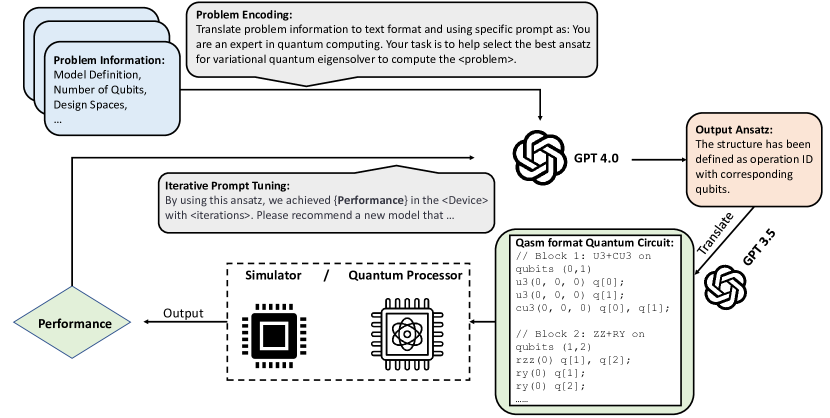
- 提出一个 GPT 指导的工作流程(QGAS),用于生成、基准测试和迭代 VQA 的 ansatz 架构。
- 评估 GPT 派生的 ansatz 在化学、金融和组合优化基准上的性能。
- 分析人类反馈在指导 GPT 驱动设计中的作用,并识别该领域中 GPT 的局限性。
提出的方法
- 定义六个带有特定门块和量子比特放置的 ansatz 架构设计空间。
- 使用 GPT-4 生成候选的 ansatz 结构,然后通过 GPT-3.5 将其转换为可执行的 QASM。
- 在与问题相关的哈密顿量上训练生成的 ansatz 结构(化学通过费米子映射;金融/优化使用 Ising 模型)。
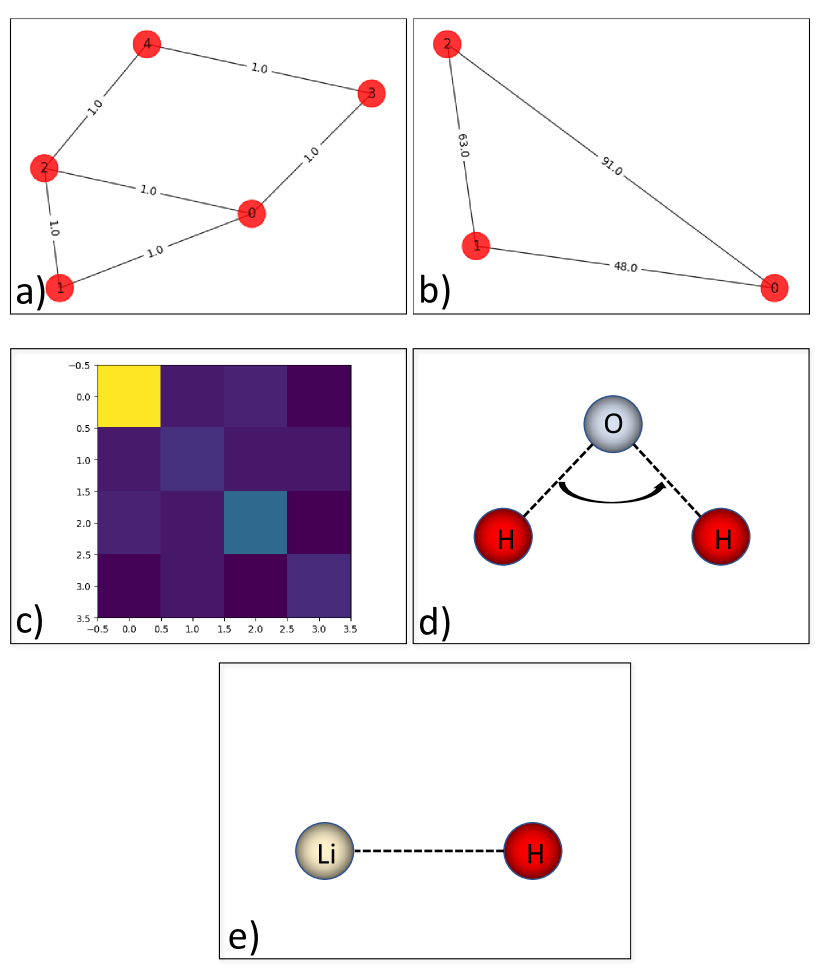
- 使用基准测试评估 ansatz 的性能(H2O 和 LiH 的分子基态能量;Max-Cut、TSP、组合投资组合优化)。
- 纳入人类专家反馈以对设计空间进行排序并指导随后的基于 GPT 的搜索(QGAS)。
- 在噪声和硬件模型下,将 QGAS 生成的 ansatz 与最先进的基线方法(UCCSD、QuantumNAS)进行比较。
实验结果
研究问题
- RQ1GPT-4 能否在预定义的设计空间内迭代提出高质量的 VQA ansatz 架构?
- RQ2在门数、保真度和优化效率方面,GPT 指导的架构搜索(QGAS)与现有方法相比如何?
- RQ3在人类反馈对 GPT 驱动的量子电路设计的影响,特别是在噪声和硬件约束下,是什么?
- RQ4GPTs 在实现容错量子计算工作流方面的局限性和未来能力是什么?
主要发现
- QGAS 能在有限的提示和迭代次数下产生高性能的 ansatz 架构。
- QGAS 在投资组合优化任务上优于一些传统架构(TwoLocal、RealAmplitude),有时以更高的门数为代价。
- 在无噪声条件下,QGAS 的分子基态能量任务结果与 UCCSD 相当或更好,并接近 QuantumNAS。
- GPT 驱动的提示结合人类反馈可以显著减少优化轮次并引导电路深度。
- 在嘈杂环境中,QGAS 的效果不如 QuantumNAS,但仍优于随机生成的 ansatz。
- 人类反馈对引导 GPT 建议以及实现实际可行性和性能提升至关重要。
更好的研究,从现在开始
从论文设计到论文写作,大幅缩短您的研究时间。
无需绑定信用卡
本解读由 AI 生成,并经人工编辑审核。