
[论文解读] Unleashing the Power of Edge-Cloud Generative AI in Mobile Networks: A Survey of AIGC Services
本文综述了移动边缘网络如何通过云-边-端协同提供 AIGC 服务,概述生命周期、基础设施、应用、挑战和未来方向。
Artificial Intelligence-Generated Content (AIGC) is an automated method for generating, manipulating, and modifying valuable and diverse data using AI algorithms creatively. This survey paper focuses on the deployment of AIGC applications, e.g., ChatGPT and Dall-E, at mobile edge networks, namely mobile AIGC networks, that provide personalized and customized AIGC services in real time while maintaining user privacy. We begin by introducing the background and fundamentals of generative models and the lifecycle of AIGC services at mobile AIGC networks, which includes data collection, training, finetuning, inference, and product management. We then discuss the collaborative cloud-edge-mobile infrastructure and technologies required to support AIGC services and enable users to access AIGC at mobile edge networks. Furthermore, we explore AIGCdriven creative applications and use cases for mobile AIGC networks. Additionally, we discuss the implementation, security, and privacy challenges of deploying mobile AIGC networks. Finally, we highlight some future research directions and open issues for the full realization of mobile AIGC networks.
研究动机与目标
- 定义 AIGC、PGC 与 UGC,并在移动网络中确立 AIGC 服务的生命周期。
- 提出具备云-边-端协作基础设施的移动 AIGC 网络,以实现实时、私有的 AIGC 部署。
- 调研创意 AIGC 应用并举例移动边缘环境中的用例。
- 识别实现、安全与隐私方面的挑战,并讨论未来的研究方向。
提出的方法
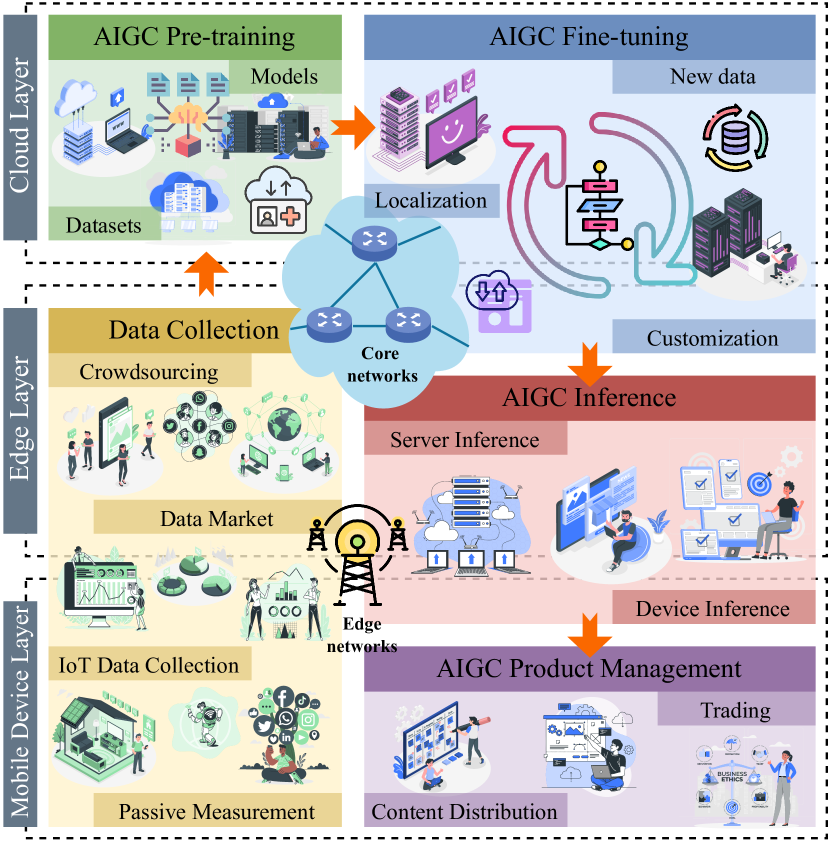
- 提供关于 AIGC 及其在移动网络中的生命周期的背景信息(数据收集、预训练、微调、推理、产品管理)。
- 描述为在移动边缘网络中支持 AIGC 服务所需的云-边-端协作基础设施。
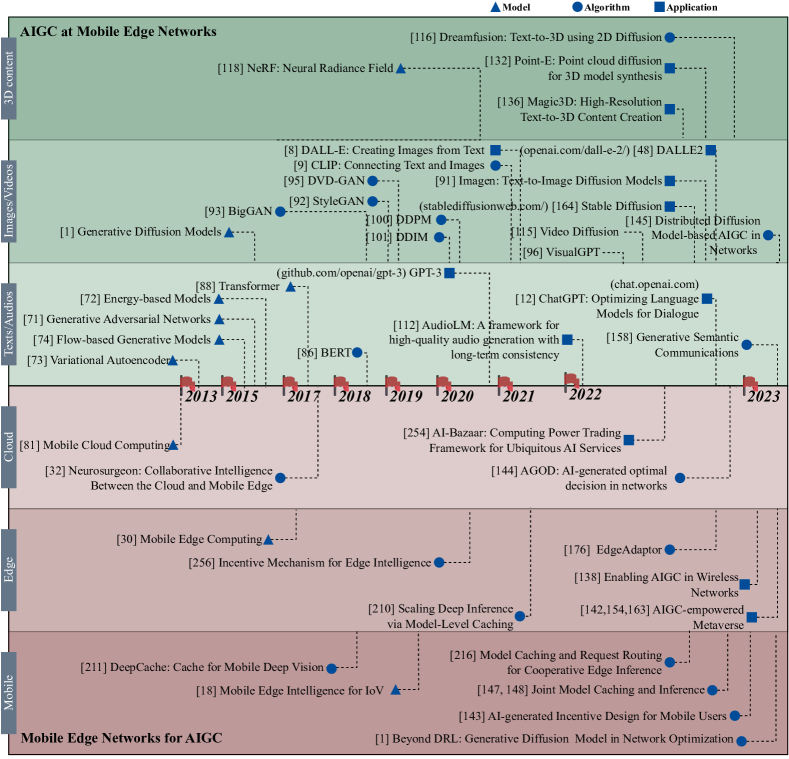
- 在移动 AIGC 网络中展示涵盖文本、图像、视频和 3D 内容生成的用例与应用。
- 分析实现挑战,包括资源分配、缓存、移动性、隐私与安全考量。
- 从网络、计算与机器学习角度讨论未来的研究方向。
实验结果
研究问题
- RQ1如何通过云-边-端协作在移动边缘网络中提供 AIGC 服务?
- RQ2需要哪些基础设施与技术来支持低时延、隐私保护的移动 AIGC 服务?
- RQ3哪些现实的用例与应用可以展示移动 AIGC 网络的好处?
- RQ4在部署移动 AIGC 网络时的关键实现挑战和待解决的问题有哪些?
- RQ5为实现完整的移动 AIGC 部署,建议的未来研究方向有哪些?
主要发现
- AIGC 使在移动环境中快速、个性化的文本、图像、视频和 3D 模态内容生成成为可能。
- 移动 AIGC 网络依赖云端进行预训练,边缘用于数据收集、推理和管理,以实现低延迟。
- 数据收集、微调和推理可以在边缘本地化,以提高隐私和定制性。
- 资源分配、模型缓存、移动性管理和激励机制对实际边缘部署至关重要。
- 安全、隐私与内容完整性是在移动 AIGC 部署中需要解决的关键挑战。
更好的研究,从现在开始
从论文设计到论文写作,大幅缩短您的研究时间。
无需绑定信用卡
本解读由 AI 生成,并经人工编辑审核。