
[论文解读] Unsupervised Embedding Learning for Human Activity Recognition Using Wearable Sensor Data
本文提出了一种基于自编码器的无监督方法,利用可穿戴传感器数据中的时间一致性与局部性保持特性,学习用于人体活动识别的判别性嵌入。通过将这些领域特定先验嵌入损失函数,模型在基准数据集上的聚类性能得到提升,在 PAMAP2 数据集上使用 k-means 的准确率最高达到 0.8543,优于标准自编码器和 PCA。
The embedded sensors in widely used smartphones and other wearable devices make the data of human activities more accessible. However, recognizing different human activities from the wearable sensor data remains a challenging research problem in ubiquitous computing. One of the reasons is that the majority of the acquired data has no labels. In this paper, we present an unsupervised approach, which is based on the nature of human activity, to project the human activities into an embedding space in which similar activities will be located closely together. Using this, subsequent clustering algorithms can benefit from the embeddings, forming behavior clusters that represent the distinct activities performed by a person. Results of experiments on three labeled benchmark datasets demonstrate the effectiveness of the framework and show that our approach can help the clustering algorithm achieve improved performance in identifying and categorizing the underlying human activities compared to unsupervised techniques applied directly to the original data set.
研究动机与目标
- 解决从可穿戴传感器中进行人体活动识别(HAR)时标注数据有限的挑战。
- 开发一种无监督方法,从大规模未标注可穿戴传感器数据中学习有意义的表征。
- 通过将传感器序列嵌入到相似活动更接近的特征空间,提升下游聚类性能。
- 在学习过程中引入领域特定先验——时间一致性与个体不变的活动特征。
- 证明无监督表征学习可在无需人工标注的情况下实现具有竞争力的性能。
提出的方法
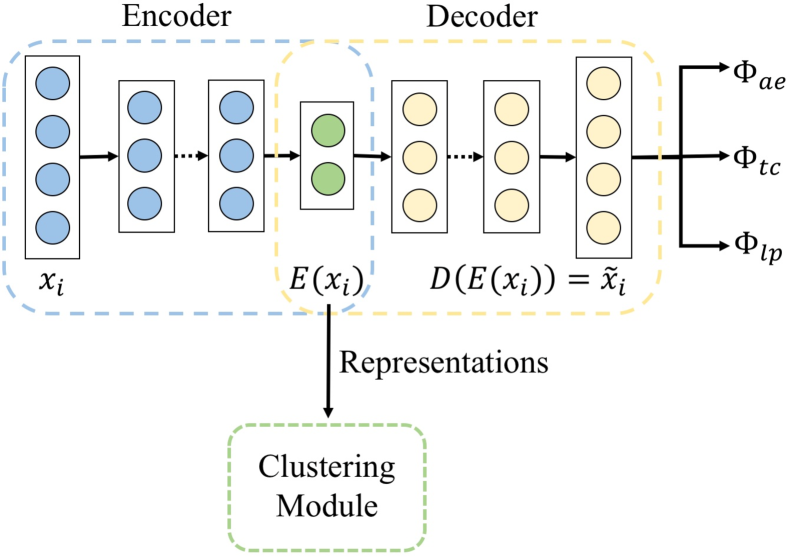
- 使用深度自编码器架构,从原始可穿戴传感器序列中学习紧凑的低维表征。
- 引入时间一致性(TC)损失,以鼓励同一活动内时间相邻样本的嵌入保持一致。
- 应用局部性保持(LP)损失,将相似活动的嵌入拉近,同时将不相似活动的嵌入推开,减少个体差异的影响。
- 将自编码器的重构损失与 TC 和 LP 损失联合优化,形成联合目标函数。
- 在学习到的嵌入上使用 k-means 聚类,以在无真实标签的情况下识别不同的活动簇。
- 在三个基准 HAR 数据集(PAMAP2、REALDISP 和 SBHAR)上验证方法,采用标准评估指标。

实验结果
研究问题
- RQ1在无任何标签的情况下,无监督表征学习是否能提升人体活动识别中的聚类性能?
- RQ2时间一致性和局部性保持在 HAR 嵌入学习中分别起到什么作用?
- RQ3通过引入领域特定归纳偏置增强的自编码器,是否能优于标准自编码器和 PCA 在无监督 HAR 中的表现?
- RQ4所提出的损失组件在单独和联合使用时,对聚类准确率的提升程度如何?
- RQ5尽管缺乏标签,该方法与监督 HAR 基线相比,在聚类质量方面表现如何?
主要发现
- 所提方法在 PAMAP2 数据集上使用 k-means 的准确率达到 0.8543,显著优于标准自编码器(0.7859)和 PCA。
- 在 REALDISP 数据集上,该方法达到 0.6812 的准确率,优于次优基线(0.6610,使用 LP + AE 损失)。
- 消融实验表明,同时结合时间一致性与局部性保持损失可获得最佳聚类性能,在 PAMAP2 上的 ARI 为 0.8016,NMI 为 0.8730。
- 联合损失函数在聚类性能上优于单一损失组件,表明两种归纳偏置具有互补优势。
- 尽管在区分跑步与慢跑等细微活动时存在挑战,模型仍保持良好性能,仅因运动模式相似导致少量误分类。
- 该方法对个体差异具有鲁棒性,通过聚焦于与活动相关的特征,成功在不同个体间对相似活动进行分组。
更好的研究,从现在开始
从阅读论文到最终审阅,大幅缩短您的研究时间。
无需绑定信用卡
本解读由 AI 生成,并经人工编辑审核。