
[论文解读] Unsupervised Representation Learning for Time Series: A Review
tldr: 对时间序列的无监督表示学习的综合综述,介绍 ULTS——一个用于在 9 个真实数据集上评估 17 个模型的统一库,聚焦对比学习。
Unsupervised representation learning approaches aim to learn discriminative feature representations from unlabeled data, without the requirement of annotating every sample. Enabling unsupervised representation learning is extremely crucial for time series data, due to its unique annotation bottleneck caused by its complex characteristics and lack of visual cues compared with other data modalities. In recent years, unsupervised representation learning techniques have advanced rapidly in various domains. However, there is a lack of systematic analysis of unsupervised representation learning approaches for time series. To fill the gap, we conduct a comprehensive literature review of existing rapidly evolving unsupervised representation learning approaches for time series. Moreover, we also develop a unified and standardized library, named ULTS (i.e., Unsupervised Learning for Time Series), to facilitate fast implementations and unified evaluations on various models. With ULTS, we empirically evaluate state-of-the-art approaches, especially the rapidly evolving contrastive learning methods, on 9 diverse real-world datasets. We further discuss practical considerations as well as open research challenges on unsupervised representation learning for time series to facilitate future research in this field.
研究动机与目标
- 提供一个系统性、最新的时间序列无监督表示学习方法分类体系。
- 识别现有综述中的空白并强调下游任务之前的表示学习。
- 引入 ULTS 以实现对模型的公平、统一基准测试并增强可复现性。
- 在多样的真实世界数据上实证评估最前沿方法,特别是对比学习方法。
- 讨论实用性因素和未解决的挑战以指引未来研究。
提出的方法
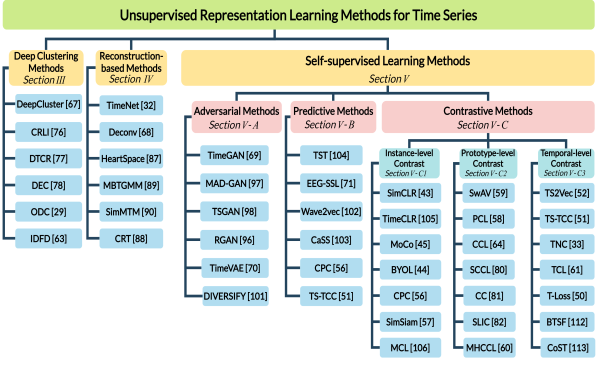
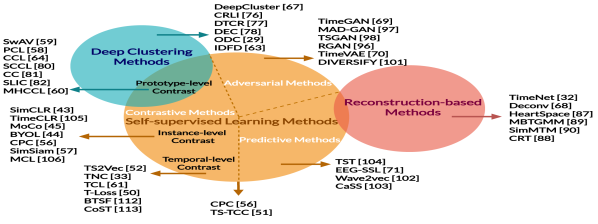
- 将无监督时间序列方法分为深度聚类、重建为基础和自监督学习三大类。
- 进一步将自监督方法细分为对抗性、预测性和对比性前处理任务,并区分实例级、原型级和时间级对比。
- 开发 ULTS,这是一个基于 PyTorch 的库,整合 17 种模型用于统一评估并提供灵活的数据增强。
- 提供标准化的评估测试床并对 9 个真实世界数据集进行实证研究。
- 回顾并综合洞见,以指导无监督时间序列表示学习中的方法设计和未来工作。
实验结果
研究问题
- RQ1对于时间序列的无监督表示学习,是否存在一个全面、最新的分类体系?
- RQ2在统一评估框架下,最先进的无监督模型,尤其是对比学习方法,在不同真实世界时间序列数据集上的表现如何?
- RQ3一个标准化的库(ULTS)是否能够在方法和数据集之间实现公平比较与可复现性?
- RQ4哪些实际考虑因素和未解决的挑战会影响无监督时间序列表示的开发?
主要发现
- ULTS 库使在深度聚类、基于重建和自监督方法之间对 17 种模型进行便捷、统一的评估成为可能。
- 对比学习方法在无监督时间序列表示学习中属于快速演进且被广泛评估的技术之一。
- 综述指出由于在研究之间的增强、骨干网络和数据集差异,公正比较面临的挑战。
- 讨论了实际考虑因素和未解决的研究挑战,以促进无监督时间序列表示学习的未来工作。
- 在 9 个多样化真实世界数据集上的实证评估为理解不同模型的优势和适用场景提供了参考。
更好的研究,从现在开始
从论文设计到论文写作,大幅缩短您的研究时间。
无需绑定信用卡
本解读由 AI 生成,并经人工编辑审核。